Over 110,000 Long-term Unemployed for More Than Half a Year
Highest Level in 25 Years Since the Foreign Exchange Crisis
One in five unemployed individuals has been seeking a job for more than six months but has not been able to find work. The number of long-term unemployed people who have been unable to find a job for over six months has been increasing for the past six months.
On the 1st, Yonhap News cited data from the Statistics Korea National Statistical Portal (KOSIS) reporting that as of August, the number of unemployed was 564,000. Among them, 113,000 people had been job hunting for more than six months, accounting for 20% of the total. This is the highest level in 25 years since August 1999 (20.1%), during the aftermath of the foreign exchange crisis.
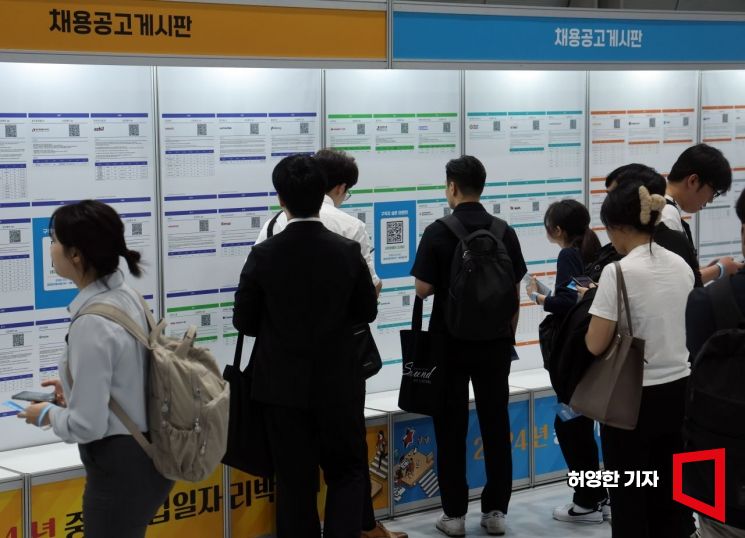 At the mid-sized companies job fair held at COEX, Seoul last May, job seekers are looking at the job posting board. Photo by Huh Younghan younghan@
The number of long-term unemployed individuals who have been jobless for more than six months exceeded 100,000 during the COVID-19 pandemic from October 2020 to July 2021, continuing an upward trend, then shifted to a downward trend and generally remained below 100,000. However, the number of long-term unemployed began to rise again from March this year and increased for six consecutive months until August. In particular, until July, it showed a steep increase with a double-digit growth rate compared to the same month last year. On the other hand, the total number of unemployed shifted to a year-on-year decrease from July and recorded negative figures for two consecutive months. Although the total number of unemployed decreased, the increase in long-term unemployed caused their proportion to rise sharply.
The increase in long-term unemployment is analyzed as reflecting a 'job mismatch' phenomenon, where job seekers cannot find jobs that meet their expectations, thus extending their job search period.
According to microdata from the Economically Active Population Survey, as of August, among long-term unemployed who had worked for less than a year, 24.7% left their previous jobs due to dissatisfaction with working conditions such as time and pay. This was the second highest reason after 'completion of temporary or seasonal work' (26.4%). By industry, previous jobs of long-term unemployed who had worked less than a year were in wholesale and retail trade (18.9%), manufacturing (15.9%), and health and social welfare services (13.7%), in that order. By employment status of the previous job, the distribution was regular employees (44.8%), temporary workers (36.3%), and daily workers (13.3%).
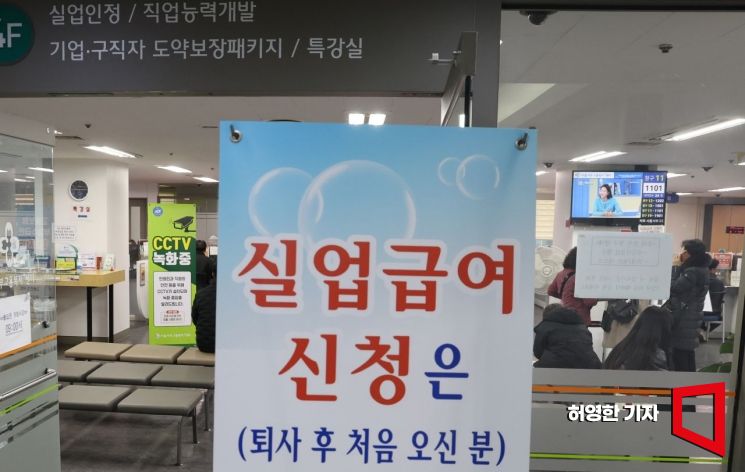 At an employment support center in Seoul, clients are waiting in line at the unemployment recognition application window to receive unemployment benefits. Photo by Heo Younghan younghan@
Notably, the youth proportion among long-term unemployed this year was prominent. From January to August, the average monthly number of long-term unemployed was 90,858, an increase of 10,448 compared to the same period last year. Among them, youth aged 15-29 accounted for 29,442 (32.4%), the largest share, followed by those in their 30s at 21,177 (23.3%).
Also, among the economically inactive population in August, the number of those 'resting' increased by 245,000 (10.6%) compared to the same month last year, reaching 2,567,000. This is the highest number recorded for August since statistics began in 2003. 'Resting' includes people who have no intention to work and those who want to work but do not look for jobs because there are no suitable positions. Among them, as of May, 82,000 youth had been 'resting' for more than three years. The number of unemployed youth who have been out of work for over three years was 96,000 in 2021, 84,000 in 2022, 80,000 in 2023, and has increased again to 82,000 this year.
© The Asia Business Daily(www.asiae.co.kr). All rights reserved.
![Clutching a Stolen Dior Bag, Saying "I Hate Being Poor but Real"... The Grotesque Con of a "Human Knockoff" [Slate]](https://cwcontent.asiae.co.kr/asiaresize/183/2026021902243444107_1771435474.jpg)

















