Keynote Speech at M360 Hosted by Global Telecom Operators Association
Introducing Expansion of Telecom Services and Roles in the AI Era
Collaboration with MS... "Utilizing Various Global Technologies"
Kim Young-seop, CEO of KT, announced on the 1st that the company is preparing communication services that directly connect smartphones and satellites, as well as 6G. He emphasized the importance of telecom companies owning data sovereignty and artificial intelligence (AI) technology while utilizing various global technologies. Recently, KT formed a strategic partnership with Microsoft to build an AI and cloud ecosystem.
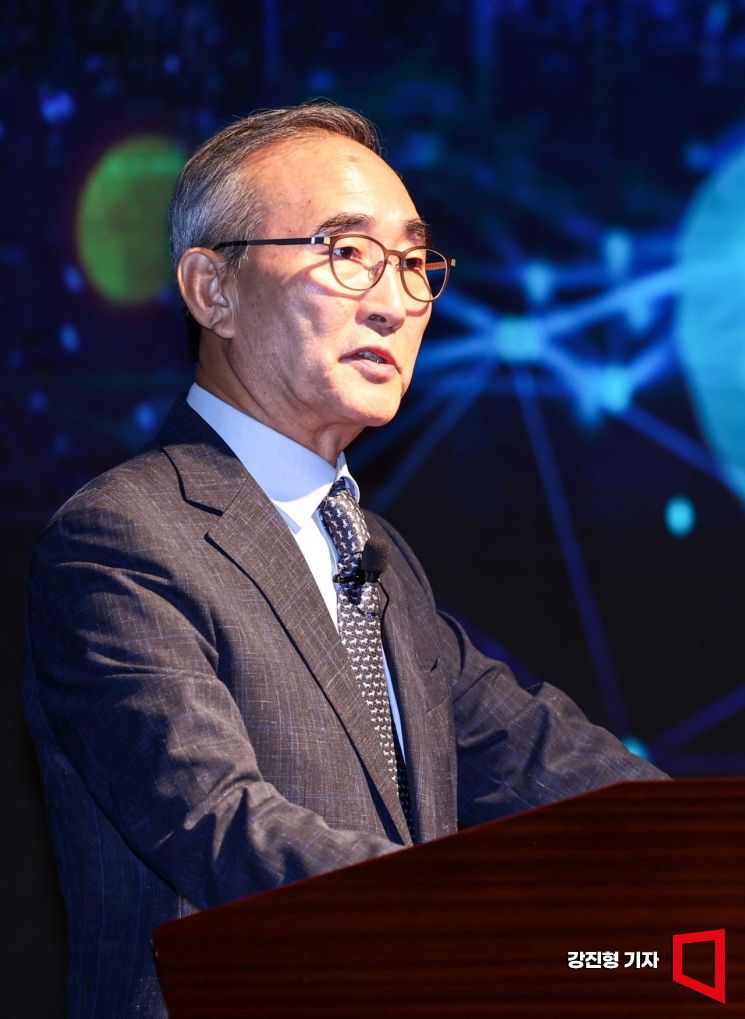
On the same day, Kim made these remarks during his keynote speech at the M360 APAC hosted by the Global System for Mobile Communications Association (GSMA) held at the Westin Chosun Hotel Seoul in Jung-gu, Seoul. Under the theme "The Role of AICT Companies in Forming Autonomous AI Models Based on Cooperation," he raised the topic of the changing role of telecom companies in the AI era.
Kim introduced the technological development directions where AI-based solutions are being launched across all sectors including telecommunications, healthcare, public transportation, manufacturing, and logistics. He explained KT’s services such as AI-based smart medical systems for remote consultations and video diagnosis services, and intelligent transportation systems including AI video analysis solutions. He stated, "Telecom companies are expanding their roles from traditional network service providers to AI-driven service providers."
He said, "In the future, 4G, 5G, and 6G will coexist, each providing optimal services in their respective domains," adding, "Telecom companies need to establish strategies to coexist and cooperate with satellite communication networks." He further revealed, "KT is preparing communication services that directly connect smartphones and satellites, as well as 6G services, in collaboration with global satellite operators."
Kim predicted that telecom companies will take on roles that provide innovation and value through AI. He said, "KT will deliver greater value to customers and society through digital innovation, productivity improvement, cost efficiency, hyper-personalization, real-time decision-making, automated processing, accuracy enhancement, and sectoral innovation." He also forecasted, "The ability to actively collaborate with big tech, emerging startups, and global telecom companies will become a core competency."
He explained that while large-scale investments are necessary to accelerate technological innovation, there are limits to owning all advanced technologies such as AI, autonomous driving, and humanoid robots directly, and it is inefficient in terms of opportunity cost and time.
He stated, "Telecom companies must strengthen their core infrastructure and capabilities while acquiring advanced technologies through collaboration with big tech and creating new value. Especially, it is important for each company to own data sovereignty and AI technology rights and utilize diverse global technologies without relying on specific technologies."
Kim announced, "KT has formed a strategic partnership with Microsoft to strengthen leadership in the AI industry and provide tangible value to customers." Specifically, the two companies agreed to jointly invest in infrastructure such as hyperscale data centers and GPU farms, develop Korean-style AI, cloud, and IT services, and establish AI and cloud innovation centers and talent development programs.
Satya Nadella, CEO and Chairman of Microsoft, projected through a video message that AI will fundamentally transform the productivity of every individual, organization, and industry including telecommunications. He expressed, "We look forward to building an AI and cloud ecosystem by combining KT’s expertise with Microsoft’s technology."
Additionally, Kim introduced KT’s ongoing AI-based illegal spam message and voice phishing detection services, as well as activities supporting the digital divide reduction, emphasizing, "The purpose of telecom companies is to solve the challenges faced by future society and contribute to enhancing the value of human life."
Meanwhile, M360 APAC was attended by major domestic and international ICT companies including KT, Samsung Electronics, Telstra, and GeoReliance, as well as key figures from the Ministry of Science and ICT, Korea Telecommunications Operators Association (KTOA), and academia.
Various sessions and discussions involved global telecom operators and policy experts discussing topics such as network investment sharing, joint contributions of ICT ecosystem members, 3G network optimization, and globally significant telecom policy issues.
M360 APAC was held in South Korea again this year following last year, with KT, a GSMA board member, serving as the host sponsor for the second consecutive year.
© The Asia Business Daily(www.asiae.co.kr). All rights reserved.

















