2024 Jinju K-Entrepreneurship International Forum
'Entrepreneurship Turning Crisis into Opportunity' Session
The 'Four Major Companies of Jinju'?Samsung, LG, GS, and Hyosung?emphasized that K-entrepreneurship means human-centered, future-challenging management, which can overcome complex crises such as climate change and digital transformation. They stressed that true entrepreneurship is a management philosophy that pursues not only corporate profits but also the interests of customers and employees (humans).
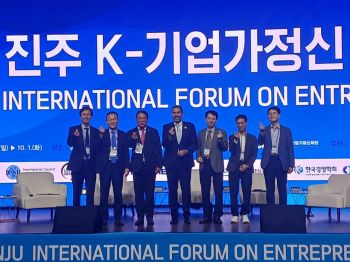 Participants at the 'Jinju K-Entrepreneurship International Forum' held on the 30th at the 100th Anniversary Hall of Gyeongsang National University in Jinju, Gyeongnam. From the third person on the left: Lee Jeong-il, Senior Advisor at Samsung Global Research; Ayman Tarabishy, President of the International Council for Small Business (ICSB) and Professor at George Washington University; Kim Jae-moon, Division Head at LG Management Research Institute; Choi Nuri, Executive Director at GS Corporation; Kim Soo-young, Managing Director and Head of Human Resources Development at Hyosung.
 [Photo by Moon Chae-seok]
Choi Nuri, Executive Director at GS Corporation
On the 30th, Samsung, LG, GS, and Hyosung made these remarks at the 'Jinju K-Entrepreneurship International Forum' held at the 100th Anniversary Hall of Gyeongsang National University in Jinju, Gyeongnam. The Jinju K-Entrepreneurship International Forum is called the 'Korean Davos Forum.' Jinju is regarded as the capital of Korean entrepreneurship, having produced these four major companies.
The forum session involving the four major companies was themed 'Entrepreneurship that Turned Crisis into Opportunity.' Jeong-il Lee, Senior Advisor at Samsung Global Research; Jae-moon Kim, Division Head at LG Management Research Institute; Nuri Choi, Executive Director at GS Corporation; and Soo-young Kim, Managing Director and Head of Human Resources Development at Hyosung, presented their companies' cases of overcoming crises based on entrepreneurship.
Advisor Lee said, "Founder Lee Byung-chul, when starting his business, reviewed whether it was a business needed by the country, aligned with the people's interests, and competitive in the global market." He added, "Former Chairman Lee Kun-hee created the 'Samsung DNA' of continuous challenge and future preparation through the New Management Declaration, which called for changing everything except the family, and Chairman Lee Jae-yong is striving to realize a vision of enriching human society with technologies that do not yet exist."
Advisor Lee explained that Samsung's case can summarize entrepreneurship into five elements: insight to foresee the future, strong breakthrough power to carry out will, relentless challenging spirit, correct direction-setting to conduct business that benefits humanity beyond the company, and a spirit of prioritizing talent. He said, "In short, entrepreneurship can be described as the spirit of creation that implements innovation to create and lead new paradigms."
Division Head Kim explained that the four chairmen?Koo In-hoe, Koo Ja-kyung, Koo Bon-moo, and Koo Kwang-mo?each realized 'business model creation, manufacturing base establishment, emergence as a global market leader, and customer-centered management,' respectively. He said Chairman Koo Kwang-mo emphasizes listening to the voice of the customer. The philosophy of Chairman Koo Kwang-mo is said to be connected to the teaching of 'Gyeong' by Nammyung Jo Sik, a 16th-century Confucian scholar from Jinju. 'Gyeong' means respect, linking to LG's philosophy emphasizing customer respect.
Division Head Kim said, "LG established the philosophy of 'Jeongdo Management' in 1995 and 'LG Way' in 2005, which means LG has been practicing ESG (Environmental, Social, Governance) management even before the term ESG became known." He added, "The most difficult challenge in Chairman Koo Kwang-mo's era is timely sensing customer changes, which is a much more important and difficult challenge than threats like China."
Executive Director Choi introduced GS founder Heo Man-jung as "the first venture capitalist in Korea." Heo Man-jung's father, Heo Jun, known as Jisinjeong, pioneered industry with agricultural capital. Heo Man-jung also invested the capital accumulated by his father not in agriculture but in industry (LG). Executive Director Choi said, "Heo Man-jung was a rare figure of his time who transformed from a large landowner to a capitalist and invested in LG, which was close to a venture company with uncertain success. I think these people should be called Korea's first venture capitalists."
Managing Director Kim introduced the secret behind Hyosung becoming the world's number one spandex company. In the 1990s, when DuPont of the United States was the global leader, Hyosung reached number one after relentless challenges. DuPont eventually exited the business. During the 1997 International Monetary Fund (IMF) foreign exchange crisis, under the leadership of the late Chairman Cho Seok-rae, Hyosung implemented 'selection and concentration' management to directly overcome the crisis. Emphasizing the spirit of 'turning crisis into opportunity' from Sun Tzu's Art of War, they strengthened technological capabilities, maximized management efficiency, and promoted business globalization. Notably, they never stopped investing in the future despite the crisis.
Participants at the forum proposed 'entrepreneurship for a sustainable future,' stating that complex crises can be overcome through respect for the community and human dignity.
Former Prime Minister Seung-soo Han diagnosed climate change and digital transformation as both crises and opportunities of this era. Han said, "Entrepreneurs must fully embrace their social responsibility to promote eco-friendly technologies and sustainable business models to lead future markets." He added, "Especially, the role of companies is essential to ensure that innovative technologies such as artificial intelligence (AI) contribute to sustainability and human welfare."
Ayman Tarabishy, President of the International Council for Small Business (ICSB) and Professor at George Washington University, summarized K-entrepreneurship as rationality, patriotism and love for the people, critical thinking, and talent development. President Tarabishy said, "In the past, Western leadership was known to lead companies, but through research on Jo Sik, I learned how Eastern philosophy drives global development." He added, "Ethical leadership, sustainable development, international education and human resource development, and international cultural exchange will be key words leading the future of companies."
© The Asia Business Daily(www.asiae.co.kr). All rights reserved.

















