Average Official Land Price for Reconstruction in 2023: 7.19 Million KRW per 1㎡
If Complexes with Floor Area Ratio Above 300% Upgrade Zoning
Maximum Floor Area Ratio Limited to 125% of Allowed FAR
High-Density Complexes Required to Achieve 'Excellent' Grade or Higher for Long-Life Housing
The Seoul Metropolitan Government has finalized and announced detailed guidelines, including a profitability adjustment coefficient, to enhance the feasibility of reconstruction and redevelopment projects in the Gangbuk area, where business viability is low. These guidelines can also be applied to existing maintenance zones, and for projects already under construction, they can be applied within the scope that does not affect public contributions or general sales. When upgrading the zoning in overcrowded complexes with a current floor area ratio (FAR) of 300% or more, it is possible to secure up to 125% of the maximum current FAR.
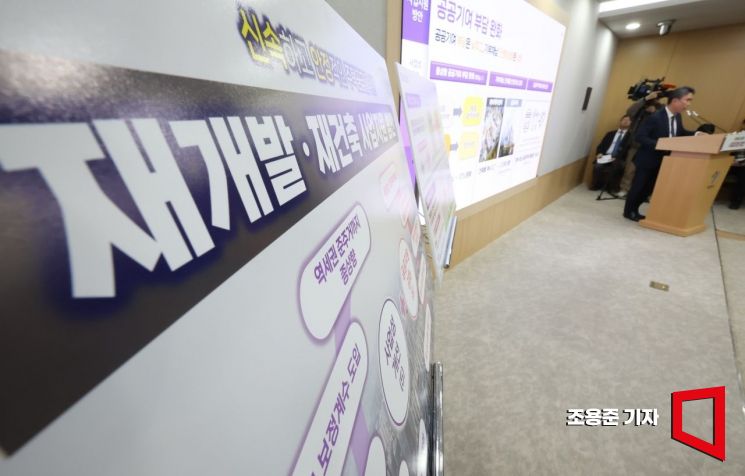 Yoo Chang-soo, Deputy Mayor for Administration of Seoul, is holding a press briefing on the 'Support Measures for Redevelopment and Reconstruction Projects' for rapid and stable housing supply on the 27th at the Seoul City Hall briefing room in Jung-gu, Seoul. Photo by Jo Yong-jun jun21@
On the 2nd, Seoul City announced that it will immediately implement the detailed standards for improvement measures in maintenance projects according to the '2030 Urban and Residential Environment Maintenance Basic Plan' announced at the end of last month. The main points include recognizing the profitability adjustment coefficient and the current floor area ratio.
Increasing Feasibility of Small-Scale, High-Density Complexes in Gangbuk
The profitability adjustment coefficient refers to multiplying the allowable floor area ratio incentive by an adjustment coefficient (1.0 to 2.0) to promote projects in complexes and areas with low profitability. The adjustment coefficient is calculated by dividing the average official land price of Seoul by the average official land price of the target area, then adding adjustment coefficients for site area and household density. The average official land price for apartment complexes used by Seoul City to calculate the profitability adjustment coefficient for reconstruction projects is 7,192,258 KRW per square meter as of 2023. Going forward, Seoul City plans to announce the average official land price for apartments separately for reconstruction and redevelopment projects each year based on the previous year.
A Seoul City official explained, "The official land price for the current year is finalized in May, so it was deemed appropriate to apply the previous year's standard when promoting projects," adding, "The calculation was based on the 2nd and 3rd general residential areas, which are reconstruction project zones, among the standard land prices."
The adjustment coefficient for project sites is higher for smaller site areas or when there are many small-sized units. For project sites with an area of 10,000 square meters or less, a coefficient of 0.2 is applied; for 20,000 square meters or less, 0.1 is applied. When supplying units smaller than 59 square meters exclusive area per household, a coefficient of 0.2 is applied; for units of 85 square meters exclusive area, 0.1 is applied.
The average official land price applied to redevelopment projects is 5,861,129 KRW per square meter, and the adjustment coefficient is calculated by dividing this by the average official land price of the target area. This price is based on the 1st and 2nd general residential areas, where most redevelopment projects are located. Seoul City plans to review the application of household density adjustment coefficients for redevelopment projects in the future.
A Seoul City official stated, "It is possible to apply the profitability adjustment coefficient to areas where maintenance plans are being created or are already underway, but depending on stakeholders' interests, if it is judged that income will increase even if it takes time due to reduced rental units and increased sales, a change procedure will be followed."
Additional Floor Area Ratio Allowed Within 25% for High-Density Complexes Over 300%
For complexes or areas built exceeding the allowable floor area ratio, the 'current floor area ratio' is recognized as the allowable floor area ratio. However, for complexes with an allowable floor area ratio of 300% or more, the incentives available during reconstruction projects are limited to 125% of the maximum floor area ratio. In other words, an additional floor area ratio can be secured within one-quarter of the current floor area ratio. This measure is to ensure fairness with overcrowded complexes below 300%.
The current floor area ratio was introduced to assist project sites where reconstruction is difficult due to already high floor area ratios. Apartments built in the 1990s had floor area ratios exceeding 300%, but after the subdivision of zoning types in 2004 into types 1, 2, and 3, the maximum floor area ratio for the 3rd general residential area was set at 300%. In this process, complexes with floor area ratios over 300% were required to donate the excess floor area ratio, which reduced project feasibility. Going forward, complexes with a current floor area ratio of 300% can apply up to 375% (125% of 300%), and those with 320% can apply up to 400%.
A Seoul City official explained, "Complexes with floor area ratios over 300% previously had to donate land or facilities to have their floor area ratio recognized, leading many to switch from reconstruction to remodeling. Now, they can secure the maximum floor area ratio within one-quarter of the current floor area ratio."
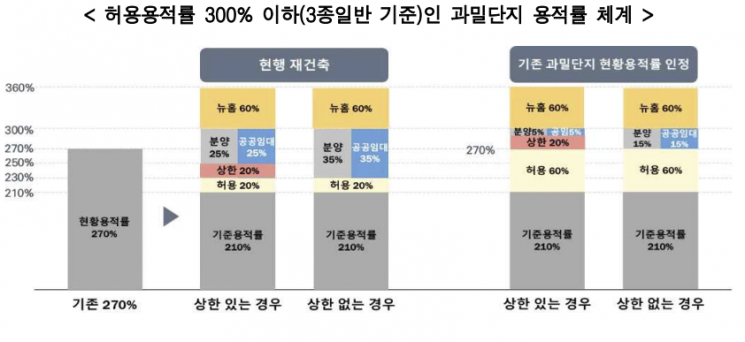 Allowable floor area ratio system for complexes with a floor area ratio of 300% or less (Photo by Seoul City)
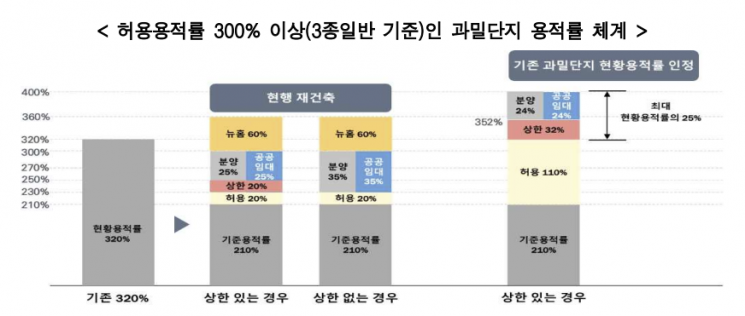 Floor area ratio system for complexes with a permitted floor area ratio of 300% or more (Photo by Seoul City)
Additionally, adjustments through the profitability adjustment coefficient are allowed up to 20% of the total allowable floor area ratio. For example, if a complex with a current floor area ratio of 270% has a profitability adjustment coefficient of 2.0, the maximum allowable floor area ratio applied would be 290%. However, considering the difficulty of further increasing floor area ratios after high-density reconstruction, it is mandatory to use long-life housing rated 'Excellent' or higher to ensure long-term apartment use, and environmental standards will be applied one level higher than the legal mandatory standards.
When upgrading zoning, the amount of public contribution is calculated proportionally to the actual additional maximum floor area ratio. For example, when upgrading from the 3rd general residential area (maximum 300%) to a semi-commercial area, if the maximum floor area ratio allowed is 400%, the public contribution rate applied will be 5%.
Furthermore, in redevelopment cases, when upgrading from the 1st general residential area to the 2nd general residential area, the current floor area ratio is recognized only up to the 2nd area's standard floor area ratio (190%). When upgrading from the 2nd to the 3rd general residential area, it is recognized only up to the 3rd area's standard floor area ratio (210%).
For semi-industrial areas, the floor area ratio can be applied up to the range specified by the urban planning ordinance. This reflects the amendment to the Urban and Residential Environment Maintenance Act at the end of last year, which changed the legal maximum floor area ratio from 300% to 400% in Seoul City's standards.
© The Asia Business Daily(www.asiae.co.kr). All rights reserved.



















