Hyundai Motor's Production Surpasses 100 Million Units
Jung Eui-sun Drives Brand Value with High-End, High-Performance Cars Reflecting Predecessors' Achievements
Hyundai Motor Company announced on the 30th that its cumulative production has surpassed 100 million units. To mark this milestone, a delivery ceremony was held for the 100 millionth plus one vehicle, the Ioniq 5. The video released on the company’s YouTube account that morning was titled ‘100 Million and 1’. According to a company official, emphasizing 100 million plus one rather than just 100 million reflects their commitment to carefully preparing for the future beyond the achievements accumulated so far.
The foresight of Hyundai Motor Group Chairman Chung Euisun and the owner management team played a significant role. Chung’s grandfather, the late founder Chung Ju-yung, said when he established the company in 1967, “If a country’s land is compared to the human body, roads are like blood vessels, and cars are like the blood flowing through those vessels.” Chairman Chung has experience operating a vehicle repair shop before the Korean War. The following year, he built an assembly plant in Ulsan and began producing the second-generation Ford Cortina. At that time, it was rare for a company less than a year old to build a factory and start assembly production.
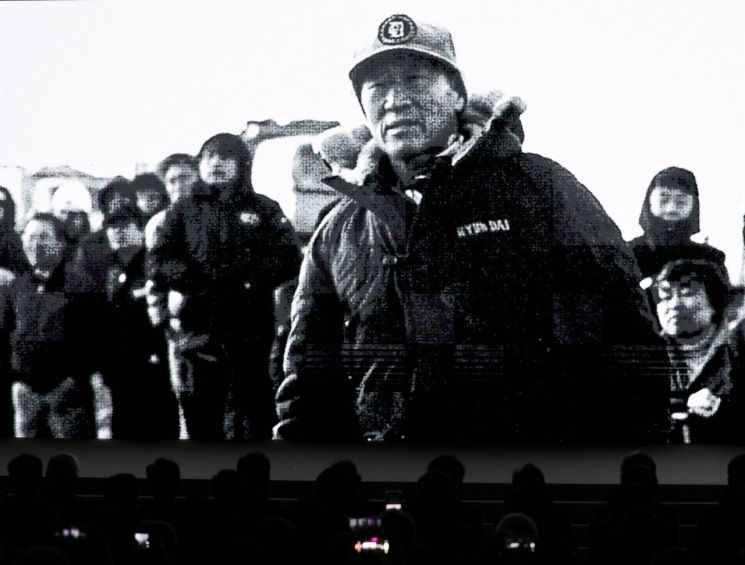 Last November, at the groundbreaking ceremony for the electric vehicle-only plant held at Hyundai Motor Ulsan Plant in Buk-gu, Ulsan City, the voice of Hyundai's founder, Jeong Ju-young, restored by artificial intelligence (AI), is shown along with a photo.
 [Image source=Yonhap News]
The first domestically developed Pony also began with Chung Ju-yung’s decisive decision. Since unpaved roads were predominant, breakdowns were frequent, and a Ford investigator who was consulted to solve the problem suggested avoiding driving on rough roads. Feeling the limitations of assembly production, Chung Ju-yung decided to establish a joint venture with Ford.
Negotiations over the localization of key parts faced difficulties and eventually broke down. Hyundai Motor then shifted its focus to developing its own model. This led to the launch of the Pony in 1975. It came to market about three years after the project started. The Pony also set the record for the first domestically produced car exported overseas when it was shipped to Ecuador the year after its domestic release. The Pony Excel model was also the first Korean car exported to the United States, the birthplace of the automobile, in 1986.
Honorary Chairman Chung Mong-koo, who took office in 1999, strengthened the fundamentals of the automotive company through ‘quality management.’ In 2000, Hyundai Motor separated from the Hyundai Group and established its headquarters in Yangjae-dong, and the following year, it set up a quality control center at headquarters. Customer complaints from around the world were received in real time 24 hours a day. A full inspection system was introduced at all domestic and overseas factories. This was based on the judgment that quality must be supported to gain customer recognition.
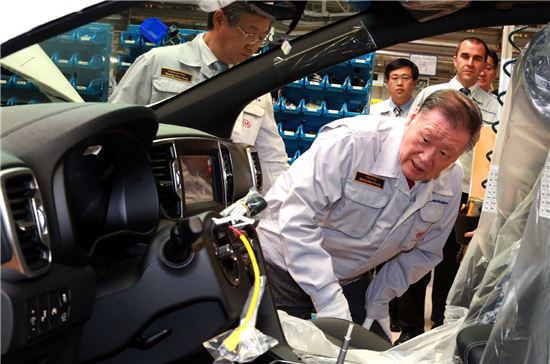 In 2016, Chung Mong-koo, then Chairman of Hyundai Motor Group, visited Kia's Slovakia plant to inspect the quality of automobiles.
 [Photo by Hyundai Motor Group]
Establishing production bases worldwide and actively promoting localization was also a hallmark of Chairman Chung Mong-koo’s tenure. Among Hyundai’s overseas plants, the oldest is the Turkey plant established in 1997, followed by the Chennai plant in India in 1998. During Chung Mong-koo’s leadership, Hyundai Motor consecutively launched production at the Alabama plant in the U.S. (2005), the Czech plant (2009), and the Brazil plant (2012), boosting production capacity. At the turn of the 20th to the 21st century, the global automotive industry was rife with mergers and acquisitions, emphasizing ‘economies of scale.’ Some predicted that only five large automakers would survive. At that time, Hyundai Motor was ranked within the top 10 worldwide.
Chairman Chung Euisun has been refining the business based on the achievements of previous management while also venturing beyond automobiles. His introduction of design management as Kia president in 2005 and the launch of the premium brand Genesis as Hyundai Motor vice chairman in 2015 are seen as his accomplishments. When Genesis was launched, many predicted it would be difficult to compete against well-established European and American brands or Japanese manufacturers with a history in mass-market cars. However, Genesis dispelled concerns by surpassing cumulative sales of one million units in August 2023, seven years after its launch.
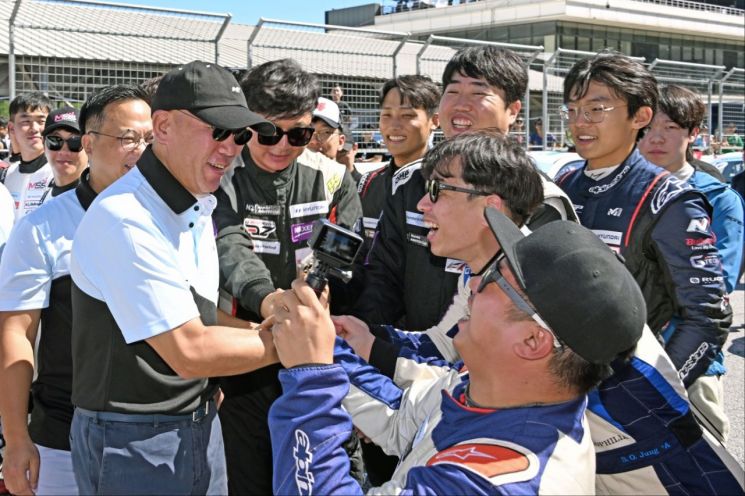 Hyundai Motor Group Chairman Chung Euisun is greeting participants at the N Festival event held on the 28th at Everland Speedway in Yongin.
 [Photo by Hyundai Motor Group]
He also encouraged the development of high-performance models. Albert Biermann, who was responsible for high-performance vehicle development at BMW, was brought on board. Biermann’s move to Korea caused a stir even in Germany. Hyundai participated in international motorsport events such as the World Rally Championship (WRC), honing its technological capabilities. Motorsport competitions involving leading global automakers are considered excellent platforms to test power performance and durability.
The Hyundai Ioniq 5 N, launched last year, is regarded as a model that presents the direction high-performance cars should take in the electrification era. The automotive industry is relatively difficult for brands with a short history to stand out, but the electrification transition has drawn global attention. The hydrogen fuel cell vehicle, considered the ultimate eco-friendly car, has also released the first mass-produced model for large commercial and passenger vehicles, clearly indicating the future direction. The company’s efforts to pursue various new businesses beyond traditional automotive sectors?such as robotics, Advanced Air Mobility (AAM), and mobility services?under the banner of ‘progress for humanity’ are also attracting attention.
© The Asia Business Daily(www.asiae.co.kr). All rights reserved.


















