Bank of Korea Governor's Official Visit to Ministry of Economy and Finance Sejong Government Complex
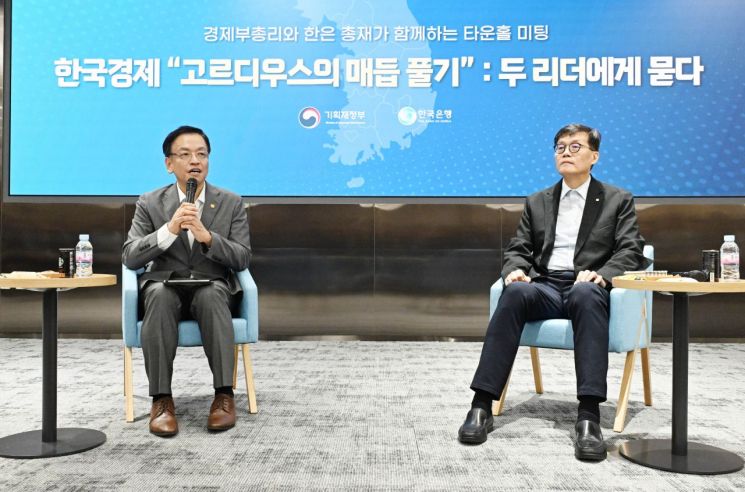 Choi Sang-mok, Deputy Prime Minister and Minister of Economy and Finance, and Lee Chang-yong, Governor of the Bank of Korea, are having a dialogue at a town hall meeting held at the Government Sejong Complex on the 30th.
Deputy Prime Minister and Minister of Economy and Finance Choi Sang-mok and Bank of Korea Governor Lee Chang-yong agreed that leading the Korean economy with an outdated economic structure has reached its limits, and they put their heads together to discuss structural reforms for the Korean economy.
The Ministry of Economy and Finance announced that on this day, Deputy Prime Minister Choi and Governor Lee held a town hall meeting with about 150 participants, including employees of the Ministry and the Bank of Korea, as well as young interns from both institutions, under the theme "Untying the Gordian Knot: Structural Reform for a Sustainable Economy."
On this day, Governor Lee made the first official visit to the Ministry of Economy and Finance as the head of the monetary authority. Although this visit was a return visit following Deputy Prime Minister Choi’s visit to the Bank of Korea in February, it is the first time since the establishment of the government that the head of the monetary authority, who has maintained a subtle tension with the government based on the independence of monetary policy, has directly visited the fiscal authority. The Ministry of Economy and Finance self-assessed that "this is significant in that the two institutions are moving beyond being partners in macroeconomic policy cooperation to opening a new era of partnership that gathers wisdom for future generations."
The event was organized in a town hall meeting format with the Deputy Prime Minister and the Bank of Korea Governor to provide frontline Ministry of Economy and Finance employees who plan policies, Bank of Korea staff responsible for research and analysis, and young people representing future generations an opportunity to ask about the direction of structural reforms for a sustainable economy and find answers together.
Before the main town hall meeting, Deputy Prime Minister Choi emphasized, "The Korean economy is facing a crisis of sustainability as structural problems such as weakened growth potential, reduced social mobility, and population onus accumulate," adding, "Even issues that appear to be short-term or cyclical have structural problems at their core, so structural reform is an unavoidable task that can no longer be postponed."
Additionally, Deputy Prime Minister Choi expressed gratitude while highly evaluating the Bank of Korea’s recent efforts to expand its excellent research capabilities to structural issues and propose various policy directions.
Governor Lee pointed out, "It has now reached its limit to lead our economy by slightly repairing the old economic structure as it is," and assessed, "There is no national disagreement that the outdated economic structure must be reformed to fit the times, but when it comes to individual issues, structural reforms have not been properly implemented due to conflicts between generations, regions, and social classes."
He also emphasized that while structural reforms cannot satisfy all social classes, they should now be pursued in a direction that balances demand and supply, moving away from the traditional supplier-centered approach.
In the subsequent dialogue, Deputy Prime Minister Choi mentioned that the case of the United States, which achieved industrial innovation centered on technology-based innovative service industries since the mid-1990s and reversed its potential growth rate, holds significant implications for the Korean economy. He stressed that as the service industry has strengthened its characteristics as tradable goods due to the advancement of digital technology, global service trade is rapidly expanding, so Korea, a strong IT and export nation, must find new growth engines in the service industry.
Furthermore, he stated the need to actively attract global talent by building an open talent ecosystem to enhance the competitiveness of Korean industries and respond to population issues, mentioning that the "Strategy for Attracting and Utilizing Overseas Talent in Advanced Industries" announced by the government on the 27th is part of these efforts.
In particular, he said that related systems and regulations need to be applied more flexibly and elastically for outstanding overseas talents who meet the demands of Korean companies.
Governor Lee introduced discussions from the recent BIS central bank governors’ meeting, expressing expectations that artificial intelligence (AI) and digital transformation will improve productivity and contribute to long-term growth in the Korean economy. However, he also noted potential problems such as job replacement and increased financial market risks, forecasting that depending on our response, these could become both great opportunities and challenges.
He also evaluated that with a declining population, dispersed regional investments make it difficult to achieve intended goals in terms of investment efficiency and sustainability, emphasizing the need to shift the balanced development paradigm to focus on key non-capital region cities.
© The Asia Business Daily(www.asiae.co.kr). All rights reserved.
![Clutching a Stolen Dior Bag, Saying "I Hate Being Poor but Real"... The Grotesque Con of a "Human Knockoff" [Slate]](https://cwcontent.asiae.co.kr/asiaresize/183/2026021902243444107_1771435474.jpg)
















