Conversational AI Service Reading User Context
Enhancing Cost Efficiency and Targeting the 1020 Generation
Service Differentiation is Key... Monetization Also a Challenge
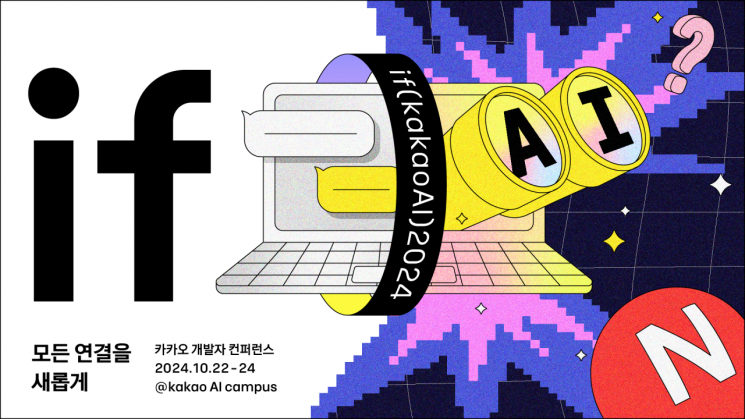 Kakao will hold its developer conference, "if kakao 2024," from October 22 to 24 at the "Kakao AI Campus" in Yongin, Gyeonggi Province.
 [Image=Kakao]
Kakao's new artificial intelligence (AI) service, 'Kanana,' is set to be unveiled. It will feature a conversational service called 'AI Mate' targeting the 10s and 20s age groups while utilizing the existing KakaoTalk platform. Since Kakao was a bit late in developing its own large language model (LLM), it is now focusing on services that leverage such technology as a strategic move.
According to the IT industry on the 2nd, Kakao will introduce Kanana at 'if kakao 2024,' held from June 22 to 24 at the 'Kakao AI Campus' in Yongin, Gyeonggi Province. Launched in 2018, if kakao is a developer conference where Kakao reveals its technological vision. The event was canceled last year due to the company's emergency management system but is now returning after two years. This year's conference theme is 'AI,' sharing Kakao's technology under the slogan 'Reinventing All Connections.'
At this event, Lee Sang-ho, Kakao KananaX Performance Leader, will explain the conversational AI service Kanana under the theme 'A New Connection with AI Mate.' A separate session titled 'A Friend Who Knows My Context, AI Mate' will also be held. The AI is expected to engage in customized conversations like a friend based on user dialogues and profile information or recommend personalized content. In an earnings call last August, CEO Jeong Shin-ah stated, "We will introduce B2C AI services in the form of a conversational platform, which is Kakao's unique strength."
Kakao's own LLM, 'KO GPT 2.0,' is also expected to be unveiled. Kim Byung-hak, Kakao Kanana Alpha Performance Leader, will introduce Kakao's generative AI model and may mention external models used in the Kanana service.
Kanana represents Kakao's strategic move in the AI competition, where it had not previously stood out. Although AI was positioned as a new growth engine and efforts were accelerated, legal risks spread across the group hindered progress. The planned release of 'KO GPT 2.0' last October was repeatedly postponed.
CEO Jeong Shin-ah transferred the main AI R&D subsidiary, Kakao Brain's key business, to Kakao headquarters and established Kanana as a dedicated AI organization. Internally, KO GPT 2.0 development is complete, but instead of releasing the model alone, Kakao chose to present it through a service. Since catching up with leading companies by model performance alone is difficult, the goal is to demonstrate real value through services that users can experience.
Kakao has accumulated expertise in chat services by operating KakaoTalk and has experience partially integrating AI. Through the 'Laboratory' feature, it currently offers functions such as summarizing received messages or changing the tone of messages users intend to send.
From a cost-efficiency perspective, Kanana is a service that can be launched quickly. Kakao has focused on finding cost-effective AI by testing various sizes of AI models with parameters ranging from 6 billion, 13 billion, 25 billion, to 65 billion. Rather than investing heavily in advancing LLMs, the focus is on integrating features into the core service, KakaoTalk.
Kanana is also expected to address the key challenge of expanding users in their teens and twenties. KakaoTalk is considered to have a weak presence among these age groups, with usage time declining due to competition from platforms like Instagram and TikTok. In this context, conversational AI could become a weapon targeting these users.
The key issue is differentiation. There are services like Character.AI (USA), which allows conversations with AI characters; Lovers, a dating AI chatbot (Japan); and XEva, which creates AI versions of real celebrities (China). In Korea, similar services include Zeta, Jappy, LopanAI, Lovidervy, and DearMate.
Another point to watch is the strategy Kakao will adopt to popularize and monetize the service. According to the 'AI Chatbot Awareness and Usage Behavior' report by the Korea Information Society Development Institute (KISDI), only 13.4% of the general public use AI chatbots, and just 5.7% use paid products. Most usage is for 'information search' and 'work tools,' while 'other' purposes such as entertainment and companionship account for only 0 to 1.8% across all age groups.
© The Asia Business Daily(www.asiae.co.kr). All rights reserved.
![Clutching a Stolen Dior Bag, Saying "I Hate Being Poor but Real"... The Grotesque Con of a "Human Knockoff" [Slate]](https://cwcontent.asiae.co.kr/asiaresize/183/2026021902243444107_1771435474.jpg)
















