China's manufacturing sector rebounded beyond market expectations but continued its 'economic contraction' phase for the fifth consecutive month.
On the 30th, the National Bureau of Statistics of China announced that the manufacturing Purchasing Managers' Index (PMI) for September recorded 49.8. This exceeded the market forecast (49.5) and rose by 0.7 points compared to the previous month.
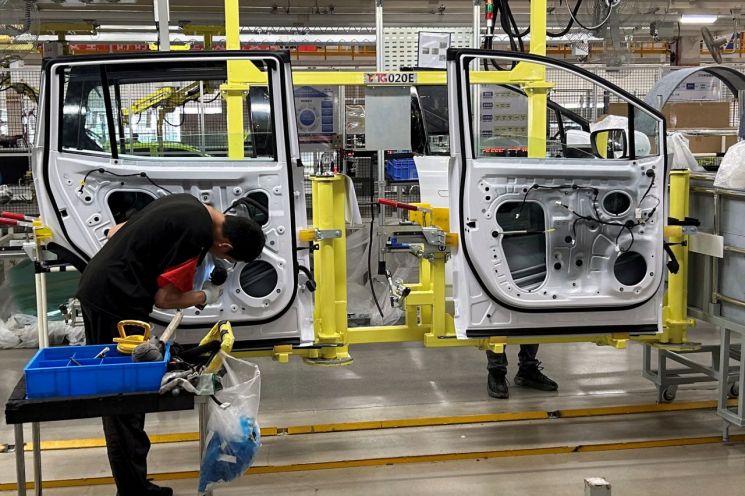
The manufacturing PMI is compiled based on surveys of purchasing managers from 3,200 companies, including large state-owned enterprises, and is a representative indicator of the economic trend in the related sector. A figure above 50 indicates an expansion phase, while below 50 indicates a contraction phase.
The manufacturing PMI, which fell below the baseline (50) at 49.5 in October last year, rose above the baseline to 50.8 in March, marking the first time in half a year. It remained above 50 in April (50.4) but slightly declined afterward, recording 49.5 in May and returning to contraction. Subsequently, it recorded 49.5 in June, 49.4 in July, and 49.1 in August.
The non-manufacturing (services) PMI, announced on the same day, recorded 50.0, down from 50.3 the previous month, falling to the baseline. The non-manufacturing PMI measures activities in construction and service sectors.
Meanwhile, the manufacturing PMI for September released by Caixin, a Chinese economic media outlet, dropped 1.1 points from the previous month to 49.3, the lowest since August last year. The September services PMI also fell 1.3 points to 50.3, the lowest since October last year.
Wang Zhe, an analyst at Caixin, stated, "Although supply slightly expanded, demand sharply decreased, causing the manufacturing economic index to decline in September." He added, "Inventory and deflationary pressures have increased, and corporate optimism has fallen to its lowest level in recent years." He further noted, "The momentum for economic recovery in the third quarter is not strong, and achieving the annual economic growth target will be very challenging." He emphasized, "Previously announced policies need to be implemented promptly, and the necessity for additional policies has increased."
Recently, concerns have arisen that China may struggle to achieve this year's growth target of around 5%, as the second-quarter growth rate was recorded at 4.7%, below the market expectation of 5.1%. In response, China has recently announced measures to stimulate the economy, including liquidity injection of 1 trillion yuan by the People's Bank of China and cuts in policy interest rates and mortgage loan rates.
© The Asia Business Daily(www.asiae.co.kr). All rights reserved.
![Clutching a Stolen Dior Bag, Saying "I Hate Being Poor but Real"... The Grotesque Con of a "Human Knockoff" [Slate]](https://cwcontent.asiae.co.kr/asiaresize/183/2026021902243444107_1771435474.jpg)
















