"Establishment of Regional Public Essential Limited Medical License System"
"Helps Address Concerns About Increased Medical School Education Environment"
The Association of Korean Medicine Doctors (AKMD) has argued that the shortage of doctors should be resolved by allowing Korean medicine doctors to work as physicians in regional and essential medical institutions after additional training.
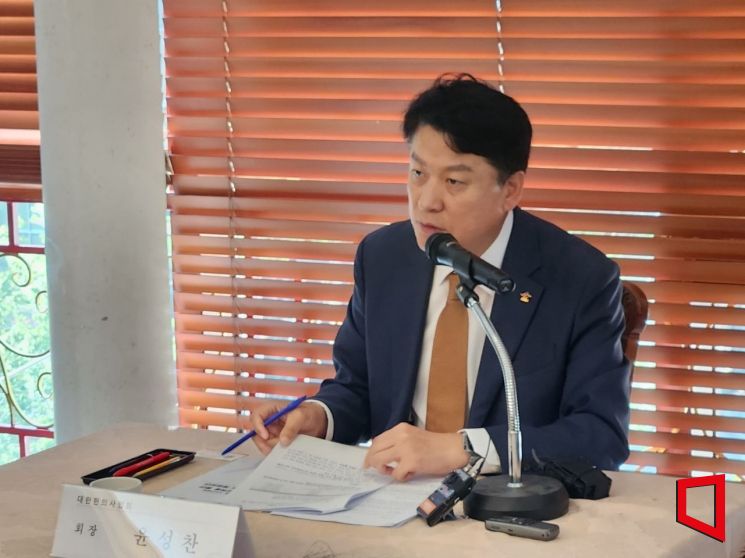 On the 30th at 12 PM, Yoon Sung-chan, President of the Korean Medicine Doctors Association, held a press conference in Yeouido, Yeongdeungpo-gu, Seoul, titled "Early Resolution of Doctor Shortage through Additional Education for Korean Medicine Doctors" and delivered a speech.
 Photo by Choi Tae-won peaceful1@
On the 30th at noon, the AKMD held a press conference in Yeouido, Yeongdeungpo-gu, Seoul, titled "Early Resolution of Doctor Shortage through Additional Training for Korean Medicine Doctors," emphasizing the need to establish a "Regional Public Essential Limited Medical License System."
Yoon Seong-chan, president of the AKMD, stated, "The curriculum of Korean medicine includes subjects such as radiology, anatomy, and physiology, and the educational content is about 75% similar to that of medical schools. By partially alleviating the doctor shortage early in response to the increase in medical school quotas, it will be possible to reduce the increase in medical school quotas by more than 500 students. This could serve as a way to reach a smooth social agreement between the Western medical community and the government."
This system is similar to the "Contract-type Essential Doctor System," where local governments sign contracts with specialists to work locally for 5 to 10 years and provide a monthly regional work allowance of 4 million KRW, but it is characterized by having no time limit. Korean medicine doctors receive two years of medical school education and, upon passing the "Regional Public Essential Limited Medical License Exam," are granted a medical license. However, the medical institutions where this license can be used are limited to those providing essential medical subjects in the region.
Specialist training is also only possible in essential medical fields. Even when working as general practitioners, they cannot work outside medical institutions that provide essential medical subjects in the region.
The AKMD proposed to implement this system preferentially for five years with 300 to 500 candidates annually, on the condition that they complete essential medical subjects and are obligated to serve in public medical institutions. Suggested educational institutions include those with both medical and Korean medicine colleges, such as Kyung Hee University, Wonkwang University, Dongguk University, Gachon University, and Busan Korean Medicine Graduate School.
The AKMD predicted that granting medical licenses to Korean medicine doctors after two years of additional training could shorten the time required to produce doctors by up to seven years. It is expected that medical school freshmen in 2025 will take up to 14 years to be deployed in the field.
To discuss these measures, the AKMD also called for the operation of a bipartisan Korean medicine limited council involving their participation. President Yoon said, "If the system implementation allows for a reduction in medical school quotas, it will help alleviate concerns related to the educational environment of expanded medical schools. Since early admissions have started, we need to discuss whether there is enough physical time for discussions. Therefore, the bipartisan Korean medicine limited council must be implemented as soon as possible."
© The Asia Business Daily(www.asiae.co.kr). All rights reserved.

















