The Public Procurement Service, responsible for procuring general military supplies, has significantly increased soldier satisfaction by actively reflecting the quality, safety, and preferences of soldiers.
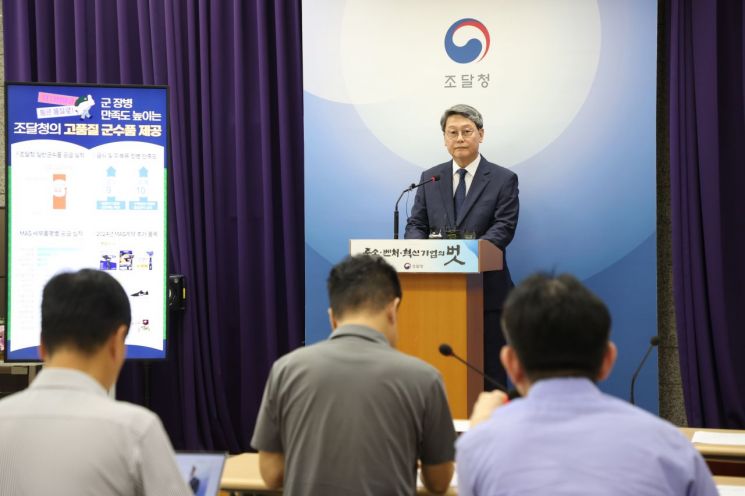 Kwon Hyuk-jae, Director of the Procurement Business Bureau at the Public Procurement Service, is briefing on the supply performance and quality management status of military supplies at the government Daejeon Government Complex press room on the 30th. Photo by Public Procurement Service
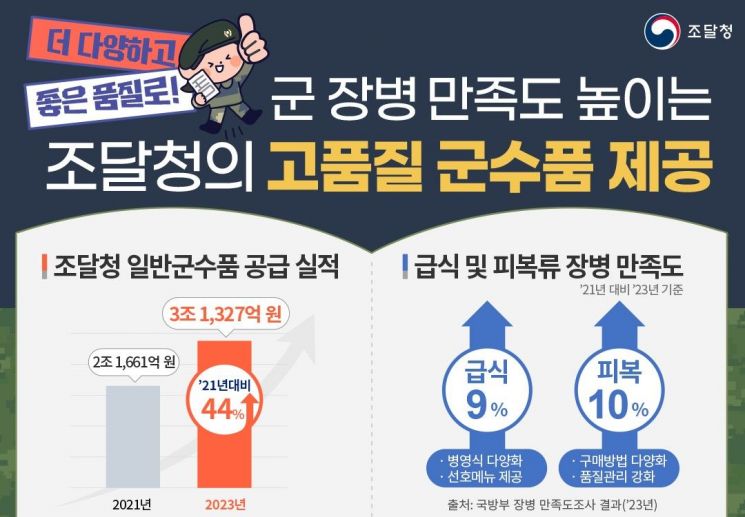
According to the Public Procurement Service on the 2nd, the procurement of general military supplies was transferred from the Defense Acquisition Program Administration to the Public Procurement Service in July 2020. As of last year, the scale of military supplies supplied by the Public Procurement Service to the military was 3.1327 trillion KRW, a 44% increase compared to 2.1661 trillion KRW in 2021.
Above all, soldier satisfaction has improved. In a soldier satisfaction survey conducted by the Ministry of National Defense last year (comparing 2021 and last year), the diversity of military meals increased by 15 percentage points, clothing by 10 percentage points, and provision of preferred menus by 9 percentage points.
◆ Boosting morale by tailoring to MZ generation soldiers’ preferences = After taking over military meal services, the Public Procurement Service prioritized supplying meals that reflect the tastes and preferences of MZ generation soldiers. ‘Quality’ and ‘soldier preference’ were set as the top priorities in contracts to enable the provision of meal kits and other items favored by soldiers.
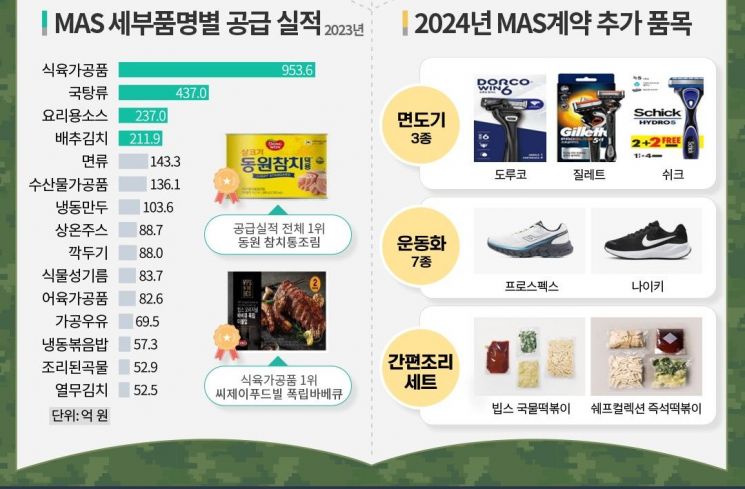
In this process, the Public Procurement Service included 4,120 products such as canned tuna, barbecue pork ribs, instant tteokbokki, and budae jjigae in soldiers’ menus based on regular surveys and feedback. This was made possible by shifting from a method where a single company supplied limited products to a multiple supplier contract system on the ‘Nara Marketplace,’ contracting with two or more companies producing products with the same or similar performance and quality.
The shift in military meal supply methods has increased soldier satisfaction while also impacting the scale of transactions and the number of registered products.
For example, last year, the supply performance of multiple supplier contracts for military meals was 332.1 billion KRW, a 133% increase from 142.1 billion KRW the previous year. Especially, as of the end of August this year, supply performance has already reached 309.3 billion KRW, confirming the expansion compared to the previous year. The number of products registered on Nara Marketplace (Defense Commercial Shopping Mall) also increased 1.5 times from 2,786 last year to 4,120 as of August.
The Public Procurement Service also introduced changes in military goods procurement such as uniforms and personal equipment by adopting a customized procurement strategy considering the preferences of MZ generation soldiers and the conditions of military units. A representative example is switching the supply of standard issue items, such as razors and sneakers, which soldiers prefer personally but are difficult for the military to improve in quality, to commercial products.
Additionally, the Public Procurement Service regularly updates regulations and standards for military clothing, equipment, and personal gear in cooperation with the Ministry of National Defense. It also participates in the Ministry’s pilot program for excellent commercial products, focusing efforts on incorporating new research findings and technological innovations into commercial military supply regulations.
◆ Stricter quality and safety management = The quality of military supplies is directly linked to soldiers’ welfare and safety. For this reason, the Public Procurement Service has placed even greater emphasis on the basics such as quality and safety management of military supplies, beyond prioritizing the preferences of MZ generation soldiers.
First, in 2022, the Public Procurement Service established the ‘Defense Materials Quality Division,’ a dedicated department for military supply quality assurance, responsible for quality assurance throughout all processes from raw materials to final product inspection. A representative example is setting separate quality standards that meet domestic and international certification criteria and selecting excellent companies by verifying each supplier’s production capacity to ensure the quality of military supplies issued to individual soldiers.
Safety measures have also been put in place to prevent unfair practices during the military supply distribution process. For example, if defects occur in delivered meal items or if suppliers violate major laws such as the Food Sanitation Act, penalties (up to a 5-point deduction) are applied during qualification evaluations.
Items with defects under multiple supplier contracts can be penalized by being barred from transactions on the shopping mall for up to six months according to additional special conditions for multiple supplier contracts for meal items.
If nonconforming products are found during self-quality inspections of meal production, the Public Procurement Service strengthens sanctions against unfair practices, including suspension of transactions on the shopping mall, based on administrative actions by relevant authorities.
Lim Gi-geun, Administrator of the Public Procurement Service, said, “The Public Procurement Service will strive to enhance military combat power by improving soldier satisfaction through creating a soldier-centered purchasing environment, strengthening quality control, and establishing a fair competitive system for MZ generation soldiers’ military life satisfaction. To this end, the Public Procurement Service will boldly improve various military supply procurement systems in cooperation with the Ministry of National Defense and focus institutional capabilities on procuring high-quality military supplies.”
© The Asia Business Daily(www.asiae.co.kr). All rights reserved.



















