Some Major Shareholders Vote Against Reappointment of Toyota Chairman
Akio Toyoda, chairman of Toyota Motor Corporation, succeeded in retaining his director position despite the controversy over quality certification fraud, but distrust among major shareholders appears to be spreading.
Bloomberg reported on the 30th that "concerns about Chairman Toyoda's leadership and the future of Toyota Motor Corporation, which arose after a series of vehicle safety scandals, have surfaced," noting that major shareholders who voted against Toyoda's reappointment at the June shareholders' meeting have begun to publicly voice their criticism.
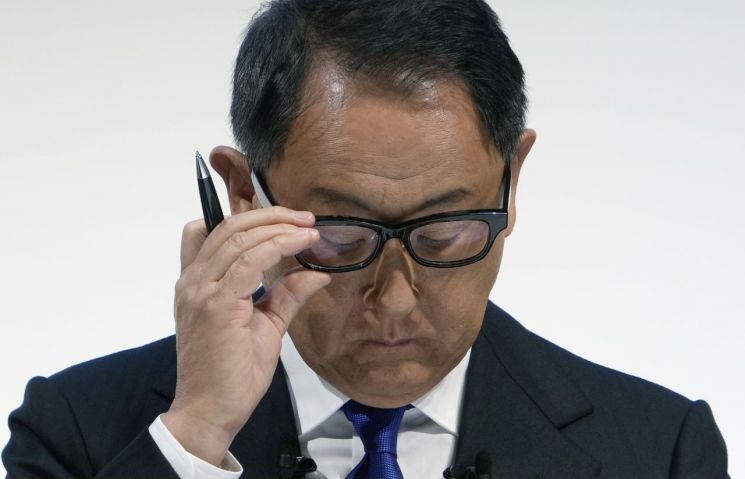
Nissay Asset Management recently announced on its website that the company voted against the reappointment of Chairman Toyoda and nine other incumbent directors at Toyota Motor Corporation's shareholders' meeting in June. Nissay explained the basis for their opposition, stating, "Their actions (quality certification fraud) not only greatly contradict societal demands but also damage public trust and the company's market value assessment."
Another major shareholder, Mitsubishi UFJ Asset Management, also announced opposition to the reappointment of Chairman Toyoda, Vice Chairman Shigeru Hayakawa, and CEO Koji Sato. They explained that Toyota's management needed to take responsibility for the quality certification fraud scandal and raise awareness about governance issues within the company.
Earlier, in June, Toyota Motor Corporation was found to have committed fraud during the acquisition process of quality certifications (type approval) necessary for mass production of vehicles, resulting in a government shipment suspension order for seven models including the Corolla Fielder, Axio, and Yaris Cross. About a month later, in July, additional quality certification fraud was discovered in seven Toyota models, leading to a corrective order for fundamental organizational reforms and significantly damaging the company's credibility.
Ahead of the June shareholders' meeting, the two major global proxy advisory firms, Institutional Shareholder Services (ISS) and Glass Lewis, recommended that Toyota shareholders oppose Chairman Toyoda's reappointment. Large institutional investors such as the California Public Employees' Retirement System (CalPERS) also expressed opposition, but all incumbent directors, including Chairman Toyoda, were successfully reappointed. Shareholders who voted in favor positively evaluated the company's willingness to eliminate the root causes of the quality fraud controversy and to innovate its organizational culture.
However, there are assessments that it is uncertain whether Chairman Toyoda will be able to maintain his position next year. As the grandson of Toyota Motor Corporation's founder, Toyoda has rarely seen shareholder support fall below 90% since becoming CEO in 2009. However, following the Daihatsu fraud incident in December last year, his support rate hit a record low of 85%, and it further dropped to 72% at the June shareholders' meeting. Notably, support among overseas institutional investors was low at 33.6%.
Chairman Toyoda himself recently expressed a sense of crisis in podcasts and interviews, saying, "No board member in Toyota's history has ever had such low support," and warned that if the downward trend is not reversed, his position could be at risk.
Bloomberg noted, "As major shareholders began to publicly disclose their votes and reasons at the June shareholders' meeting, dark clouds gathered over Chairman Toyoda's reappointment next year," adding, "Since local banks and securities firms, including institutional investors, hold 40% of the company's shares, a change in their stance could decisively impact the current chairman's term."
© The Asia Business Daily(www.asiae.co.kr). All rights reserved.
!["The Woman Who Threw Herself into the Water Clutching a Stolen Dior Bag"...A Grotesque Success Story That Shakes the Korean Psyche [Slate]](https://cwcontent.asiae.co.kr/asiaresize/183/2026021902243444107_1771435474.jpg)
















