Re-vote and Rejection of the Yellow Envelope Act and 250,000 Won Support Act
35 Bills Still Pending in Standing Committees
"Individual Bills Buried Under Party Policy"
The Democratic Party of Korea presented legislative tasks ahead of the opening of the 22nd National Assembly, but progress has been sluggish. It is interpreted that livelihood-related bills are being pushed to the sidelines as the party adopts contentious bills such as the Chae Sang-byeong Special Prosecutor Act and the Kim Geon-hee Special Prosecutor Act as party positions. Despite unresolved legislative tasks, additional contentious bills have been adopted as party positions, leading to complaints that bills proposed by individual lawmakers are being buried.
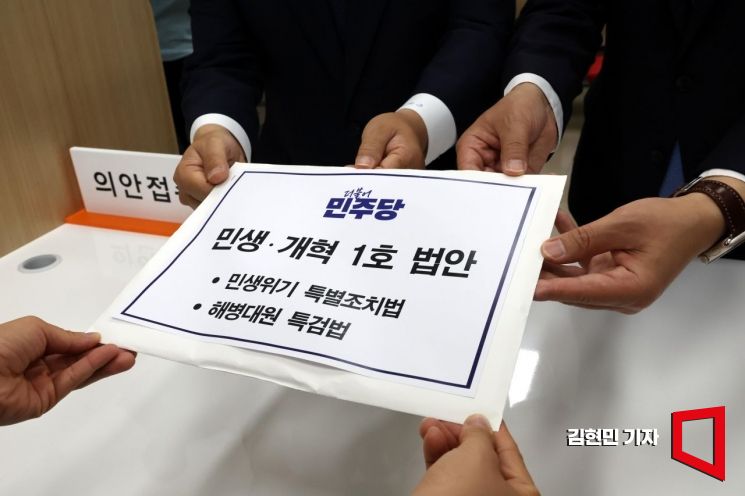 On the first day of the 22nd National Assembly session on the 30th, Min Byeong-dae (left) and Kim Yong-min, members of the Democratic Party of Korea, submitted the party's first bill, the "Marine Corps Special Prosecutor Act and Special Measures for the Livelihood Crisis Act," at the National Assembly Bill Office. Photo by Kim Hyun-min kimhyun81@
According to Asia Economy's coverage on the 30th, out of the 56 legislative bills set as tasks by the Democratic Party on May 22, only 13 bills have passed the plenary session. Among these, only 7 bills were passed and promulgated after bipartisan agreement. On the 28th of last month, the ruling and opposition parties processed the Nursing Act, the Special Act on Jeonse Fraud, and the Urban Gas Business Act through the plenary session.
The Yellow Envelope Act (amendments to Articles 2 and 3 of the Labor Union Act), the Four Broadcasting Acts (Broadcasting Act, Broadcasting Culture Promotion Act, Korea Educational Broadcasting System Act, and Korea Communications Commission Act amendments), and the Special Measures Act for Livelihood Recovery Support Payment (the 250,000 won support law) were vetoed by President Yoon Seok-yeol and subsequently discarded after a re-vote in the National Assembly plenary session on the 26th. The Chae Sang-byeong Special Prosecutor Act, Kim Geon-hee Special Prosecutor Act, and Local Currency Act are also expected to be vetoed by President Yoon on the same day. President Yoon maintains a policy of exercising veto power on bills passed without bipartisan agreement. However, the opposition continues to propose special prosecutor bills and others.
Contentious Bills Take Center Stage Over Livelihood Bills... "Individual Bills Buried Under Party Positions"
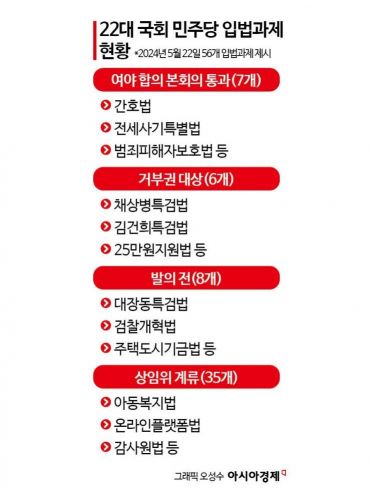
Livelihood bills have not been properly addressed. Among the legislative task bills, 35 remain pending in standing committees. Bills such as the National Health Insurance Act, which applies health insurance to nursing care costs for patients admitted to long-term care hospitals, and the Child Allowance Act, which provides a monthly 200,000 won child voucher to children aged 18, remain in committee. These bills were also part of the Democratic Party's pledges in the 22nd general election. The Public Medical School Establishment Act and Regional Doctor Training Act were also proposed but have seen little discussion amid the medical crisis.
The Daejang-dong 5 Billion Won Club Special Prosecutor Act, the Housing and Urban Fund Act, and the Prosecution Reform Act were included in the legislative tasks but have not yet been proposed. The Housing and Urban Fund Act, known as the 'Basic Housing Act,' aims to provide public rental housing with options for sale conversion of 24-pyeong units for families with two children and 33-pyeong units for families with three children. However, considering the opposition party's limitations and public resistance to basic housing, it is believed that this has not yet been pursued. The Prosecution Reform Act is expected to be adopted as a party position soon.
Despite failing to address the legislative tasks set in May, the Democratic Party has additionally adopted a batch of contentious bills as party positions. In June, they adopted the impeachment motion against former Korea Communications Commission Chairman Kim Hong-il; in July, the amendment to the Board of Audit and Inspection Act requiring the Audit Committee's resolution for audit initiation and complaints; and in August, the impeachment motion against Korea Communications Commission Chairperson Lee Jin-sook. The Democratic Party also plans to adopt the 'Seoul Spring Four Acts,' which block the possibility of martial law, as party positions.
However, some lawmakers have expressed dissatisfaction. There are criticisms that party position bills are flooding in despite the failure to resolve livelihood bills and other legislative tasks. A Democratic Party lawmaker who requested anonymity said, "I understand that party position bills are set with the intention of considering bills handled by other standing committees together, but they are quickly adopted as party positions and moved to the plenary session," adding, "Each lawmaker has bills they want to create, but it feels like they are buried under the party position bills."
© The Asia Business Daily(www.asiae.co.kr). All rights reserved.


















