 Lee Chang-yong, Governor of the Bank of Korea, is striking the gavel at the Monetary Policy Committee meeting held at the Bank of Korea in Jung-gu, Seoul, on July 11. Photo by Joint Press Corps
The Bank of Korea's climate policy ranked 16th among the central banks of the Group of Twenty (G20) countries. This is a drop of three places compared to two years ago.
According to Climate Solution on the 30th, the Bank of Korea was evaluated 16th in the Green Central Banking Scorecard, which assessed the climate policies of G20 central banks on the 26th. Although the Bank of Korea recently established the Sustainability Growth Office to accelerate its response to climate change, it is still considered insufficient at the global level.
In this report published by Positive Money, a London-based nonprofit research organization, the Bank of Korea ranked 16th out of the 20 central banks evaluated and received a D grade.
Positive Money cited as the basis for its evaluation that "there were limitations in implementing substantive policies for active climate change response, such as a lack of issuance of green bonds to expand support for green finance."
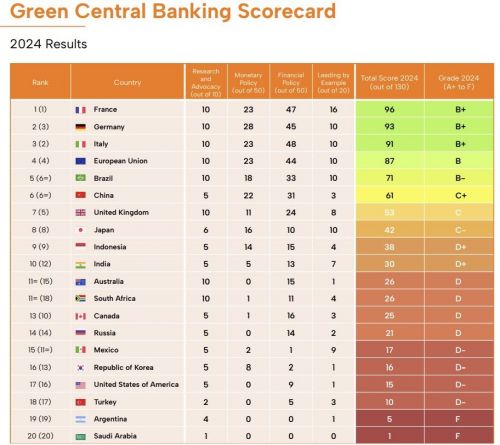
Positive Money evaluates the climate policies of G20 countries and the European Central Bank in terms of research and policy recommendations, monetary policy, and financial policy. In this year’s ranking, France, Germany, and Italy, members of the European Union, took the 1st, 2nd, and 3rd places respectively, with the European Central Bank ranking 4th. The central banks of Brazil and China also ranked high at 5th and 6th respectively.
The report also emphasized that despite the status of the dollar and the importance of the U.S. economy, the ranking of the U.S. Federal Reserve (Fed) fell from 16th to 17th. Unlike European central banks, the Fed has taken a passive stance on central banks’ responses to climate change.
Zack Livingstone, lead author of the report and a member of Positive Money, said, "Considering the enormous impact the U.S. central bank would have on the global financial environment if it focused on climate change, we hold global financial leaders accountable for the Fed and urge the Fed to adopt climate policies and set an example."
Recently, as climate change has caused soaring prices of daily necessities including agricultural products and increased natural disasters such as heatwaves and floods, leading to economic activity contraction, the impact of climate change on economic growth and inflation has increased, making climate change response one of the central banks’ important roles.
This change is also well reflected in the Bank of Korea’s recent internal research data. According to the report "The Impact of Abnormal Climate on the Real Economy" published by the Bank of Korea in August, since 2010, the impact of abnormal climate on the overall Consumer Price Index (CPI) was 0.04 percentage points. In particular, abnormal climate was analyzed to have an impact of 0.40 percentage points on fruit prices and 0.18 percentage points on food prices.
The Bank of Korea officially presented its climate change response direction in 2021 and has implemented policies such as restricting coal and fossil fuel investments in foreign currency assets and expanding ESG investments along with activating related research.
Choi Gi-won, senior researcher at the Green Transition Institute, who recently published the report "The Bank of Korea Facing the Climate Crisis, Questioning Its Role," said, "The Bank of Korea should not limit itself to research but actively consider and implement monetary credit policy tools such as green finance intermediary support loans, climate impact assessments of Bank of Korea collateral and loans, and green bond purchase programs."
Go Dong-hyun, head of the Climate Finance Team at Climate Solution, emphasized, "The fact that central banks worldwide are emphasizing climate response is evidence that the impact of climate change on inflation and economic growth has become apparent," adding, "Both the Bank of Korea and the government need to recognize that climate change response is directly related to economic and livelihood policies."
© The Asia Business Daily(www.asiae.co.kr). All rights reserved.
![Clutching a Stolen Dior Bag, Saying "I Hate Being Poor but Real"... The Grotesque Con of a "Human Knockoff" [Slate]](https://cwcontent.asiae.co.kr/asiaresize/183/2026021902243444107_1771435474.jpg)












