Strong Geographical Advantage... Heralding the Rise as an 'AI Hub'
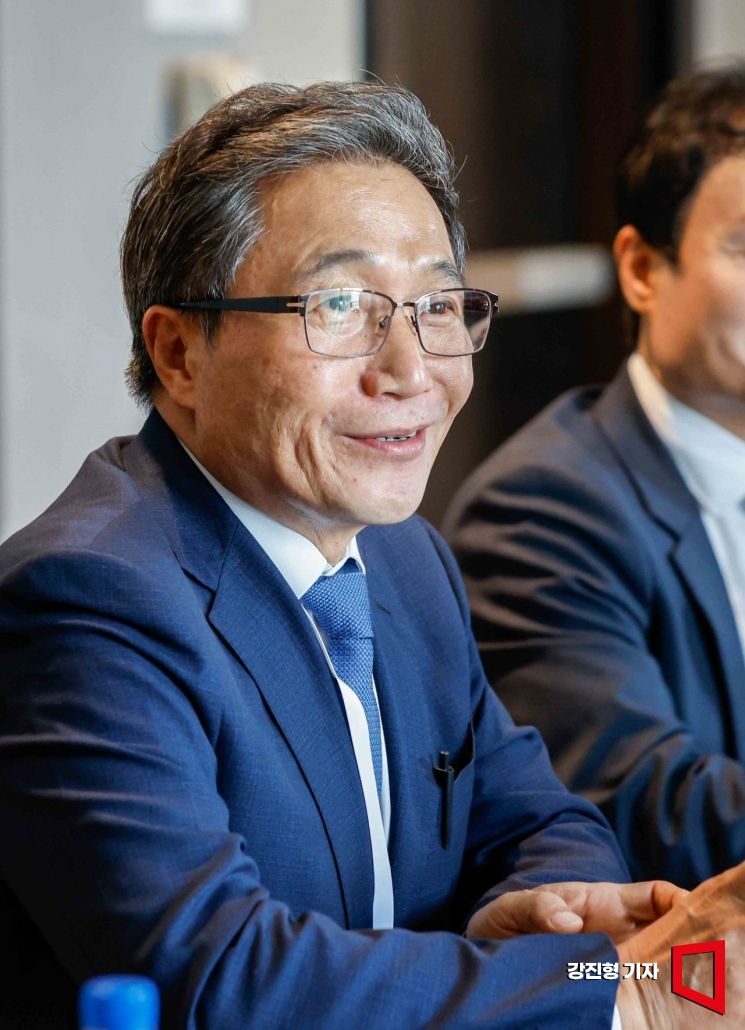 Lee Hak-jae, President of Incheon International Airport Corporation, is attending the "Strategic Discussion for Strengthening the Asia-Pacific Aviation Network" held at the Loews Hotel in Atlanta, USA, on the 25th local time, exchanging opinions with Ed Bastian, Chairman of Delta Air Lines. Photo by Kang Jin-hyung aymsdream@
Lee Hak-jae, President of Incheon International Airport Corporation, has announced plans to expand Incheon Airport beyond the scope of a traditional airport. The vision is to transform Incheon Airport into an artificial intelligence (AI) hub, attracting not only travel-related demand but also a variety of corporate clients.
On the 25th (local time), President Lee shared this vision with the Korean press corps during his visit to Atlanta, Georgia, USA, where he attended the 6th Global Customer Experience Summit hosted by the International Air Transport Association (ACI).
President Lee stated, "While faithfully fulfilling Incheon Airport’s fundamental role and maintaining the current level of service is basic, I want to establish it as an AI hub." He emphasized, "The plan is to expand the airport area into a specialized zone where companies from various sectors, not just aviation and airport industries, gather near Incheon Airport to demonstrate and research AI technologies."
He particularly highlighted the geographical location as a significant advantage. The airport is situated not far from the Seoul metropolitan area and has a vast site. Incheon Airport covers approximately 56 million square meters, making it the second largest among the world’s top 10 airports. Given that it is actively attracting cargo business related to the semiconductor value chain centered around the U.S., Japan, Taiwan, and Korea, the synergy effect of Incheon Airport establishing itself as an 'AI hub' is expected to be substantial.
Incheon Airport is also favorable for building data centers, which are core facilities for global IT giants such as Google and Microsoft (MS). As the amount of data processed by computers grows exponentially in the AI era, demand for data centers is surging. However, recently, data centers have become undesirable facilities for nearby residents, making it difficult to secure suitable sites. In contrast, Incheon Airport is not a residential area, so there is less likelihood of complaints and noise issues of this kind. At the same time, it is located not far from business clusters such as Seoul and Pangyo in Gyeonggi Province. Due to the nature of the airport, it also has a double or triple redundant safe power supply network. President Lee explained, "There is ample potential for the airport to develop beyond its existing scope into a region attracting big tech and global AI talent." He added, "If Incheon Airport establishes itself as an AI hub, it will be self-sustaining even in the face of unavoidable external variables such as COVID-19 or war."
Meanwhile, on the same day, President Lee also shared his thoughts on achievements such as being the world’s first airport to receive a 5-level customer experience certification for three consecutive years and winning the Airport Service Quality (ASQ) 'Airport of the Year' award at the 6th Global Customer Experience Summit. He emphasized, "Incheon Airport operates under the 'One Airport' policy, where over 85,000 airport family members provide integrated services focused on 'customer experience' beyond their individual work areas." He added, "We have simplified immigration procedures with services like Smart Pass (processing without passport or boarding pass) and Easy Drop (check-in outside the airport), and showcased new cultural and artistic platforms through performances and exhibitions."
© The Asia Business Daily(www.asiae.co.kr). All rights reserved.

















