Incheon Airport as Delta Air Lines' New Asia Hub Airport
Single Airport Advantage Over Japan Split Between Narita and Haneda
Strength in Network Utilization with Korean Air
Delta CEO "Asiana Merger to Maximize Synergy"
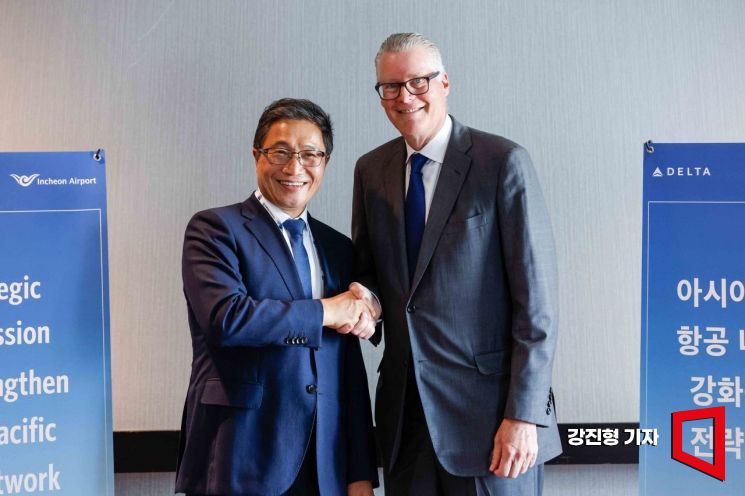 Lee Hak-jae (left), President of Incheon International Airport Corporation, and Ed Bastian, Chairman of Delta Air Lines, are shaking hands at the "Strategic Discussion to Strengthen the Asia-Pacific Aviation Network" held on the 25th local time at the Loews Hotel in Atlanta, USA. Photo by Jinhyung Kang aymsdream@
Incheon Airport is becoming the new Asian international hub for Delta Air Lines, the world's largest airline. It has been recognized for its superior potential compared to the existing hub, Narita Airport in Japan. The prospect of a closer synergy effect has also been bolstered by Korean Air, a major partner of Delta Air Lines, absorbing Asiana Airlines.
On the 25th (local time), Lee Hak-jae, President of Incheon International Airport Corporation, and Ed Bastian, CEO of Delta Air Lines, held talks at the Loews Hotel in Atlanta, USA, and decided on this collaboration. They reinstated the direct flight route between Salt Lake City, USA, and Incheon after 13 years and selected Incheon Airport as Delta Air Lines' Asian hub airport, replacing Narita Airport in Japan.
Among Asian airports, Incheon Airport is the only one with a direct flight route to Salt Lake City, USA. With the establishment of this new route, Incheon Airport will be the first in Asia to connect all four of Delta Air Lines' core hubs in the United States (Atlanta, Detroit, Minneapolis, Salt Lake City) via direct flights. It has become the fourth major overseas hub airport after London, Paris, and Amsterdam.
'One Airport' Strategy Surpassing Japan's Narita
Delta Air Lines cited the fact that Incheon Airport is a single airport as the biggest reason for choosing it as a hub over Narita Airport in Japan. In the Tokyo area, Narita Airport and Haneda Airport each operate transpacific routes, dispersing long-haul flights. This dispersal of transfer demand limits growth potential for customers departing from or arriving in Tokyo. For this reason, as of August 2019 before COVID-19, Delta Air Lines supplied 312 flights and 84,361 seats monthly at Narita Airport, its former Asian hub, but suspended all Narita-US routes after March 28, 2020.
In contrast, Incheon Airport concentrates major long- and short-haul international routes. It offers an environment where not only Korean passengers but also transfer demand from nearby Asian regions can become potential customers. Based on Delta Air Lines' seat supply, Incheon Airport rose from third place in Asia in August 2019 to second place this August. With the launch of the new Salt Lake City route next year, it will supply 112,980 seats, making it certain to claim first place. This solidifies Delta Air Lines' status of Incheon Airport as its Asian international hub.
This will lead not only to quantitative growth such as transportation performance but also qualitative growth like increased transfer rates and network expansion. As of last year, transpacific routes accounted for 10% of Incheon Airport's total passengers and 31.3% of transfer passengers, representing a major long-haul market. President Lee Hak-jae stated, "Through this cooperation with Delta Air Lines, I am confident that we can grow into a world-class hub airport in the rapidly changing global aviation market," and emphasized, "We will share a vision and cooperate to become a role model for airline partnerships that lead the global aviation market as a representative global airport and airline."
Maximizing Synergy with Korean Air Cooperation
 Ed Bastian, Chairman of Delta Air Lines, is attending the "Strategic Discussion for Strengthening the Asia-Pacific Aviation Network" held at the Loews Hotel in Atlanta, USA, on the 25th local time, exchanging opinions with Lee Hak-jae, President of Incheon International Airport Corporation. Photo by Kang Jin-hyung aymsdream@
The active cooperation between Korean Air and Delta Air Lines is also expected to be a strength. Delta Air Lines signed a joint venture (JV), the industry's highest level of cooperation, with Korean Air in 2018. A JV is a stronger partnership than a codeshare, involving joint operation and shared profits between two airlines. Since the JV agreement, the number of international connecting transfer passengers between Korean Air and Delta Air Lines at Incheon Airport reached 2,035 this year, nearly doubling from 1,110 in 2016. This is about 600 more than the 1,440 daily international transfer passengers on the JV routes between United Airlines and All Nippon Airways, despite the latter combining Narita and Haneda airports, and remains at about 70% of Incheon Airport's level.
Delta Air Lines expects the synergy effect to be maximized if Korean Air merges with Asiana Airlines. CEO Edward stated during his meeting with President Lee Hak-jae, "The merger of Korean Air and Asiana Airlines is a good opportunity for us," adding, "It seems it will be a great help to both Korean Air and Delta."
Joe Esposito, Senior Vice President of Network Planning at Delta Air Lines and the chief architect of Delta's route network, also indicated that more focus will be placed on Incheon Airport in the future. When asked about plans to establish additional hubs in Asia during a meeting at Delta's headquarters on the 26th, Vice President Esposito asserted, "One hub is enough." He continued, "Since the COVID-19 pandemic, demand for Asia-US routes, excluding China, has recovered 100%, and in Korea, it has increased compared to the pandemic period," emphasizing, "Even during the pandemic, the Incheon route was the only one connecting the US and Asia that continued operating without interruption, highlighting Incheon as a key hub connecting Asia."
© The Asia Business Daily(www.asiae.co.kr). All rights reserved.


















