Application Scale 5.9 Times the Standard Volume of 26,000 Households
Bundang Standard Volume 8,000 Households, 69,000 Households Open for Bidding
Jungdong Standard Volume 4,000 Households, 26,000 Households Open for Bidding
Ilsan Standard Volume 6,000 Households, 30,000 Households Open for Bidding
Introduction of 'Fast Track for Special Maintenance Plan Establishment'

A total of 153,000 households applied for the public contest to select leading districts in the first-generation new towns such as Bundang in Seongnam City and Ilsan in Goyang City, Gyeonggi Province, which are being selected at a scale of 26,000 households (standard volume) plus α. This is about 5.9 times the standard selection volume of 26,000 households. Among the 162 districts eligible to apply, 99 districts submitted applications. In particular, the application volume in Bundang was 7.4 times the selection volume, making it the most competitive.
153,000 Households Participate in Contest to Select 26,000 Households + α in Leading Districts
The Ministry of Land, Infrastructure and Transport and local governments of the first-generation new towns in Gyeonggi Province announced on the 28th the results of the proposal submissions for the 'First-generation New Town Redevelopment Leading District Selection Contest' held from the 23rd to the 27th.
Among the 162 districts eligible to apply, 99 districts submitted proposals. The total number of households applying is about 153,000, which is 5.9 times the selection volume based on 26,000 households.
Between 26,000 and 39,000 households will be selected as leading districts in November. The breakdown is 8,000 to 12,000 households in Bundang, 6,000 to 9,000 in Ilsan, 4,000 to 6,000 in Pyeongchon, 4,000 to 6,000 in Jungdong, and 4,000 to 6,000 in Sanbon. These figures include the standard volumes of 8,000 households in Bundang, 6,000 in Ilsan, 4,000 in Pyeongchon, 4,000 in Jungdong, and 4,000 in Sanbon, plus up to 50% additional volume in each area.
The area with the largest application volume compared to the standard volume is Bundang, where 59,000 households applied, which is 7.4 times the standard volume of 8,000 households. Among the 67 districts eligible for the contest, 47 districts including Yangji Village and the Samsung and Hanyang pilot complexes submitted proposals. The average consent rate in the submitted proposals from these districts is 90.7%.
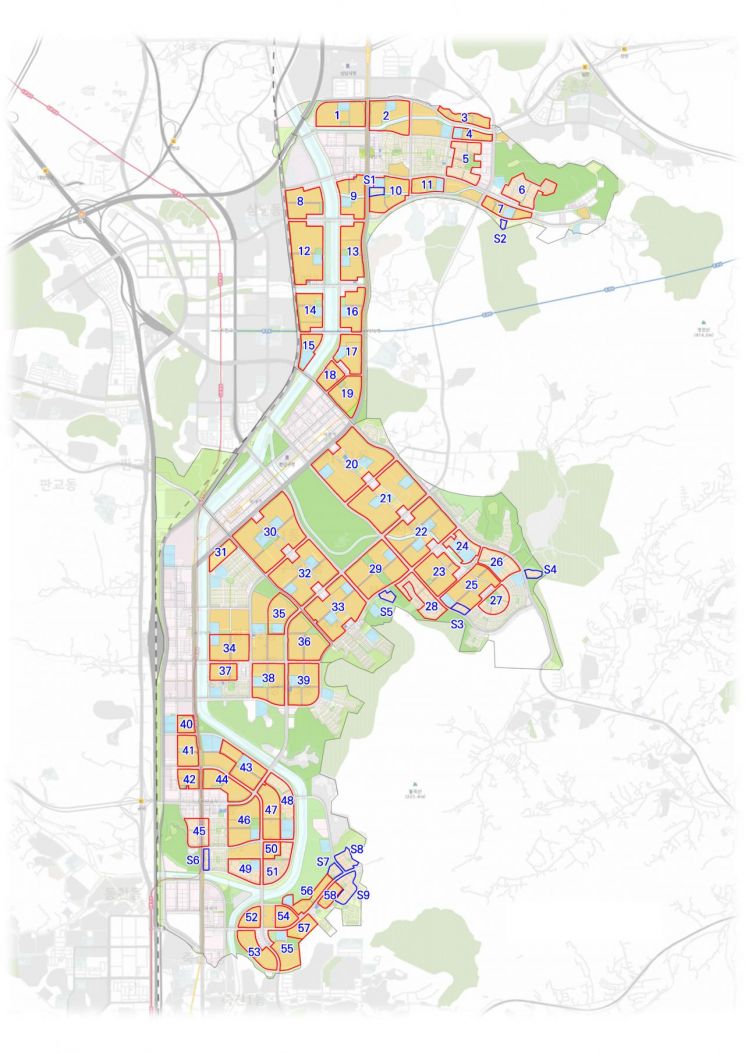 Special Maintenance Planned Area for the First Phase New Town Pilot District in Bundang, Seongnam-si, Gyeonggi Province. [Image provided by the Ministry of Land, Infrastructure and Transport]
Next, Jungdong followed with an application volume of 26,000 households, which is 6.6 times the standard volume of 4,000 households. Among the 16 districts eligible for the contest, 12 districts including Mirinae Village and Bandal Village A submitted proposals. The average consent rate in these proposals is 80.9%.
Following are Ilsan, Sanbon, and Pyeongchon in order of application volume relative to the standard volume. By region: ▲ Ilsan applied with 30,000 households, 5 times the standard volume of 6,000 households, with 22 out of 47 districts submitting proposals ▲ Sanbon applied with 20,000 households, 4.9 times the standard volume of 4,000 households, with 9 out of 13 districts ▲ Pyeongchon applied with 18,000 households, 4.4 times the standard volume of 4,000 households, with 9 out of 19 districts. The average consent rates in the proposals for these areas are ▲ Ilsan 84.3% ▲ Sanbon 77.6% ▲ Pyeongchon 86.4%.
The evaluation will be conducted next month through consultations between each local government and the Ministry of Land, Infrastructure and Transport. The Ministry’s scoring criteria include resident consent rate (maximum 60 points), number of parking spaces per household (maximum 10 points), among others. In Bundang, evaluation items are subdivided to include public contributions and inconvenience to firefighting activities, and additional points are awarded if integrated reconstruction is pursued through trust and public implementation methods. In Jungdong, a perfect score of 70 points is given if resident consent exceeds 90%. Sanbon receives additional points when integrated reconstruction is pursued through public implementation methods. Ilsan and Pyeongchon follow the Ministry’s standard evaluation criteria.
Support for Participation of Trust Companies and LH in Special Maintenance Plan Establishment upon Leading District Selection
The Ministry of Land, Infrastructure and Transport will introduce a 'Fast Track for Special Maintenance Plan Establishment' to enable the establishment of special maintenance plans upon selection of leading districts. The 'Guidelines for Special Maintenance Plan Establishment' including the fast track details will be released in November.
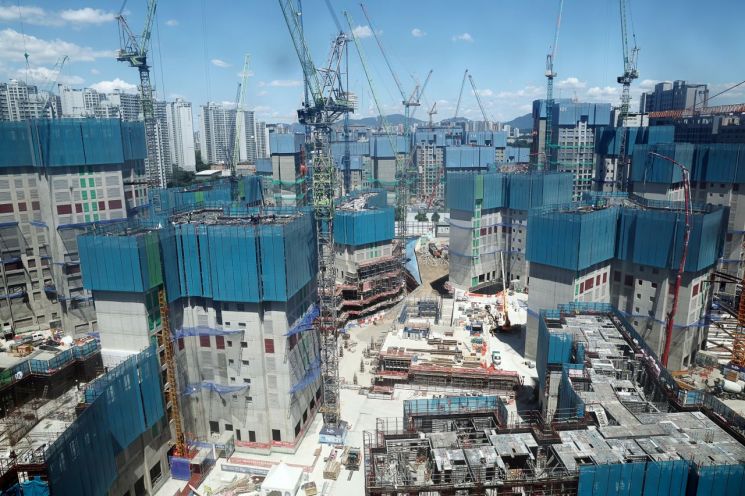
Special maintenance plans are established either directly by local governments or proposed and established by residents with more than 50% consent in the leading districts, according to the 'Old Planned City Maintenance Act.'
For the resident proposal method, the Ministry plans to establish a 'Cooperative Maintenance Support' procedure where residents and preliminary project implementers jointly establish the special maintenance plan. If a preliminary project implementer participates in the resident-proposed maintenance plan establishment process, the plan can be established more quickly. To this end, support will be provided to designate trust companies and Korea Land and Housing Corporation (LH) as preliminary project implementers when more than 50% resident consent is obtained. Previously, trust companies and LH could not qualify as project implementers before the maintenance plan was established and thus could not establish the plan.
The cooperative maintenance support procedure will also involve local governments. When residents and preliminary project implementers create a maintenance plan draft, the local government will provide advice to incorporate resident opinions. Furthermore, related departments within the local government will participate from the maintenance plan establishment stage to prevent any issues in subsequent reviews after the plan is established.
In November, the Ministry will distribute not only the special maintenance plan establishment fast track but also the 'Public Contribution Calculation and Operation Guidelines.' This is a measure to include public contribution plans when establishing maintenance plans. Accordingly, on the 20th, the Ministry held a briefing session on the public contribution guidelines for about 100 local government officials and private maintenance finance industry stakeholders.
Jung Woo-jin, head of the Urban Maintenance Planning Division at the Ministry of Land, Infrastructure and Transport, said, "We will cooperate in the evaluation process of local government proposals to ensure that leading districts are selected without delay by November. We will support the immediate commencement of special maintenance plan establishment upon selection of leading districts through the special maintenance plan establishment fast track."
© The Asia Business Daily(www.asiae.co.kr). All rights reserved.



















