Joint Exercises in Philippine EEZ with US, Australia
China's Southern Theater Command Also Conducts Regular Drills
China Criticizes "Destabilization of South China Sea"
On the 28th, as the United States began joint military exercises in the South China Sea with allies including the Philippines, China responded with its own drills involving naval and air force reconnaissance.
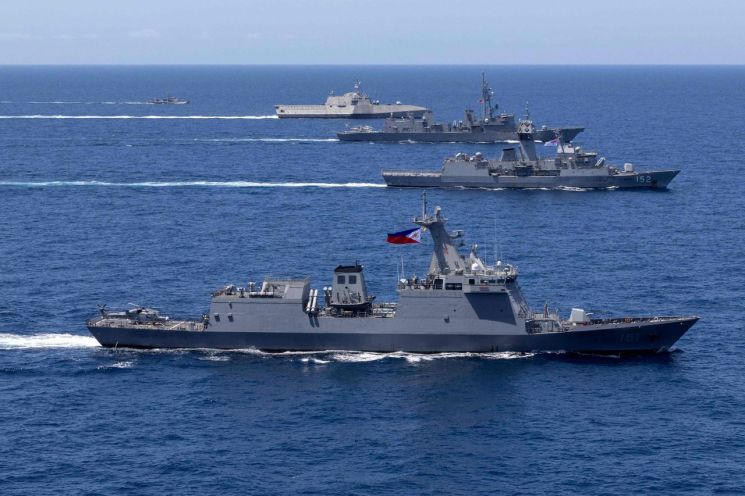 In April, the United States, Japan, Australia, and the Philippines conducted joint naval and air force exercises in the South China Sea. Photo by the Australian Department of Defense [Image source=Yonhap News]
According to Bloomberg News, the United States, along with Australia, Japan, New Zealand, and the Philippines, started joint military exercises within the Philippines' Exclusive Economic Zone (EEZ) in the South China Sea on the same day. The Australian Department of Defense stated in a press release that "maritime cooperative activities demonstrate our collective commitment to strengthening regional and international cooperation in support of a peaceful, stable, and prosperous Indo-Pacific." The statement also noted that the Australian Navy’s missile destroyer HMAS Sydney and Air Force P-8A Poseidon maritime patrol aircraft are expected to participate in the exercises.
The news agency reported that the exercises are being conducted amid rising tensions between China and the Philippines over territorial claims in the South China Sea. The United States mobilizing a large number of allies from Asia and Oceania for joint drills is largely aimed at countering China. China immediately responded with its own exercises involving the People’s Liberation Army. According to the state-run Xinhua News Agency, the Southern Theater Command of the Chinese People’s Liberation Army announced in a statement on the morning of the same day that "the navy and air force organized regular training including reconnaissance, early warning, maritime and aerial patrols near Scarborough Shoal (Chinese name Huangyan Dao)." The Southern Theater Command criticized that "certain individual countries outside this region are stirring up trouble and creating instability in the South China Sea."
The Southern Theater Command further asserted, "China holds indisputable sovereignty over Huangyan Dao and the surrounding waters," pledging to "maintain a high level of vigilance to firmly safeguard national sovereignty and maritime rights and interests, and resolutely protect regional peace and stability." While patrols around Scarborough Shoal are typically conducted by the Chinese Coast Guard, the involvement of the People’s Liberation Army is seen as unusual. China claims sovereignty over about 90% of the South China Sea, leading to disputes not only with the Philippines, Vietnam, Taiwan, Malaysia, and Brunei but also with the international community including the United States.
In particular, tensions with the Philippines have escalated sharply, with four clashes occurring within two weeks last month around the Spratly Islands in the South China Sea (Chinese name Nansha Qundao, Vietnamese name Truong Sa Qundao, Philippine name Kalayaan Islands). The joint exercises by the US and its allies and China’s counter drills are also notable as they come shortly after a diplomatic meeting between the US and Chinese foreign ministers.
On the 27th (local time), US Secretary of State Antony Blinken and Wang Yi, member of the Chinese Communist Party Central Political Bureau and Foreign Minister, held a bilateral meeting in New York where the South China Sea issue was a key topic of discussion. According to foreign media and the Chinese Ministry of Foreign Affairs, when Secretary Blinken expressed concerns about China’s risky and destabilizing actions in the South China Sea, Minister Wang retorted, "The US side should stop making trouble in the South China Sea."
© The Asia Business Daily(www.asiae.co.kr). All rights reserved.
![User Who Sold Erroneously Deposited Bitcoins to Repay Debt and Fund Entertainment... What Did the Supreme Court Decide in 2021? [Legal Issue Check]](https://cwcontent.asiae.co.kr/asiaresize/183/2026020910431234020_1770601391.png)















