Lowest Growth Rate Since February 2021
Increase in Personal Consumption Expenditure Slows
Indicates Possibility of Economic Deceleration
The inflation indicator emphasized by the U.S. central bank, the Federal Reserve (Fed), showed the slowest increase in 3 years and 6 months. Meanwhile, the growth rate of personal consumption expenditures slowed, indicating a potential slowdown in consumption.
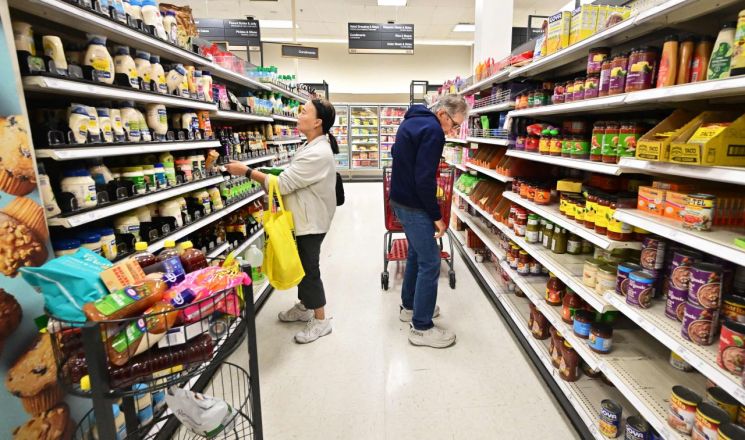
The U.S. Department of Commerce announced on the 27th (local time) that the Personal Consumption Expenditures (PCE) price index for August rose 2.2% compared to the same month last year. This figure is very close to the Fed's target of 2%, marking the lowest increase in 3 years and 6 months since February 2021 (1.8%). The month-over-month increase was 0.1%.
The month-over-month increase matched the expert forecast compiled by Dow Jones, but the year-over-year increase fell short of the forecast (2.3%).
The core PCE price index, which excludes energy and food, rose 2.7% year-over-year and 0.1% month-over-month. The month-over-month increase was below the expert forecast (0.2%), while the year-over-year increase met the forecast.
The month-over-month increase, reflecting recent inflation trends, remained within the range of 0.0 to 0.2% for both the headline and core indices over the past four months, not exceeding 0.2%. This suggests that the recent inflation trend, when annualized, is below the Fed's target of 2%. The PCE price index measures the prices paid by U.S. residents when purchasing goods and services.
The Fed uses the PCE price index as its benchmark indicator instead of the more widely known Consumer Price Index (CPI) when assessing monetary policy goals. This is because the PCE price index, which reflects changes in consumer behavior, is considered to provide more accurate inflation information than the CPI.
With inflation rates approaching the Fed's target level and the Fed having already initiated a rate-cutting cycle last week with a 'big cut' (0.50 percentage point rate reduction), market attention has shifted from inflation to economic and employment trends. The consumption expenditure growth rate announced on the same day fell short of expert forecasts, suggesting a potential slowdown in consumption.
The nominal personal consumption expenditure growth rate for August was 0.2%, significantly slowing compared to July's 0.5%. Real personal consumption expenditures also increased by only 0.1% month-over-month, a sharp slowdown from July's 0.4% increase.
© The Asia Business Daily(www.asiae.co.kr). All rights reserved.

















