Shigeru Ishiba (67), former secretary-general of the Liberal Democratic Party (LDP) who has revealed a 'dove' stance on Korea-Japan historical issues, has been chosen as Japan's next prime minister.
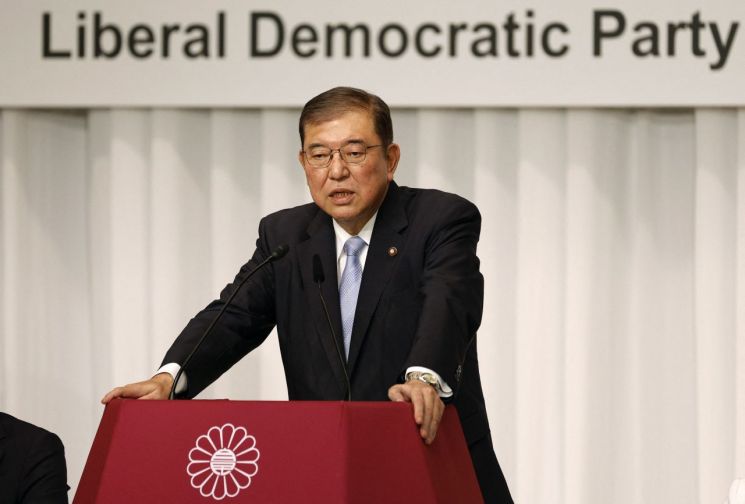
On the afternoon of the 27th, the ruling LDP announced that in the final vote count of the party presidential election held at the Tokyo party headquarters, former secretary-general Ishiba won a total of 215 votes, defeating Sanae Takaichi, Minister in charge of Economic Security, who received 194 votes, and was elected as the 28th party president.
In this presidential election, which had a record nine candidates, no candidate secured a majority in the first round of voting, leading to a runoff between the top two candidates, former secretary-general Ishiba and Minister Takaichi. Ishiba received 154 votes in the first round, trailing Takaichi's 181 votes, but succeeded in overturning the result in the runoff.
The runoff vote was conducted with a total of 415 votes, combining 368 votes from Diet members and 47 votes from local party organizations. Compared to the first round, the proportion of Diet member votes increased. Specifically, Ishiba received 189 votes from Diet members and 26 from local organizations, while Minister Takaichi received 173 votes from Diet members and 21 from local organizations.
Entering politics at the age of 29, Ishiba is considered a veteran politician with 12 terms and a policy expert within the LDP, having served twice as party secretary-general. He first joined the cabinet as Director-General of the Defense Agency under the Koizumi administration and has held positions such as Minister of Defense, earning a reputation for his expertise in defense issues.
Additionally, within the LDP, he is characterized by a 'dovish' historical perspective, differing from right-wing lawmakers. He is also negative about visits to Yasukuni Shrine, which enshrines Class A war criminals from the Pacific War. Furthermore, he has shown active willingness to improve Korea-Japan relations even when they have deteriorated.
However, Ishiba, who is considered relatively weak in factional battles within the party, has previously lost in four attempts at the party presidency. In the 2012 election, despite ranking first in the first party member vote, he was defeated by former Prime Minister Shinzo Abe, who consolidated his faction. Ahead of this presidential election, he appealed for the restoration of public trust, which had plummeted due to the LDP slush fund scandal. In a speech just before the runoff vote, he emphasized, "The LDP must be a party that follows the rules," adding, "The public may still not trust the LDP. We must build an LDP that trusts the people, does not run away, and speaks directly."
In Japan’s parliamentary system, the leader of the ruling party, which holds the majority, becomes the prime minister. The new party president is scheduled to hold a press conference at 6 p.m. that day. Subsequently, he will be nominated as the successor to Prime Minister Fumio Kishida at the extraordinary Diet session starting on the 1st of next month. A new cabinet is also expected to be announced on the same day.
© The Asia Business Daily(www.asiae.co.kr). All rights reserved.
![Clutching a Stolen Dior Bag, Saying "I Hate Being Poor but Real"... The Grotesque Con of a "Human Knockoff" [Slate]](https://cwcontent.asiae.co.kr/asiaresize/183/2026021902243444107_1771435474.jpg)
















