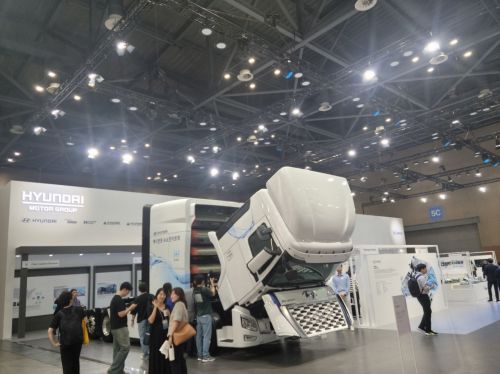
 Hyundai Motor Group is exhibiting a hydrogen truck using a hydrogen fuel cell at 'H2 Meat 2024'. Photo by Kang Hee-jong
"Our competitor is not the internal combustion engine but the fuel cell."
At the HD Hyundai Infracore booth set up at the global hydrogen expo 'H2 MEET 2024' held on the 26th at KINTEX in Ilsan, Gyeonggi Province, a company official said this while looking at the Hyundai Motor Company booth across the aisle. Hyundai Motor Company exhibited a large hydrogen electric truck, the Xcient, powered by a hydrogen fuel cell, in person at this event.
HD Hyundai Infracore introduced the 11.1ℓ-class hydrogen combustion engine 'HX12', an improved version of the existing compressed natural gas engine, at this exhibition. This engine is expected to be installed in commercial vehicles such as buses and large trucks. It is already being test-driven on Tata Daewoo trucks. HD Hyundai Infracore aims for mass production in the second half of next year.
The hydrogen mobility market has so far centered on hydrogen fuel cells for both passenger and commercial vehicles. However, recently, the hydrogen mobility market using hydrogen engines is gradually emerging. In Korea, HD Hyundai Infracore is expected to be the first to commercialize hydrogen engines.
Another reason why the company's moves are attracting attention is that it is forming a competitive structure with Hyundai Motor Group in the hydrogen industry. HD Hyundai Infracore is an affiliate of HD Hyundai Group led by Vice Chairman Jung Ki-sun. While Hyundai Motor Group is leading the hydrogen industry ecosystem centered on fuel cells, HD Hyundai Group has come out with hydrogen engines as a rival.
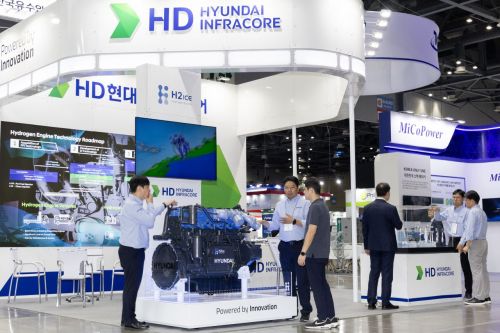 At the HD Hyundai Infracore exhibition hall at 'H2 Meat 2024,' visitors are examining a hydrogen engine. Photo by HD Hyundai Infracore
HD Hyundai and Hyundai Motor Group are also expected to compete in the clean hydrogen power generation market. The Ministry of Trade, Industry and Energy plans to open the clean hydrogen power generation market for the first time this year. Various technological methods such as hydrogen and ammonia co-firing, hydrogen fuel cells, and hydrogen engines will be applied to clean hydrogen power generation.
HD Hyundai Infracore is also developing hydrogen engines for hydrogen power generation and is currently testing them at the Gunsan engine test facility. The company plans to enter the clean hydrogen power generation market next year in collaboration with Korea East-West Power, Korea Western Power, and Pyeongtaek Urban Corporation.
Separately, HD Korea Shipbuilding & Offshore Engineering established HD Hydrogen, a hydrogen fuel cell specialized company, in August. Upon its establishment, the company acquired Conviron, a Finnish solid oxide fuel cell (SOFC) company, for 100 billion KRW. HD Hydrogen is also known to plan to enter the clean hydrogen power generation market. Previously, HD Hyundai Group announced the 'Hydrogen Dream 2030 Roadmap' in 2021. The plan was to complete the hydrogen ecosystem by 2030, including hydrogen production (HD Hyundai Oilbank), hydrogen transportation and storage (HD Korea Shipbuilding & Offshore Engineering, HD Hyundai Heavy Industries), and more.
Hyundai Motor Group, which has led the hydrogen mobility sector, is expanding into hydrogen production. Hyundai Motor Company, which had the largest exhibition booth at H2 MEET 2024 this year, prominently introduced not only fuel cells but also hydrogen production systems. This subtly emphasized that it covers the entire hydrogen ecosystem, including hydrogen production, storage, and transportation.
Green hydrogen produced by electrolysis of water using renewable energy, blue hydrogen converted from natural gas. Unlike gray hydrogen, Hyundai uses W2H (Waste-to-Hydrogen), which converts organic waste such as food waste into hydrogen, and P2H (Plastic-to-Hydrogen), which converts waste plastic into hydrogen. W2H is a technology that refines methanol generated from organic waste into biogas and then converts it into hydrogen, while P2H melts waste plastic and produces synthesis gas through a gasification process, which is then refined to produce hydrogen.
Hyundai Motor Company operates a W2H plant in Chungju, Chungbuk Province, capable of producing 500 kg of hydrogen per day, and is constructing resource-circulating hydrogen production facilities in Chungju, Chungbuk, and Paju, Gyeonggi Province, aiming for completion in 2025 and 2027, respectively. Hyundai is building a P2H plant in the SongSan 2 Industrial Complex in Dangjin, targeting completion in 2028, capable of producing 23,000 tons of hydrogen, 10,000 tons of pyrolysis oil, and 260,000 tons of carbon dioxide annually.
Hyundai is also constructing Korea's first water electrolysis-based hydrogen production base within the renewable energy theme park in Buan, Jeonbuk Province. Upon completion in 2025, it is expected to produce and store more than 1 ton of hydrogen per day using 2.5 megawatts (MW) of electricity. The hydrogen produced here will be supplied to research facilities and charging stations within Buan County.
Hyundai Motor Company is also eyeing the hydrogen power generation market. In 2021, Hyundai conducted a demonstration project in Ulsan by connecting two hydrogen fuel cell container modules capable of producing 500 kilowatts (kW) of power each, generating 8,000 MW of electricity annually. Hyundai plans to actively enter the hydrogen power generation business using this technology.
© The Asia Business Daily(www.asiae.co.kr). All rights reserved.


















