Gallup Poll
Yoon's Approval Rating Rises by 3%P
Negative Evaluation of 'Medical School Quota Expansion'
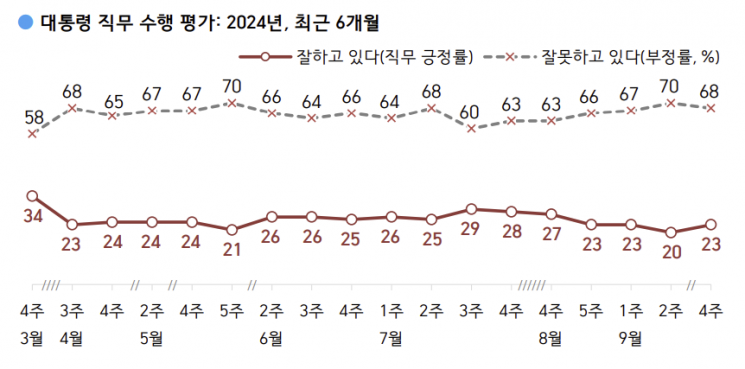
President Yoon Suk-yeol's approval rating slightly rebounded after two weeks, reaching 23%. It is analyzed that diplomatic activities such as his visit to the Czech Republic and securing nuclear power plant contracts positively influenced this evaluation.
According to a survey conducted by Gallup Korea from the 24th to the 26th among 1,001 adults nationwide aged 18 and older, the positive evaluation rate of President Yoon's job performance rose by 3 percentage points from two weeks ago to 23%. During the same period, the negative evaluation dropped by 2 percentage points to 68%.
As for the factors contributing to positive evaluations, "diplomacy" ranked first with 25%, up 10 percentage points from the previous survey. This was followed by "expansion of medical school quotas" (7%), "doing one's best/overall good performance" (6%), "securing nuclear power plant contracts" (5%), and "firmness and conviction" (4%).
Regarding negative evaluation factors, "expansion of medical school quotas" was the highest at 16%. This was followed by "lack of communication, economy, livelihood, inflation" (13%), "overall poor performance" (7%), and "issues related to First Lady Kim Keon-hee" (6%).
Respondents who said President Yoon is currently "doing well" were notably from the People Power Party supporters (60%) and those aged 70 and above (53%). On the other hand, those who responded that he is "doing poorly" were concentrated among supporters of the Democratic Party and the Justice Innovation Party (in the 90% range), as well as those in their 40s (84%).
By region, in Seoul, positive and negative evaluation rates were 23% and 68%, respectively. In Incheon and Gyeonggi, they were 21% and 70%; in Daegu and Gyeongbuk, 31% and 60%. The Busan, Ulsan, and Gyeongnam region recorded 27% and 64%, Daejeon, Sejong, and Chungcheong 26% and 61%, and Gwangju and Jeolla 8% and 82%, respectively.

Party support rates showed that the People Power Party rose by 3 percentage points to 31%, while the Democratic Party fell by 1 percentage point to 32% compared to two weeks ago. The non-partisan group, those without a preferred party, decreased by 3 percentage points to 23% during the same period. This was followed by the Justice Innovation Party at 8%, the Reform New Party at 4%, and the Progressive Party at 1%.
This survey was conducted via telephone interviews by surveyors using randomly selected wireless phone virtual numbers. The sampling error is ±3.1 percentage points at a 95% confidence level, and the response rate was 11.5%. For more details, refer to the Central Election Survey Deliberation Commission and Gallup Korea websites.
© The Asia Business Daily(www.asiae.co.kr). All rights reserved.
![Clutching a Stolen Dior Bag, Saying "I Hate Being Poor but Real"... The Grotesque Con of a "Human Knockoff" [Slate]](https://cwcontent.asiae.co.kr/asiaresize/183/2026021902243444107_1771435474.jpg)

















