Passage of Maternity Protection Act and Deepfake Prevention Act in National Assembly Plenary Session
Some Contentious Bills in Economic and Industrial Sectors Stalled
On the 26th, the National Assembly passed 83 non-controversial livelihood bills in the plenary session. However, some contentious bills that have been under discussion since the 21st National Assembly were not processed. This is why there are criticisms that economic and industrial bills, which have relatively minor differences in opinion, should be handled swiftly.
The 83 bills passed late in the afternoon on the 26th included the three maternal protection laws and the Deepfake Prevention Act. The three maternal protection laws refer to the amendment to the "Act on Gender Equality in Employment and Work-Family Balance Support," which extends spousal paternity leave from 10 to 20 days; the amendment to the "Labor Standards Act," which raises the age of children eligible for reduced working hours during childcare from the current 8 to 12 years; and the amendment to the "Employment Insurance Act," which extends the period of wage payment during spousal paternity leave. The Deepfake Prevention Act includes provisions to make penalties for distributing false videos equivalent to those for illegal filming.
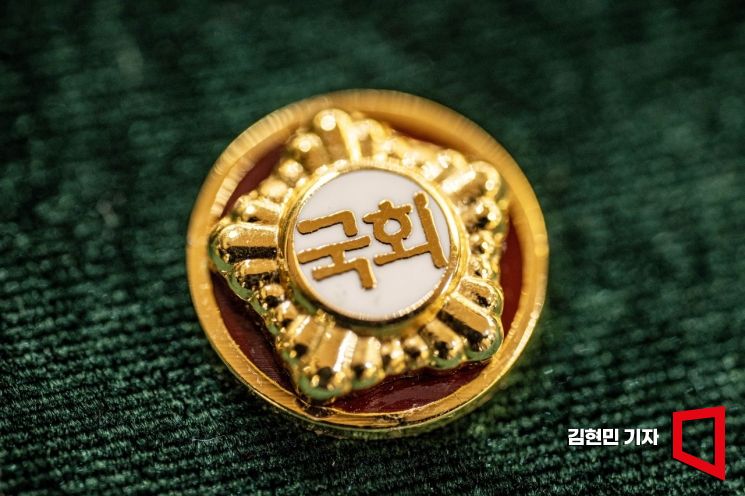 On April 8th, at the plaque unveiling ceremony of the 22nd National Assembly Opening Comprehensive Support Office held at the National Assembly Members' Office Building, 300 National Assembly member badges were unveiled. Photo by Hyunmin Kim kimhyun81@
In addition, bills submitted by various standing committees of the National Assembly passed the plenary session. These include the law to establish the Sejong District Court in Sejong Special Self-Governing City (Judiciary Committee), the law to expand the budget for the university "1,000 Won Breakfast" project (Education Committee), and the law to promote Hallyu support policies across ministries at a government-wide level (Culture, Sports and Tourism Committee).
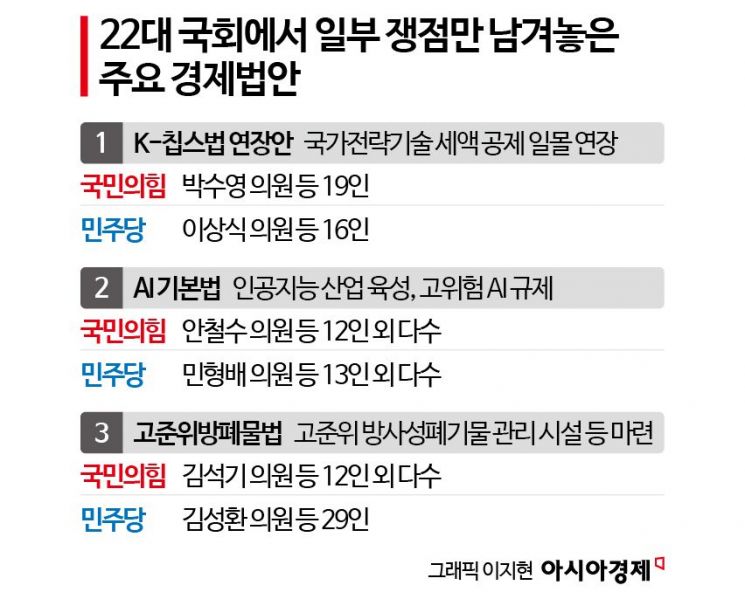
However, the extension of the K-Chips Act (amendment to the Restriction of Special Taxation Act), the Basic AI Act, and the High-Level Radioactive Waste Management Act (High-Level Radioactive Waste Act), which have been discussed since 2021, remain stagnant. Both ruling and opposition parties have introduced similar bills in the 22nd National Assembly. The K-Chips Act, which provides tax credits for industries classified as national strategic technologies such as semiconductors and secondary batteries, is set to expire at the end of this year. Lawmakers Park Su-young of the People Power Party and Lee Sang-sik of the Democratic Party have proposed bills to extend the expiration date of the K-Chips Act. The two bills differ only slightly in the tax credit rates.
Although the names vary, multiple bills related to the Basic AI Act have been proposed that aim to foster the AI industry while regulating high-risk AI. The "High-Level Radioactive Waste Act" and the "High-Level Radioactive Waste Disposal Act," which establish facilities and systems for managing high-level radioactive waste, are currently under review by the National Assembly's Industry, Trade, Energy, Small and Medium Enterprises Committee. The People Power Party predicted last month that these bills could be processed through bipartisan agreement.
The 22nd National Assembly reached agreements on the Nursing Act and the Special Act on Jeonse Fraud. Voices are emerging that the ruling and opposition parties should also strive for legislation in the economic and industrial sectors. Political commentator Park Sang-byeong said in a phone interview, "Looking at the recent situation, the ruling and opposition parties cannot help but be fully committed to livelihood issues related to the economy," adding, "Since it is during the regular session, bills with few disagreements should be processed quickly." This year's regular session began on September 2 and will end within 100 days.
© The Asia Business Daily(www.asiae.co.kr). All rights reserved.
![Clutching a Stolen Dior Bag, Saying "I Hate Being Poor but Real"... The Grotesque Con of a "Human Knockoff" [Slate]](https://cwcontent.asiae.co.kr/asiaresize/183/2026021902243444107_1771435474.jpg)

















