Minister Sang-min Lee Chairs Central Disaster and Safety Countermeasures Headquarters Meeting, Announces Structural Reform
20 Trillion Won Over 5 Years for First Phase of Medical Reform... 3.3 Trillion to Tertiary Hospitals
Focus on Specialists and PA Nurses... General Beds Likely to Be Reduced

The government will invest 3.3 trillion won annually in health insurance finances for the pilot project on the restructuring of tertiary general hospitals, which will be implemented from next month. In particular, the workforce structure of tertiary general hospitals will be reorganized to focus on specialists and physician assistant (PA) nurses, and general hospital beds will be reduced by up to 15%.
Lee Sang-min, the 2nd Deputy Head of the Central Disaster and Safety Countermeasures Headquarters (CDSCH) for the medical collective action (Minister of the Ministry of the Interior and Safety), presided over the CDSCH meeting on the 27th and announced detailed plans, stating, "Next month, we will fully implement the pilot project for the restructuring of tertiary general hospitals, one of the important tasks of medical reform."
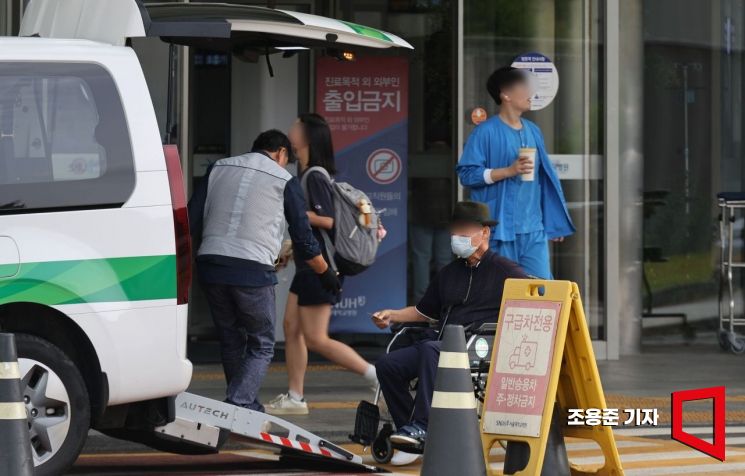 On the 24th, Seoul National University Hospital, which had entered an indefinite strike starting from the 17th, resumed normal medical services. Patients visiting the outpatient clinic at Seoul National University Hospital in Jongno-gu, Seoul, are seen moving for their appointments. Photo by Jo Yongjun jun21@
First, Deputy Lee stated, "The government will faithfully implement the first phase of medical reform measures, including the restructuring of tertiary general hospitals, and invest 20 trillion won over five years." This funding will be used for concentrated compensation for six priority areas: severe and high-difficulty essential treatments, emergency care, night and holiday care, pediatrics and childbirth, and medically vulnerable areas, as well as for training environment innovation and expansion of regional and essential medical services.
He also disclosed specific details about the pilot project for restructuring tertiary general hospitals. Deputy Lee explained, "The workforce structure of tertiary general hospitals will be reorganized to focus on specialists and physician assistant (PA) nurses," adding, "They will concentrate on high-difficulty treatments such as severe and rare diseases, and general hospital beds mainly used by mild patients will be reduced by 5 to 15%."
He continued, "To this end, 3.3 trillion won of health insurance finances will be invested annually, including increased fees for severe surgeries, a 50% increase in intensive care unit fees, and performance-based compensation," expressing expectations that "the pilot project will enhance the capacity to treat severe patients and establish a sustainable medical system, including emergency medical care."
On the same day, the government reiterated its commitment to medical reform. Deputy Lee referred to the recently released 2024 OECD health statistics, stating, "As of 2022, South Korea ranked among the lowest in the number of clinical doctors per 1,000 people among OECD member countries, alongside Mexico. Without increasing the insufficient number of doctors, it is difficult to secure the medical workforce necessary to normalize essential and regional medical care." He added, "The government is accelerating medical reform efforts, including increasing medical school admissions, so that citizens can receive high-quality medical services anytime and anywhere without worry," and urged, "We hope the medical community will also participate in medical reform to normalize the healthcare system of the Republic of Korea."
© The Asia Business Daily(www.asiae.co.kr). All rights reserved.


















