'Science and Technology Talent Growth and Development Strategy'
Strengthening Science and Career Education for Women from Elementary School
20% Quota for Female Executives in Public Research Institutes
Improvement to Allow Early Graduation from Gifted High Schools and University Admission
The government has announced a plan to nurture science and technology talent, including expanding the number of female STEM majors, establishing new gifted high schools, increasing admission quotas at the four major science and technology institutes, and improving the treatment of postdoctoral researchers (postdocs). However, some critics argue that these measures do not address the fundamental issues needed to increase the influx of STEM students.
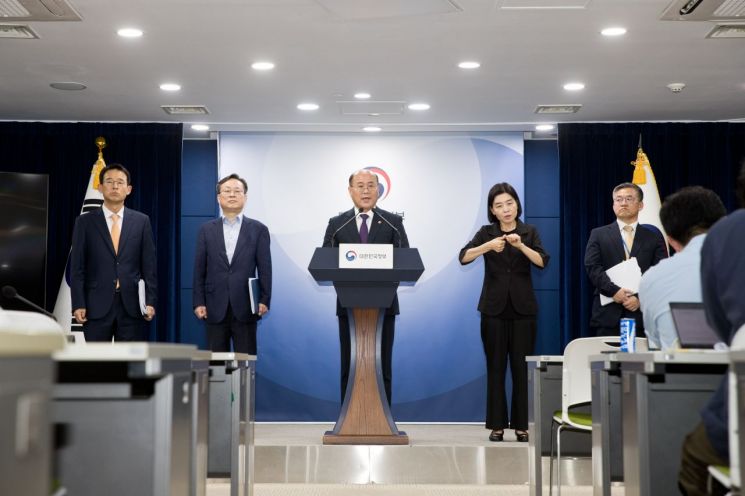 Lee Chang-yoon, the 1st Vice Minister of the Ministry of Science and ICT, is briefing on the plan for fostering science and technology personnel. Photo by Ministry of Science and ICT
On the 27th, the Ministry of Science and ICT announced the 'Science and Technology Talent Growth and Development Strategy' at the 3rd Talent Development Strategy Meeting. The Ministry of Science and ICT has been preparing this plan since March in collaboration with the Ministry of Education through a joint task force.
The Ministry of Science and ICT will first expand women's entry into STEM fields. From elementary school, STEM (Science, Technology, Engineering, Mathematics) education and career guidance will be strengthened to encourage female students to pursue STEM fields. A target system for female leadership positions will be introduced in public research institutions to increase the proportion of female leaders to over 20%. Lee Chang-yoon, the 1st Vice Minister of the Ministry of Science and ICT, stated in a briefing, "Currently, the proportion of female leaders is about 10%, but through this plan, we expect to achieve 20% by around 2023." To prevent career interruptions for female scientists due to childbirth and childcare, the reduced working hours system will be extended from the current 1 year to 3 years and applied to all research institutions by 2028.
The admission quotas for science high schools and science gifted schools will be gradually expanded through the establishment of new schools. In particular, the issue where students from science high schools can graduate early and enter university but those from gifted high schools could only do so when entering KAIST will also be addressed. Meister high schools will be expanded focusing on advanced technology fields to support early entry into society.
To strengthen talent development functions in the three major game-changer technologies and national strategic technology fields, the quotas for the four major science and technology institutes?KAIST, GIST, UNIST, and DGIST?are also expected to increase. Hwang Pan-sik, Director at the Ministry of Science and ICT, explained, "The ongoing improvement plan for the four major science institutes will include quota expansion." Research living allowances and master's specialized scholarships for STEM undergraduates and graduate students, which have already been announced, will proceed as planned.
Support for postdoctoral researchers (postdocs) will also be significantly expanded. Enrollment in the Science and Technology Personnel Mutual Aid Association will be promoted, and the hiring of postdocs at university-affiliated research institutes and the four major science and technology institutes will be expanded to about 2,900 over the next 10 years.
The Ministry of Science and ICT plans to allow university researchers to continue research after retirement and expand the beneficiaries of the 'Excellent Researcher System' and 'Post-Retirement Reemployment System' at government-funded research institutes. Regarding retirement age extension, the ministry plans to pursue it long-term based on social discussions. The ministry will also support retired or elderly scientists to engage in small and medium-sized enterprises or overseas official development assistance.
Regarding this plan, Lee Deok-hwan, Professor Emeritus at Sogang University, stated, "Restoring the honor of scientists who were accused as scapegoats during the R&D budget cuts is a priority. We need to increase regular positions rather than temporary postdoc jobs." Professor Lee emphasized that since high school science students are entering liberal arts universities to get into top-tier universities, "STEM development should focus on increasing undergraduate students rather than securing graduate students."
© The Asia Business Daily(www.asiae.co.kr). All rights reserved.
![Clutching a Stolen Dior Bag, Saying "I Hate Being Poor but Real"... The Grotesque Con of a "Human Knockoff" [Slate]](https://cwcontent.asiae.co.kr/asiaresize/183/2026021902243444107_1771435474.jpg)











