2 People Did Not Return by Final Return Deadline
Possible Illegal Stay According to Ministry of Justice Measures
Issues Including Poor Working Conditions and Actual Earnings
Two Filipino domestic workers who lost contact after leaving their accommodation during the recent Chuseok holiday did not return by the final deadline. According to additional measures by the Ministry of Justice, they may become undocumented immigrants.
On the 27th, according to Seoul City and the Ministry of Employment and Labor, the private agency that employed the domestic workers confirmed that they had not returned by the previous day and reported the unauthorized absence to the Ministry of Employment and Labor as a foreign employment change notification. Under current law, employers who hire foreign workers under the Employment Permit System (E-9) must report to the local employment office if the workers are absent without valid reason for more than five business days.
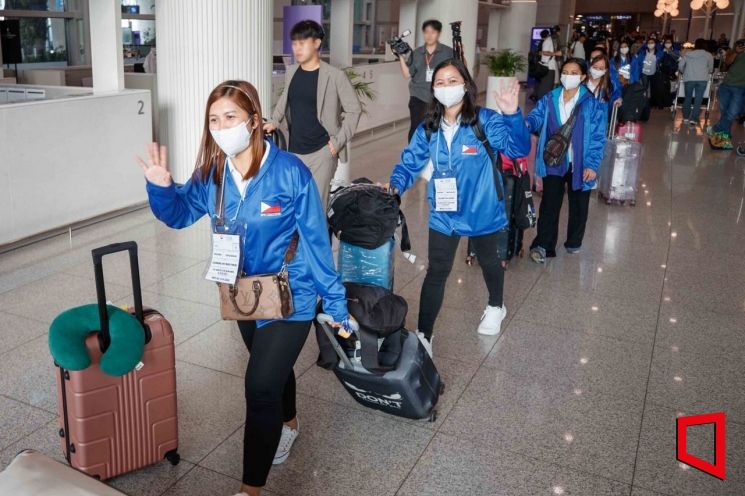 Filipino workers participating in the pilot project for foreign housekeeping managers are arriving through Incheon International Airport on the 6th. Photo by Gonghang Photojournalists Group
The final determination regarding illegal stay is made by the Ministry of Justice. The Ministry will locate the individuals and proceed with summons and other procedures before making a final decision.
Earlier, the workers left their accommodation in Yeoksam-dong, Gangnam-gu, Seoul on the 15th, during the Chuseok holiday, and contact was lost. The service provider confirmed the departure of the two domestic workers through CCTV, and Seoul City was notified of this on the 19th. Seoul City and the Ministry of Employment and Labor made various attempts to contact their families in the Philippines to facilitate their return, but the deadline was ultimately missed.
The exact reason for their departure from the site has not been revealed, but poor working conditions have been suggested. The domestic workers’ training allowances were not paid on time, and wages for this month are paid the following month, resulting in a low net income that likely caused financial hardship. According to the employment contract, the salary payment date is the 20th of each month, so wages for work done from the 3rd of this month will be paid next month. Domestic workers who only received training allowances have reportedly expressed economic difficulties. According to Seoul City, the allowance paid for training received from the 6th of last month to the 2nd of this month was 2,011,440 KRW, from which 539,700 KRW was deducted for accommodation and taxes, resulting in a net amount of 1,471,740 KRW. The workers received this amount in three installments on the 30th of last month, and the 6th and 20th of this month.
The time spent traveling between multiple households, which several domestic workers are responsible for, was also cited as a hardship. Some workers care for 3 to 4 households, and the travel time between homes is burdensome, leading to calls for assignments that consider the locations of the households.
There were also complaints about the domestic workers’ accommodation being operated with a "10 PM curfew." Although the curfew is not a guideline from Seoul City or the Ministry of Employment and Labor, nor a contractual matter, it is known to have been voluntarily implemented by the agency due to the nature of communal living.
In response, Seoul City has proposed improvements. To resolve the domestic workers’ financial difficulties and create a smoother working environment, Seoul City announced that it will coordinate with the Ministry of Employment and Labor to change the wage payment system from monthly to weekly pay.
For domestic workers caring for families with multiple children, additional allowances are also being considered. Kim Seon-soon, Director of the Women and Family Office at Seoul City, said, "There have been cases where a domestic worker had to care for a 20-month-old and a 5-year-old child in one household, which was challenging. Currently, Korean caregivers receive a 50% increase in the basic allowance when caring for two children. We plan to incorporate such measures into this project as well."
Meanwhile, to prevent further absences, Seoul City sent individual letters to domestic workers on the 19th. The message included, "We hope that the pilot project will operate well and lead to the main project, thereby extending your employment period and providing many opportunities for those who wish to come to Korea after you."
© The Asia Business Daily(www.asiae.co.kr). All rights reserved.
![Clutching a Stolen Dior Bag, Saying "I Hate Being Poor but Real"... The Grotesque Con of a "Human Knockoff" [Slate]](https://cwcontent.asiae.co.kr/asiaresize/183/2026021902243444107_1771435474.jpg)
















