100-Day Meeting of Han Gong Chairman's Inauguration
Emphasizing Design Purpose as "Investor-Friendly Tax"
Claims "No Immediate Substitute for Transaction Tax" if Deferred or Abolished
"There is a lot of 'fear marketing' claiming that the introduction of the financial investment income tax (Geumtu Tax) will cause the stock market to crash, but this is completely contrary to the facts. In fact, the Geumtu Tax is a tax that is friendly to (domestic stock) investors."
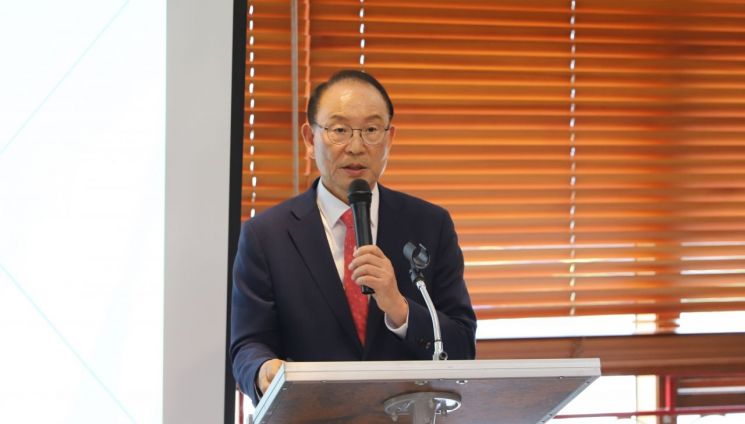
On the 26th, at a press conference commemorating the 100th day since the inauguration of the president of the Korean Institute of Certified Public Accountants (KICPA) held in Yeouido, Seoul, when asked about the Geumtu Tax, Choi Un-yeol, president of KICPA, responded this way. President Choi has been deeply involved in the Geumtu Tax bill to be implemented from next year and is called the "father of the Geumtu Tax." He said, "I am indeed the designer of the Geumtu Tax as mentioned in the media," and added, "The Geumtu Tax is a law designed to resolve the irrational aspects of the securities transaction tax and to make taxation investor-friendly, thereby supplying liquidity concentrated in real estate to the capital market. My conviction on this has not changed."
President Choi pointed out that the 'fear marketing' surrounding the Geumtu Tax is excessive. He said, "Although discussions have been ongoing for some time, whenever the Geumtu Tax is mentioned, the example of Taiwan is brought up, claiming that the stock market crashes," and added, "People always talk about timing, but who exactly judges what is good or bad timing?" He also said, "Recently, a high-ranking official said, 'It was necessary before, but not now,' so I clearly explained the necessity of the Geumtu Tax."
He cited the deduction limits in the Geumtu Tax?2.5 million KRW for overseas stocks and 50 million KRW for domestic stocks?and said, "If the tax is not introduced, capital outflow overseas will worsen," raising his voice, "Is there any tax as investor-friendly as this in our country?" He also pointed out that if the Geumtu Tax is postponed or abolished, there is no substitute to compensate for the revenue loss from the securities transaction tax, which is being phased out, warning that a 'tax revenue shortfall' will occur.
Regarding the 'Value-Up Program' incentive, which exempts companies with excellent governance from the periodic designation system for a certain period, Vice Chairman Yoon Chang-ho, who has been discussing this with government authorities, responded. Vice Chairman Yoon said, "We are still in the discussion phase, and no conclusion has been reached," adding, "We think it is appropriate to observe the results after at least one cycle (6+3) of the periodic designation system has passed and then prepare supplementary measures." In the accounting industry, there are ongoing concerns that the incentive system promoted by the authorities may undermine the periodic designation system, and KICPA is also showing a negative stance. President Choi was deeply involved in creating the periodic designation system and is nicknamed the "father of the periodic designation system."
There was also discussion related to the 'employment crisis.' This year, the number of certified public accountants who passed the exam reached a record high of 1,250, but even when combining the Big 4 accounting firms and local firms, the number of new hires is around 1,000, so about 200 people are struggling to find training institutions. Due to the nature of the CPA system, one must complete a training period of 1 to 2 years to obtain full CPA qualification. President Choi said, "Our role is to help new CPAs establish themselves as accountants," and added, "I have personally met with the heads of the Big 4 firms to plead for opportunities for young people, and if there are still those who cannot find employment, we are considering creating a training program within KICPA itself to accommodate them."
Meanwhile, KICPA is conducting research on CPA demand commissioned to the Korean Accounting Association. Before the Financial Services Commission finalizes the number of CPA recruits for next year in November, they plan to discuss with the authorities based on objective data. This is to prevent a recurrence of the confusion caused by the authorities' failure to predict demand, as happened this year.
© The Asia Business Daily(www.asiae.co.kr). All rights reserved.

















