Last Year’s US Visit Revealed Yoon’s Taste
‘Healthy Pleasure’ Spotlighted Since COVID-19
0kcal... Artificial Sweeteners Used Instead of Sugar
#1. “Bring some zero cola to Representative Han Dong-hoon.” President Yoon Suk-yeol requested a staff member at the Blue House to bring zero cola for Representative Han, who was repeatedly pouring only water into his soju glass during a dinner with ruling party figures last July. Zero cola is a beverage that Representative Han likes.
#2. “Here is President Yoon’s drink, zero cola.” When U.S. President Joe Biden hosted President Yoon and First Lady Kim Keon-hee during their state visit to the United States last April, he offered zero cola to President Yoon as he reached for a glass of grape juice. The Blue House explained at the time that “President Biden showed familiarity by thoughtfully recognizing and accommodating President Yoon’s usual preference for zero cola.”
Amid ongoing conflicts and confrontations over private meetings between President Yoon Suk-yeol and Han Dong-hoon, leader of the People Power Party, a common ground in their beverage preferences has become a hot topic. Both are known to regularly enjoy zero cola, which contains no calories and no sugar.
President Yoon’s love for zero cola is well known even in the U.S. During the state visit last April, President Biden offered zero cola, saying, “Here is President Yoon’s drink.” Representative Han, who is not good at drinking alcohol, also enjoys zero cola. On July 23, during a meeting with President Yoon, Representative Han raised a zero cola for a love shot.
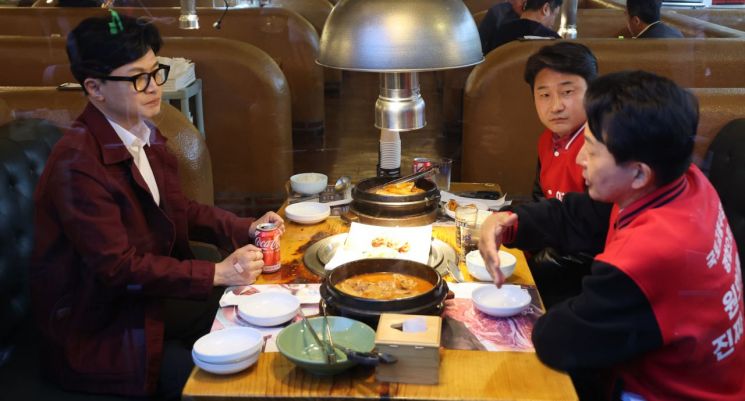 Han Dong-hoon, the leader of the People Power Party, is seen with a zero-calorie cola in front of him when he met candidate Won Hee-ryong at a barbecue restaurant in Gyeyang-gu, Incheon, on April 8 during the 22nd National Assembly election period as the party's emergency response committee chairman.
 [Photo by Yonhap News]
What is the charm of zero cola that they love so much?
Zero cola literally contains zero calories, sweetened with artificial sweeteners such as allulose, stevia, and aspartame instead of sugar. Because it contains less sugar and fewer calories than regular cola, it gives consumers hope that it can help with weight loss. It is popular among consumers who have high blood sugar or weak teeth and find it burdensome to drink regular cola with high sugar content.
The popularity of zero cola skyrocketed during the COVID-19 period. While the zero beverage market was worth about 210 billion KRW until 2021, it expanded more than threefold to about 600 billion KRW last year. This was influenced by the ‘healthy pleasure’ trend?a combination of health and enjoyment?that swept the beverage industry after COVID-19.
The growth of zero cola contrasts sharply with the sluggish growth rate of regular carbonated drinks. According to food industry statistical data, the domestic market size (sales value basis) of regular cola shrank at an average annual rate of -2.4% over five years from 2019 to last year. During the same period, zero cola’s average annual growth rate was 87.3%.
Domestic beverage manufacturers are leading market growth by improving the taste and quality of existing zero carbonated drinks and continuously launching various new products to meet consumer demand. According to the Ministry of Food and Drug Safety, if the calorie content is less than 4 kcal per 100 ml, it can be labeled as zero calorie. If the sugar content is less than 0.5 g per 100 ml, it can be labeled as sugar-free (zero sugar).
© The Asia Business Daily(www.asiae.co.kr). All rights reserved.

















