Bank of Korea's 'Financial Stability Situation' Report
The loan delinquency rate among vulnerable self-employed individuals remains high, highlighting the need for debt restructuring through programs such as the New Start Fund.
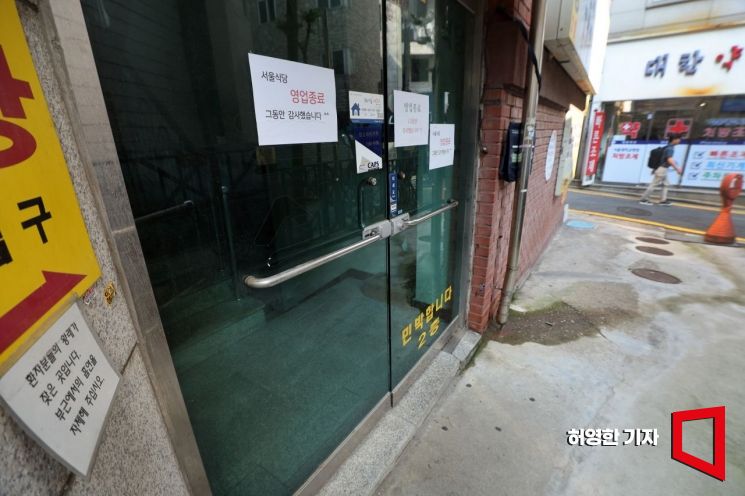 As the prolonged conflict between the government and the medical community causes many hospitals to face financial difficulties, pharmacies and small business owners in the surrounding commercial areas are also struggling. A closure notice is posted in front of a restaurant on a street near Seoul National University Hospital in Jongno-gu, Seoul, where pharmacies and restaurants are located. The owner said that the restaurant, which had been in business for 41 years, is closing due to the recession caused by the recent situation. Photo by Heo Younghan younghan@
According to the 'Financial Stability Report' released by the Bank of Korea on the 26th, loans to vulnerable self-employed individuals have been increasing recently. At the end of the second quarter of this year, loans to vulnerable self-employed borrowers (those who are multiple debtors with low income or low credit) amounted to 121.9 trillion won, an increase of 12.8 trillion won compared to a year ago. Accordingly, the share of loans to vulnerable self-employed individuals rose from 10.5% to 11.5% over the past year. There are a total of 410,000 vulnerable self-employed individuals, accounting for 13.1% of all self-employed borrowers.
However, the delinquency rate is rising. At the end of the second quarter, the loan delinquency rate for vulnerable self-employed individuals was 10.15%. This figure not only significantly exceeds the overall self-employed loan delinquency rate (1.56%) but also greatly surpasses the delinquency rate of non-vulnerable self-employed borrowers (0.44%). The delinquency rate for vulnerable self-employed individuals has steadily increased since the second quarter of 2022 (3.96%), reaching as high as 10.21% in the first quarter of this year.
The loan delinquency rates for self-employed individuals have increased in both household loans and individual business loans. Household loan delinquency rates rose from 1.07% in the first quarter of last year to 1.72% at the end of the second quarter this year. During the same period, individual business loan delinquency rates increased from 0.94% to 1.48%.
By sector, delinquency rates have risen rapidly, especially in non-bank loans. The delinquency rate for non-bank loans to self-employed individuals increased from 1.99% in the first quarter of last year to 3.30% in the second quarter of this year. This contrasts with bank loan delinquency rates, which rose modestly from 0.33% to 0.41% during the same period.
A Bank of Korea official stated, "Loans to vulnerable self-employed individuals have recently increased, and their delinquency rates remain high," but added, "Considering the sound resilience of financial institutions, the negative impact of rising defaults among these vulnerable self-employed borrowers on the overall financial system is expected to be limited."
He continued, "However, it appears that some differentiation is occurring recently among self-employed borrowers in terms of income and creditworthiness," and added, "Going forward, while selectively supporting self-employed borrowers based on their repayment capacity, it is necessary to take a more proactive approach to debt restructuring for some vulnerable self-employed individuals with low prospects of recovery through programs such as the New Start Fund."
© The Asia Business Daily(www.asiae.co.kr). All rights reserved.
![Clutching a Stolen Dior Bag, Saying "I Hate Being Poor but Real"... The Grotesque Con of a "Human Knockoff" [Slate]](https://cwcontent.asiae.co.kr/asiaresize/183/2026021902243444107_1771435474.jpg)
















