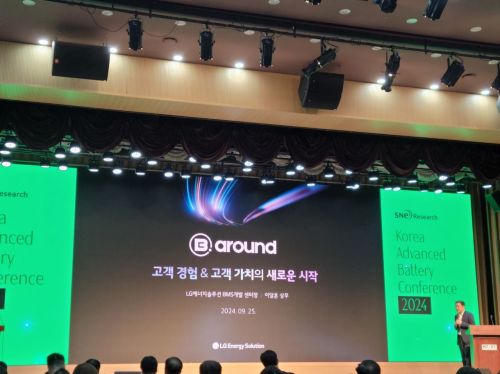
 Daehun Lee, Senior Vice President and Head of BMS Development Center at LG Energy Solution, is presenting at 'KABC 2204' held on the 25th. Photo by Heejong Kang
"China manages all vehicle data through the government and allows automobile and manufacturing companies to utilize it. We hope that regulations related to battery data will be improved in South Korea to foster the development of the battery industry."
LG Energy Solution, which is competing with China for the lead in the global electric vehicle battery market, has actively called for the relaxation of battery data regulations. Lee Dal-hoon, General Manager of the BMS Development Center at LG Energy Solution, spoke at the 'Korea Advanced Conference (KABC) 2024' held by SNE Research on the 25th at the Korea Science and Technology Center in Seoul, presenting the company's newly launched BMS brand, 'B.around.'
Recently, with electric vehicle fires raising concerns about battery safety, the advancement of Battery Management Systems (BMS) has emerged as a key solution. To develop an accurate BMS, data on the battery's condition during actual road driving is necessary. While China legally requires the government to collect this data and allows necessary companies to use it, domestic battery companies in South Korea find it difficult to access such data.
After his presentation, Lee told reporters, "China mandates the installation of telematics modules on all vehicles, enabling the government to collect and manage various data through them," adding, "South Korea also needs to improve its system so that related companies can access battery data to advance BMS."
Given this situation, LG Energy Solution is developing BMS relying on overseas data. Lee explained, "Domestic companies like Hyundai Motor are also reluctant to share driving battery data with battery cell companies," and added, "We are developing BMS by securing data from overseas automobile manufacturers."
BMS refers to a system that monitors data such as current, voltage, and temperature of the battery to help the battery perform optimally and detect abnormal signs in advance to prevent accidents. Sensors are attached to each battery cell, pack, or module, and managed through the vehicle's software (SW).
On this day, LG Energy Solution announced 'B.around,' an upgraded BMS that combines cloud and artificial intelligence (AI) functions to perform safety diagnostics and degradation/lifespan prediction. LG Energy Solution stated, "We are innovatively improving the existing BMS based on over 20 years of accumulated BMS design expertise, more than 8,000 overwhelming BMS-related patents, and various empirical data analyses."
LG Energy Solution explained that this service was developed based on empirical data from disassembling and analyzing more than 130,000 battery cells and over 1,000 modules. Lee Dal-hoon said, "It has already been applied to over 100,000 electric vehicles from more than 10 automobile manufacturers, achieving a safety diagnostic detection rate of over 90%, and the degradation diagnostic error rate is at the industry's top level of around 1%." Using these functions, it is also possible to predict the remaining battery life (SOH) about 2 to 3 years in advance.
LG Energy Solution is also developing a system-on-chip (SoC)-based BMS in collaboration with semiconductor companies such as Qualcomm. Lee explained, "As the automotive market evolves into software-defined vehicles (SDV), high-performance computing (HPC) chips are being installed in vehicles, enabling the implementation of various BMS functions that were previously limited by hardware (HW) specifications." LG Energy Solution expects to expand its business into various fields such as certification and battery reuse through cooperation with insurance companies and leasing firms.
© The Asia Business Daily(www.asiae.co.kr). All rights reserved.
![Clutching a Stolen Dior Bag, Saying "I Hate Being Poor but Real"... The Grotesque Con of a "Human Knockoff" [Slate]](https://cwcontent.asiae.co.kr/asiaresize/183/2026021902243444107_1771435474.jpg)
















