Hyundai Glovis will share car carrier ships (PCTC) and global container logistics operation infrastructure with Chinese electric vehicle company BYD.
Hyundai Glovis announced on the 25th that it signed a memorandum of understanding (MOU) with BYD for "strategic collaboration on logistics and finished vehicle maritime transportation business." The MOU signing ceremony held on the 23rd at BYD headquarters in Shenzhen, China, was attended by Kim Tae-woo, Head of Shipping Business Division (Executive Director) of Hyundai Glovis, and Wang Junbao, General Manager of BYD Shipping Business, along with other representatives from both companies.
Under this agreement, the two companies will explore cooperation on global container logistics operations and joint utilization of car carrier ship capacity.
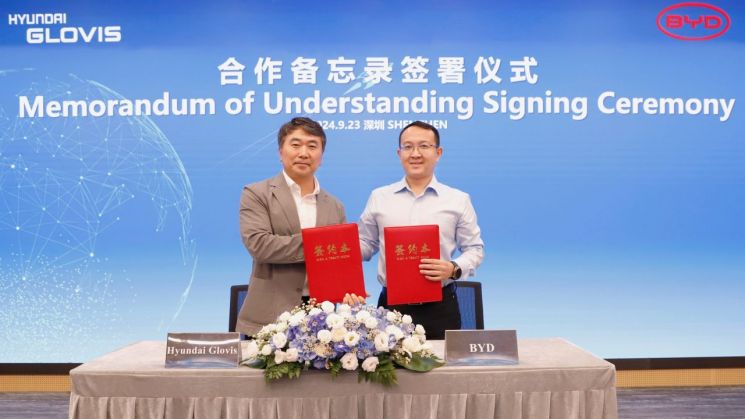 Kim Tae-woo, Head of Shipping Division at Hyundai Glovis (left), and Wang Junbao, Head of Shipping Business at BYD, are posing for a commemorative photo at the business agreement ceremony held on the 23rd at BYD headquarters in Shenzhen, China.
 [Photo by Hyundai Glovis]
First, in the logistics sector, they will discuss collaboration on container forwarding business utilizing Hyundai Glovis’s global logistics infrastructure and network. Forwarding refers to the process where a freight forwarding specialist company takes full responsibility for the entire transportation process from departure to arrival of cargo. Last year alone, Hyundai Glovis supplied over 320,000 40ft (12m) containers worth of automotive parts, batteries, steel products, equipment, and materials overseas.
In the finished vehicle maritime transportation sector, they will consider collaboration on jointly utilizing the car carrier ship capacity owned by BYD. Additionally, in the mid to long term, they plan to explore maritime transportation options for exporting BYD finished vehicles using Hyundai Glovis’s car carrier ships.
At the '2024 CEO Investor Day' held in June, Hyundai Glovis announced plans to expand the proportion of non-affiliated sales in the finished vehicle maritime transportation sector to around 50% over the next five years. While prioritizing affiliated volume transportation, the company aims to increase non-affiliated customers to achieve sales growth. To this end, they plan to increase their fleet from about 90 vessels currently to 128 vessels by 2030.
A Hyundai Glovis official said, "Based on mobility transportation competitiveness, we plan to expand logistics cooperation with global finished vehicle manufacturers."
© The Asia Business Daily(www.asiae.co.kr). All rights reserved.

















