IBS Climate Physics Research Group Conducts 100 Simulations of Past and Future Climate
Analysis of Future Permafrost Thawing Effects: "Arctic Wildfires to Intensify in the 21st Century"
As global warming accelerates the thawing of permafrost, wildfires in the polar regions of the Northern Hemisphere are expected to increase, with the resulting damage becoming more severe, according to a recent analysis.
The research team led by Axel Timmermann, Director of the IBS Center for Climate Physics at Pusan National University (Distinguished Professor at Pusan National University), collaborated with climate and permafrost experts to predict an increase in wildfires due to the acceleration of global warming using large-scale climate model simulation data. The study revealed that wildfires in the permafrost regions of Canada and Siberia are expected to intensify rapidly.
Recent observations show that unusually warm and dry conditions have led to even greater large-scale wildfire damage in the Arctic. Understanding how future human-induced global warming will affect the occurrence of Arctic wildfires is a critical issue in addressing climate change. To achieve this understanding, it is necessary to consider the role of soil moisture content?a key factor in wildfire combustion that is greatly affected by permafrost?and the acceleration of permafrost thawing.
However, previous wildfire studies have mainly calculated wildfire risk indices based on weather conditions, and related climate models have not sufficiently considered the interactions between global warming, permafrost thawing, soil moisture-wildfire dynamics, and vegetation changes.
To address this, the IBS research team used the Community Earth System Model (CESM), one of the most comprehensive Earth system models, for permafrost and wildfire analysis. This model is the first to integratively combine soil moisture, permafrost, and wildfire processes.
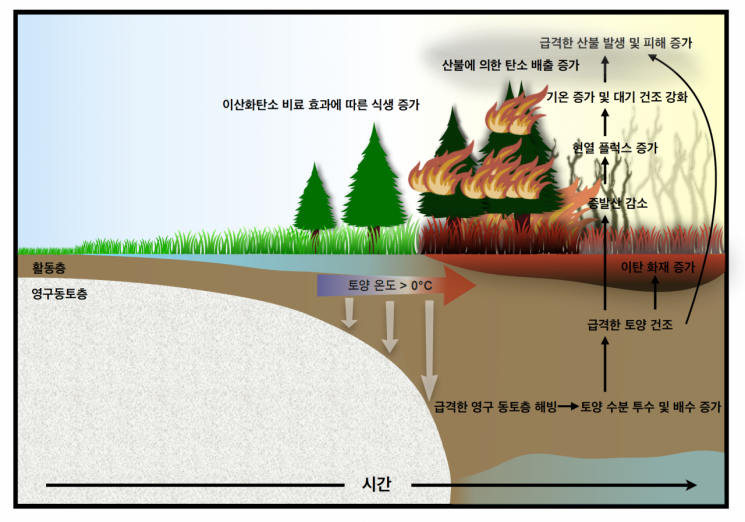 A schematic diagram of the enhanced mechanism of wildfires in the Northern Hemisphere polar regions due to rapid permafrost thawing caused by accelerated global warming.
The IBS research team and the National Center for Atmospheric Research (NCAR) in Colorado, USA, conducted large-scale ensemble simulations (100-member ensemble for the period 1850?2100 under the SSP3-7.0 greenhouse gas emission scenario) using the IBS supercomputer "Aleph" to clearly distinguish between climate changes caused by natural factors and those induced by human activities (such as increased greenhouse gas emissions). For a clearer explanation of the mechanisms, they selected and analyzed 50 ensemble simulation datasets under identical conditions.
The results predict that by the mid-to-late 21st century, about 50% of permafrost regions will experience rapid permafrost thawing due to human-induced warming (increased greenhouse gas emissions). This will cause a rapid increase in excessive soil moisture drainage in many areas, drastically reducing soil moisture. The resulting dry soil conditions, especially in summer, decrease evapotranspiration from the land surface, increase air temperatures, and make the atmosphere even drier.
Kim Inwon, IBS Research Fellow, stated, "These rapid changes in soil moisture and atmospheric conditions intensify wildfires. Our model simulations show that regions where wildfires rarely occurred could transition to areas experiencing intense wildfires in just a few years. Furthermore, the increase in atmospheric carbon dioxide concentration due to human activities promotes plant photosynthesis, increasing vegetation in high-latitude regions. This increased vegetation acts as fuel for wildfires, exacerbating wildfire damage."
Axel Timmermann, Director of the IBS research group, added, "Wildfires release carbon dioxide, black carbon, and organic carbon into the atmosphere. This not only affects the climate but can also further influence the permafrost thawing process in the Arctic. However, interactions between wildfire combustion products and the atmosphere are not yet fully incorporated into Earth system models, so we plan to study these aspects in greater detail in future research."
The research findings were published on September 25 (00:00 KST) in the international journal Nature Communications (IF 14.7).
 (From the top left clockwise) Inwon Kim Research Fellow (First Author), Axel Timmermann Research Group Leader (Co-author), Jieun Kim Research Fellow (Co-author), Sunseon Lee Research Fellow (Co-author).
© The Asia Business Daily(www.asiae.co.kr). All rights reserved.


















