IBS Research Team Analyzes Future Permafrost Thaw Impact
Permafrost Thaw Due to Accelerated Global Warming
"About 50% of Permafrost Areas to Thaw by Mid-to-Late 21st Century"
"Arctic Wildfires Intensify"
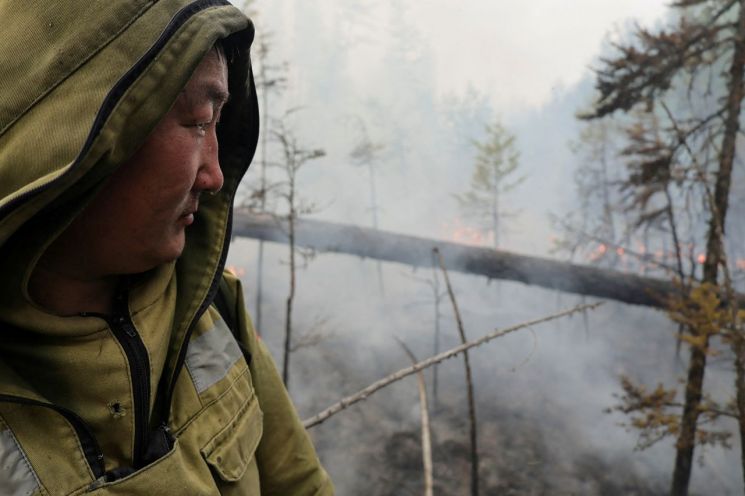 An expert from the Russian Forest Protection Agency shows a tired expression while suppressing a fire that occurred in the Siberian region.
 Photo by Reuters Yonhap News
Temperatures approaching 40 degrees Celsius are not just a problem unique to the Korean Peninsula. In Siberia, once a land of permafrost, heatwaves with temperatures nearing 40 degrees are occurring frequently. In this area, which was once permanently frozen, methane gas is being released from thawed soil, and wildfires are occurring regularly. There is a warning that if such cases become frequent, it will further accelerate global warming.
The Institute for Basic Science (IBS, President Noh Do-young) announced on the 25th that the research team led by Axel Timmermann, head of the Climate Physics Research Division (adjunct professor at Pusan National University), presented a forecast that the thawing of permafrost in Canada and Siberia due to global warming will accelerate, leading to an increase in wildfires in the Northern Hemisphere's polar regions and worsening damage.
This study provided important scientific evidence clearly showing the relationship between permafrost thawing and the increase in wildfires.
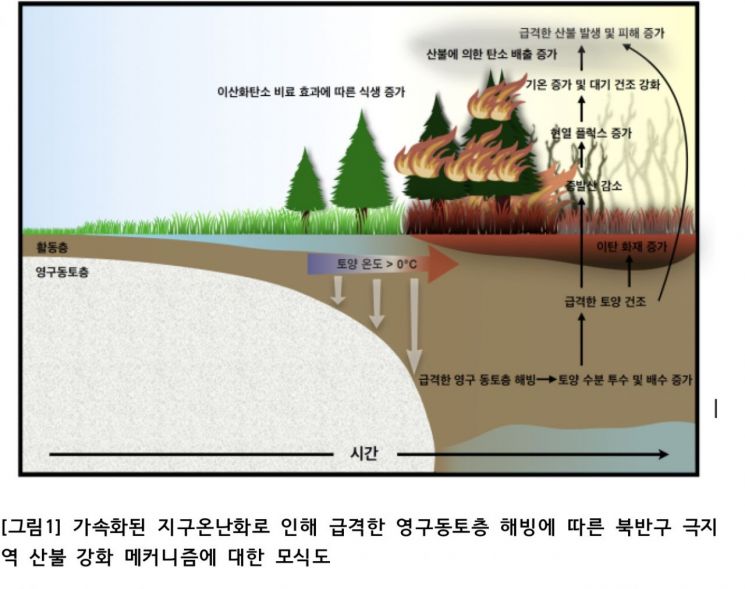
The IBS research team used the Community Earth System Model (CESM), one of the most comprehensive Earth system models, for analyzing permafrost and wildfires. This model is the first to integratively combine soil moisture, permafrost, and wildfire processes.
Using the IBS supercomputer 'Aleph' to analyze climate data, the research team estimated that about 50% of the Arctic permafrost will thaw by the mid to late 21st century due to the acceleration of global warming. When permafrost thaws, there is a rapid increase in excess soil moisture drainage and a sharp decrease in soil moisture. As a result, summer temperatures become higher and the atmosphere becomes drier. This means that the risk of wildfire occurrence increases further.
This study particularly provides a hint that permafrost thawing does not simply cause changes in the Arctic ecosystem but has a significant impact on the global climate system.
Axel Timmermann, head of the IBS Climate Physics Research Division, explained, “Wildfires release carbon dioxide, black carbon, and organic carbon into the atmosphere, which not only directly affect the climate but also influence the thawing process of Arctic permafrost,” adding, “Further research is needed to fully incorporate the interactions between combustion products from wildfires and the atmosphere into climate models.”
IBS Research Fellow Kim In-won stated, “Rapid changes in soil moisture and the atmosphere intensify wildfires, which can result in strong wildfires occurring even in areas where wildfires were almost nonexistent just a few years ago.” Kim explained, “The increase in atmospheric carbon dioxide concentration due to human activities promotes photosynthesis in plants, increasing vegetation in high-latitude regions, which serves as fuel for wildfires and exacerbates the damage.”
This study was published in the international academic journal Nature Communications. The IBS research team plans to conduct more in-depth research on the impact of emissions from wildfires on climate change in the future.
© The Asia Business Daily(www.asiae.co.kr). All rights reserved.
![Clutching a Stolen Dior Bag, Saying "I Hate Being Poor but Real"... The Grotesque Con of a "Human Knockoff" [Slate]](https://cwcontent.asiae.co.kr/asiaresize/183/2026021902243444107_1771435474.jpg)

















