On the 23rd (local time), the Israeli military launched hundreds of airstrikes targeting the Lebanese Shiite militant group Hezbollah in Lebanon, resulting in more than 492 deaths. Military clashes between Israel and Hezbollah have escalated, raising the possibility of a full-scale confrontation for the first time in 18 years since 2006.
According to AP News and others, the Israeli military stated in a press release that it carried out about 650 airstrikes over 24 hours targeting more than 1,300 Hezbollah facilities in southern and eastern Lebanon, where Hezbollah is based.
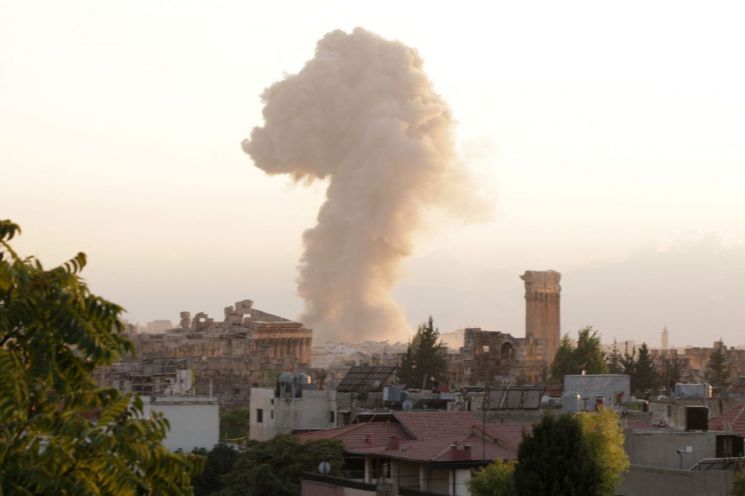
Local media reported that intense Israeli airstrikes were also witnessed in areas such as the Bekaa Valley in eastern Lebanon and Baalbek, located about 100 km from the Israeli border.
Yoav Gallant, Israel's Minister of Defense, said on the day that a "significant milestone" had been reached, adding, "We have destroyed tens of thousands of (Hezbollah) rockets and precision munitions." Israel estimates that Hezbollah possesses about 150,000 rockets and missiles.
In the evening, the Israeli military conducted a targeted airstrike in Beirut, the capital, aimed at Hezbollah senior commander Ali Karaki. This came four days after a targeted strike on the southern outskirts of Beirut on the 20th. Hezbollah stated that Karaki survived and moved to a safe location.
While the Israeli military claimed to have attacked Hezbollah facilities, civilian casualties surged due to the airstrikes that day.
The Lebanese Ministry of Health reported, "Due to Israeli airstrikes on villages in the south, Bekaa Valley, and Baalbek, 492 people have died, including 35 children and 58 women, and 1,645 have been injured." According to Lebanese government officials, this is the highest daily death toll since the Lebanese civil war from 1975 to 1990.
Firas Abiad, Lebanon's Minister of Health, said at a press conference, "Thousands of people have fled from the attacked areas."
AP News reported that this scale of casualties and displacement is the largest since the Israel-Hezbollah war in July-August 2006.
Since the outbreak of the Gaza Strip war in October last year until the recent pager explosion incident, about 600 people, including around 100 civilians, had died in Lebanon due to Israeli attacks. Since the pager and radio explosion incidents on the 17th and 18th, clashes between Israel and Hezbollah have intensified.
Israeli Prime Minister Benjamin Netanyahu has stated his intention to continue attacks on Hezbollah. At a security cabinet meeting that day, Netanyahu said, "I promise to change the balance of power and security in the north (adjacent to Lebanon)," adding, "This is exactly what we are doing."
According to AP News, in a video statement, Netanyahu urged Lebanese citizens to "take evacuation warnings seriously," assuring, "You will be able to return home safely once our operations are complete."
Daniel Hagari, the chief spokesperson for the Israeli military, said at a briefing, "We will conduct extensive and precise strikes on terrorist targets embedded throughout Lebanon," adding, "These airstrikes will continue for the time being."
When asked about the possibility of Israeli ground forces crossing the border to conduct operations in Lebanon, he replied, "We will do whatever is necessary to restore security in northern Israel."
Hezbollah also launched a counterattack. Hezbollah announced that it fired dozens of missiles toward Israeli military bases in northern Israel in response to the Israeli airstrikes. However, foreign media reported no specific information on Israeli casualties.
Nasser Kanaani, spokesperson for Iran's Ministry of Foreign Affairs and a supporter of Hezbollah, called Israel's airstrikes "madness" and warned, "The Zionists' (Israel's) new adventure will have dangerous consequences."
The Palestinian militant group Hamas condemned Israel's airstrikes in Lebanon as a "barbaric invasion and war crime," expressing solidarity with Hezbollah and the Lebanese people.
Ant?nio Guterres, Secretary-General of the United Nations (UN), said he is "deeply concerned" and urged all parties to "step back from the brink."
U.S. President Joe Biden, ahead of a meeting with Mohammed bin Zayed Al Nahyan, President of the United Arab Emirates (UAE), stated, "We continue to maintain contact with the parties involved and are working to de-escalate tensions." He also said he would discuss the Israel-Hezbollah clashes and the Gaza Strip war ceasefire with the UAE president.
The U.S. Department of Defense plans to deploy additional troops to the Middle East. Currently, the United States has about 40,000 troops stationed in the region.
© The Asia Business Daily(www.asiae.co.kr). All rights reserved.

















