Goolsbee "Long Way to Go"... Bostic Also Leaves Room for Big Cut
'Hawkish' Kashkari "Will Take Smaller Steps"
Interest Rate Futures Market Divided on Big Cut vs. Small Cut Outlook
"There is still a long way to go to lower the benchmark interest rate to a neutral level." vs "Smaller steps are expected."
Members of the U.S. Federal Reserve (Fed) show differing views on the pace of future interest rate cuts. Some members have left open the possibility of an additional 'big cut' (a 0.5 percentage point reduction in the benchmark interest rate), arguing that the restrictive rates are burdening the economy, while a prominent hawkish (monetary tightening-favoring) official within the Fed expects the pace of monetary easing to slow down. Uncertainty is increasing regarding the pace of future rate cuts by the Fed, which initiated a monetary easing cycle last week by lowering the benchmark interest rate from 5.25?5.5% to 4.75?5.0%, 30 months after starting rate hikes in March 2022.
'Dove' Goolsbee: "There is a long way to go to lower rates to neutral"... Bostic also leaves room for a big cut
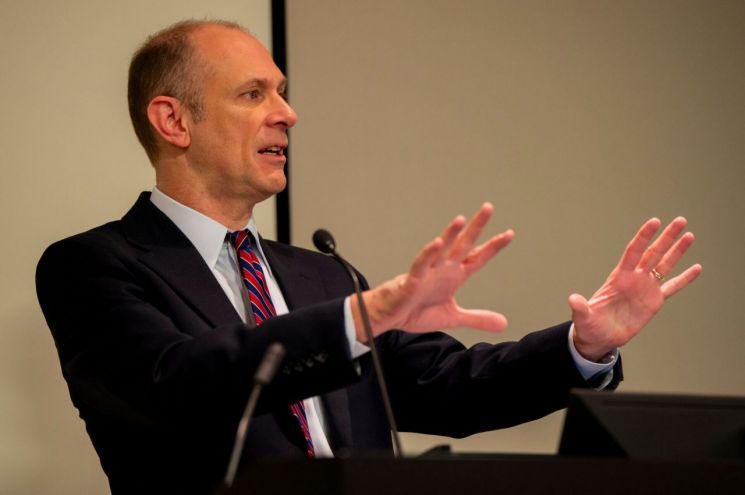
Austin Goolsbee, President of the Chicago Federal Reserve Bank, said at an event on the 23rd (local time), "The current benchmark interest rate is estimated to be several hundred basis points (1bp = 0.01 percentage points) higher than the neutral rate," adding, "There is a long way to go to lower rates close to neutral over the next 12 months to maintain the current situation."
The neutral rate is a theoretical interest rate level at which the economy can achieve its potential growth rate without overheating or recession.
He said, "Both employment and inflation are at good levels, but unless the Fed significantly lowers rates in the coming months, that state will not be maintained," and warned, "If restrictions are imposed for too long, we will no longer be able to stay at a good point in the dual mandate of price stability and full employment."
This is an argument that the benchmark interest rate should be lowered to the neutral rate level to prevent an economic downturn. The U.S. Consumer Price Index (CPI) inflation rate slowed from a peak of 9.1% in 2022 to 2.5% in August this year. Meanwhile, the unemployment rate has raised concerns about recession, rising from the 3% range in the first half of the year to the 4% range since July.
Goolsbee, considered a leading dove (favoring monetary easing) within the Fed, does not have voting rights at this year's Federal Open Market Committee (FOMC) but will have voting rights starting next year.
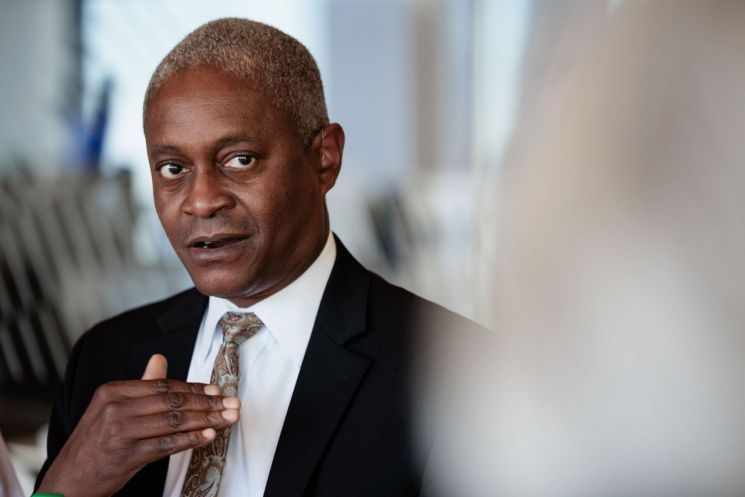
Rafael Bostic, President of the Atlanta Federal Reserve Bank, who has voting rights at this year's FOMC, also sees room for the Fed to cut rates to the neutral level. Although more cautious than Goolsbee, he left room for an additional big cut depending on future employment data.
At an event hosted by the European Economic and Financial Center that day, he said, "Progress on inflation and cooling of the labor market have occurred much faster than expected in early summer," adding, "I now expect monetary policy normalization to proceed faster than what was considered appropriate a few months ago." He explained the background of the big cut by saying, "Due to concerns about inflation, the Fed could have stayed with a relatively small first move last week, that is, a 25bp cut, but that would have denied the increased uncertainty about the labor market trajectory."
Regarding the labor market, he assessed that the risk of failing to achieve full employment has increased but said, "The red light has not yet turned on."
He emphasized, "The Fed is in a good position," and that the big cut has expanded the Fed's room for maneuver in monetary policy. He added, "If additional evidence emerges that the labor market has weakened substantially, views on how aggressive policy adjustments need to be in the future will change."
Kashkari: "Smaller steps will be taken"... Interest rate futures market evenly split between big cut and small cut forecasts
On the other hand, some Fed members ruled out the possibility of a big cut.
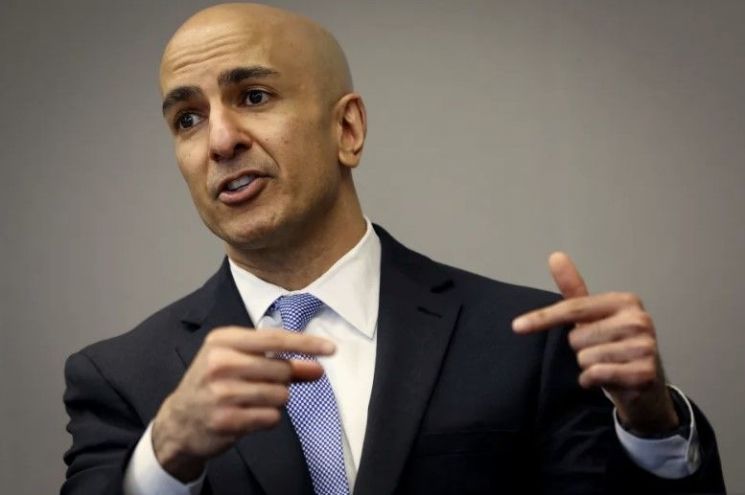
Neel Kashkari, President of the Minneapolis Federal Reserve Bank, said in an interview with CNBC that "unless the data changes materially, I expect smaller steps to be taken to balance things." He predicted that the next rate cut is more likely to be 0.25% rather than 0.5%.
He confirmed that the reason behind the big cut on the 18th was the Fed's judgment that its policy needed to be recalibrated from price stability toward employment focus. He explained, "Even after the 50bp cut, we are still in a restrictive position, so it was comfortable to take a big first step."
Kashkari said, "The labor market is currently strong and healthy, and I want to keep it that way," adding, "Many recent inflation indicators are on a path back to 2%, which is very positive."
However, Kashkari will only have speaking rights at the FOMC until 2026 and will not have voting rights on monetary policy decisions.
Additionally, Michelle Bowman, a Fed Governor, is also expected to argue for slowing the pace of rate cuts in a public speech scheduled for this week. Bowman was the only member to oppose the 0.5 percentage point rate cut at the FOMC on the 18th, advocating instead for a 0.25 percentage point cut.
As disagreements among Fed members over the size of future rate cuts have surfaced, the interest rate futures market is also evenly split between forecasts of a 25bp cut and a 50bp cut. According to the Chicago Mercantile Exchange (CME) FedWatch, the federal funds futures market on this day reflected a 50.5% probability that the Fed will cut rates by 0.25 percentage points at the November FOMC meeting and a 49.5% probability of a 0.5 percentage point cut.
© The Asia Business Daily(www.asiae.co.kr). All rights reserved.



















