All 22 Violations During 2 Years of Enforcement Found Guilty

Two years after the Serious Accidents Punishment Act (SAP Act) came into effect, courts have handed down guilty verdicts in all cases involving violations of the Act. However, prison sentences for CEOs accounted for only 3 out of 22 cases. The majority of punishments were suspended sentences.
According to data submitted by the Court Administration Office to Rep. Park Ji-won of the Democratic Party of Korea, since the SAP Act was enforced in January 2022 until last month, there have been 22 first-instance rulings on violations of the Act, all resulting in guilty verdicts. However, only 3 cases (14%) resulted in actual prison sentences for CEOs. Suspended sentences accounted for 19 cases (86%). In all 22 cases, fines were imposed on the corporations under the principle of joint punishment.
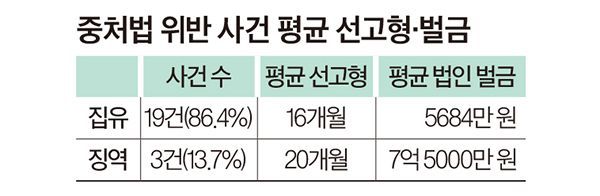
In April last year, the court sentenced Sung Mo, CEO of Korea Steel, to prison for the first time under the SAP Act. Sung was sentenced to one year in prison and was taken into custody in court. The Supreme Court upheld the original ruling last year. Subsequently, in April this year, Lee Mo, CEO of Emtech, was sentenced to two years in prison, and in August, Song Mo, former CEO of Samgang S&C, was sentenced to two years in prison (taken into custody) for violations of the SAP Act and related charges.
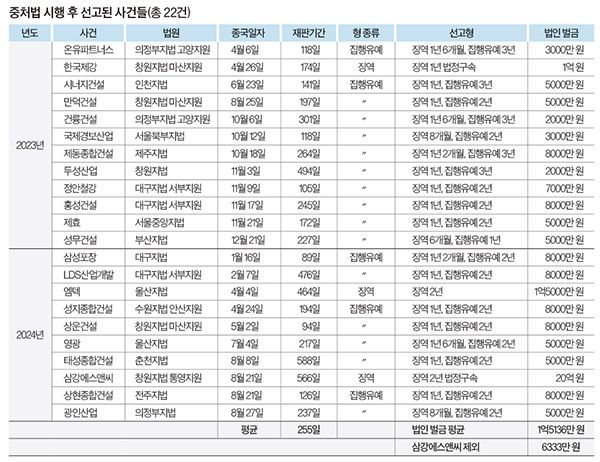
The Samgang S&C case involved the highest corporate fine. The Tongyeong Branch of Changwon District Court imposed a fine of 2 billion KRW on the corporation. The lowest fine for a corporation under the SAP Act was imposed on Geonryung Construction, which was fined 20 million KRW. Excluding Samgang S&C, the average fine imposed on the other 21 corporations for SAP Act violations was 63.33 million KRW.
The court took an average of eight months to adjudicate SAP Act violation cases. On average, about 255 days passed from the date the case was filed to the verdict. The longest trial period was in the Taeseong General Construction case, where the Chuncheon District Court took 588 days to reach a verdict. The shortest was the Samsung Packaging case, which concluded the first trial in 89 days. Both cases were handled by a single judge, and suspended sentences were given to the CEOs and others involved.
Legal circles evaluate that the purpose of the law has been sufficiently reflected during the two years since the SAP Act's implementation, but concerns about 'lenient punishments' still persist.
A lawyer from a major law firm who requested anonymity explained, “The more serious the case, the longer the trial tends to take, so prison sentences may appear fewer so far,” adding, “Since it is the early stage of the law’s enforcement, prosecutors may find it difficult to demand harsh sentences.”
Rep. Park Ji-won said, “The courts and prosecutors need to pay more attention to the legislative intent of raising social awareness.”
Lim Hyun-kyung, Legal Times Reporter
※This article is based on content supplied by Law Times.
© The Asia Business Daily(www.asiae.co.kr). All rights reserved.
![Clutching a Stolen Dior Bag, Saying "I Hate Being Poor but Real"... The Grotesque Con of a "Human Knockoff" [Slate]](https://cwcontent.asiae.co.kr/asiaresize/183/2026021902243444107_1771435474.jpg)


















