On the 23rd, Lucas Bednarski, author of Battery War, presented at the Korea Chamber of Commerce and Industry's 'Korea-US Industrial Cooperation Conference'
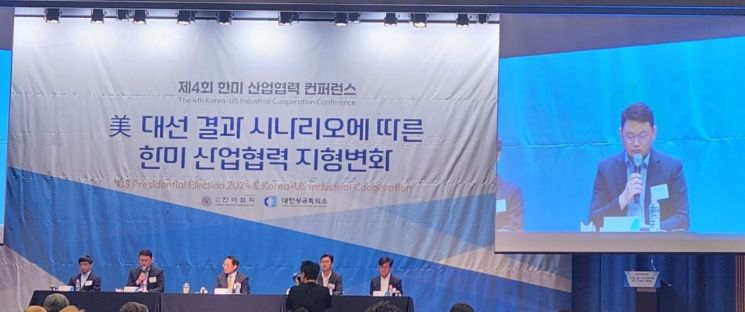 On the 23rd, participants are engaged in a panel discussion chaired by Professor Seo Jeong-geon of Kyung Hee University at the 'Korea-US Industrial Cooperation Conference' held at the Korea Chamber of Commerce and Industry in Jung-gu, Seoul. Photo by Jeong Dong-hoon
Renowned battery industry analyst and author of "Battery Wars," Lukas Bednarski, evaluated that former U.S. President Donald Trump views the electric vehicle and battery market not as an alternative to internal combustion engine vehicles but rather as a 'niche market.'
Trump's 'Cold Shoulder' to EVs vs. Harris' 'Electrification of School Buses'
On the 23rd, Bednarski spoke via video connection at the 'Korea-U.S. Industrial Cooperation Conference' held at the Korea Chamber of Commerce and Industry in Jung-gu, Seoul, stating, "Trump is skeptical about electrification and sees electric vehicles as only a 'niche market' rather than an alternative to internal combustion engine vehicles." He added, "He has mentioned several times that he would abolish EV subsidies, and there is a high possibility he would implement this if in office. However, such a decision cannot be executed by Trump alone; we need to see what Congress decides." He further noted, "If Trump returns to power, the benefits of the Inflation Reduction Act (IRA) would be reduced, which would also impact Korean battery companies."
Bednarski is the senior analyst for batteries at S&P Global, a market analysis and financial services firm. He is well-known for his book "Battery Wars," which covers the entire battery supply chain from raw material sourcing to cell production.
Concerns about the potential reduction of IRA benefits were widely expressed in the battery sector. Bednarski said, "The IRA is the most impactful legislation on U.S. manufacturing in recent decades. Over the two years since its enactment, about 125 projects across the supply chain, including lithium mines and battery factories, have been launched, with investments totaling approximately $95 billion (about 128 trillion KRW)."
While he predicted that Korean batteries would be affected if former President Trump were elected, Bednarski also foresaw continued benefits for Korean batteries if Vice President Kamala Harris were elected. He stated, "Harris links her policies to electrification, such as the electrification of school buses, and would pursue active EV policies. If elected, the overall battery policy, including the IRA, would be maintained." Vice President Harris has pledged to invest $1 billion annually over the next five years to electrify school buses.
Regarding bilateral cooperation, he added, "Korea's battery industry can utilize lithium mined by U.S. companies, and there is a need for joint research and development (R&D) between companies and universities of both countries, as well as ways for Korean battery-related startups to connect with U.S. venture capital."
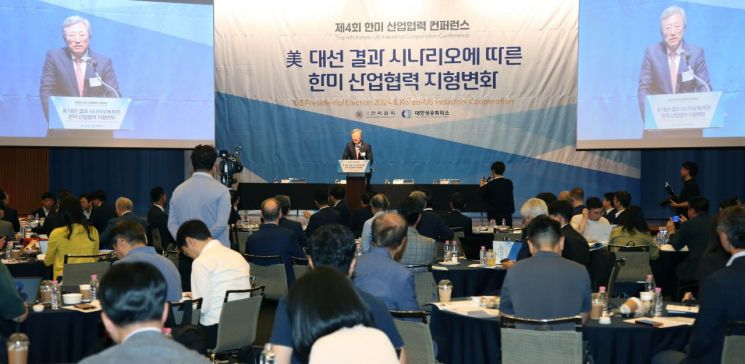 On the 23rd, Choi Jung-kyung, Chairman of the Korea-US Association, delivered the opening remarks at the "Korea-US Industrial Cooperation Conference" held at the Korea Chamber of Commerce and Industry in Jung-gu, Seoul. Photo by Korea Chamber of Commerce and Industry
Concerns Over Possible IRA Benefit Reduction Depending on Election Outcome... "Should Seize Opportunity for Supply Chain Internalization and Diversification"
In the subsequent panel discussion on the battery sector, Choi Jong-seo, General Director of the Korea Battery Industry Association, said, "If Trump is re-elected and uses executive authority to reduce IRA support, our companies will inevitably suffer. Although the pace of our companies' investments in the U.S. may adjust accordingly, considering the growth potential of the U.S. EV market, the scale of investment is unlikely to change significantly."
Choi also emphasized, "Given that supply chain internalization may become urgent depending on the U.S. election results, it is essential for the government to support narrowing the price gap with low-cost Chinese products by utilizing the Supply Chain Act enacted this year and to foster the domestic battery materials industry."
Hwang Kyung-in, Senior Research Fellow at the Korea Institute for Industrial Economics & Trade, expressed concern, saying, "Even if Trump wins, considering the strong Republican support in IRA beneficiary regions in the U.S., repealing the law will not be easy. However, if the IRA regresses due to executive authority, domestic companies' investments in the U.S., made with expectations of future profits, will be fully readjusted." He added, "Regardless of which candidate wins, the policy to decouple the battery supply chain from China is expected to continue, so internalization of battery raw materials and materials and diversification of procurement sources are necessary."
Park Jae-beom, Senior Researcher at POSCO Research Institute, said, "The decoupling supply chain policies of both candidates could actually be an opportunity for Korea. A shift from GVC (Global Value Chain) to TVC (Trusted Value Chain) is needed, and Korea can be the only alternative to China in the entire value chain from mineral processing to materials, batteries, and electric vehicles." Park emphasized, "The government should strengthen support for Korean companies in securing mineral resources, processing materials, and production to break away from dependence on the Chinese supply chain and become a key partner in the U.S. supply chain sector."
Jung Kyung-yoon, Director of the Sustainable Future Technology Research Division at the Korea Institute of Science and Technology, said, "The U.S. prioritizes the interests of its domestic companies, so, like Ford circumventing the IRA earlier this year by partnering with CATL, it will not completely exclude Chinese batteries." He added, "It is most important for companies and the government to secure technological superiority through focused technology development to compete with China." Jung further emphasized, "Efforts to decouple raw materials and materials from China are necessary to respond to the IRA, but more fundamentally, Korea must take the lead in these fields."
© The Asia Business Daily(www.asiae.co.kr). All rights reserved.
![Clutching a Stolen Dior Bag, Saying "I Hate Being Poor but Real"... The Grotesque Con of a "Human Knockoff" [Slate]](https://cwcontent.asiae.co.kr/asiaresize/183/2026021902243444107_1771435474.jpg)












