Park Ilha Dongjak-gu Mayor "Serious Low Birthrate, Basic Local Governments Must Set an Example"
First Adoption of 'Childcare Officials Working from Home Once a Week' Among 25 Seoul District Offices
Filial Piety Package Project and 10,000 Won Housing, 'Bulldozer Administration'
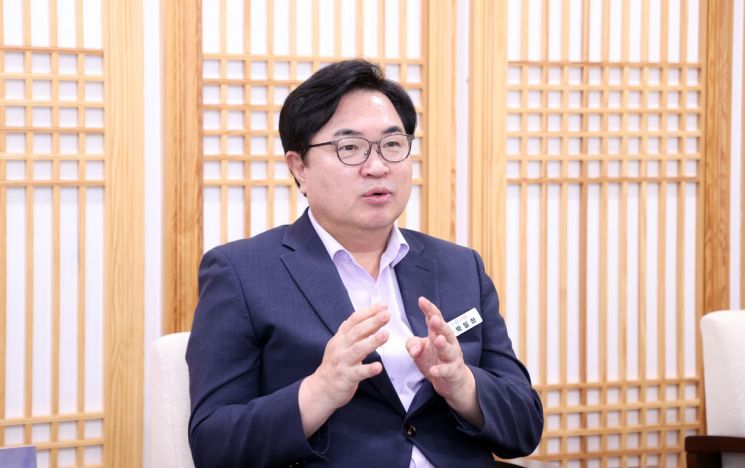 Dongjak District Mayor Park Il-ha emphasized the importance of prompt administration in an interview with Asia Economy on the 20th, stating, "First, you have to start the work to create alternatives and solutions." Provided by Dongjak District Office.
Park Il-ha, the mayor of Dongjak District, announced a somewhat groundbreaking policy last month. It was a rare move in the public sector: “Mandatory once-a-week remote work for public officials with childcare responsibilities.” Public officials with children under the age of eight are required to choose one weekday to work from home, and this policy was implemented starting in September.
Among basic local governments nationwide, only Dongjak District and Gongju City in Chungnam Province have mandated once-a-week remote work. Although Seoul Metropolitan Government also started enforcing mandatory once-a-week remote work for childcare public officials last month, the circumstances differ between metropolitan and basic local governments due to the nature of their work. This has raised concerns about whether it is realistically feasible, given the many civil service and field tasks typical of basic local governments.
On the 20th, in a meeting at the mayor’s reception room, Mayor Park Il-ha said, “We kept hearing the voices of employees struggling with childcare,” and added, “Public officials with childcare duties should be able to work from home at least one day a week to take care of their children.” Mayor Park explained, “Although it may seem that public officials only work during office hours and leave promptly, in reality, many are continuously involved in local events or work support during evenings or holidays. When there is heavy rain or snow, they must be on emergency standby day and night and go out to the field.”
Dongjak District has identified about 300 childcare public officials, which is one-fifth of the district office’s 1,500 public officials. However, by the second week of the first month of implementation, only 14 childcare public officials had applied for once-a-week remote work. The district believes that since it is still early in the implementation phase, many employees have not yet applied, and when excluding those whose duties make remote work difficult, the actual number of eligible applicants is much smaller than the total number of childcare public officials.
Other district offices in Seoul are closely monitoring Dongjak’s situation. The total number of public officials in Seoul’s 25 districts is about 40,000 (including those on leave and fixed-term employees), with an estimated 8,000 childcare public officials.
Regarding the reason for hastening the introduction of this policy, Mayor Park explained, “Due to low salaries and other working conditions, the popularity of public service has declined, and with the serious low birthrate issue, basic local governments need to set an example so that the central government can introduce more progressive policies.”
Mayor Park said, “My motto is to just get things done when necessary,” adding, “Only by starting something can alternatives and solutions emerge.” He also mentioned, “It would be ideal to have substitute personnel to cover any work gaps, but since budget and personnel are under the central government’s authority, the district office cannot prepare for that. However, it is not acceptable to only demand sacrifices from colleagues, so after operating the system for a few months, we will analyze the results and seek alternatives.”
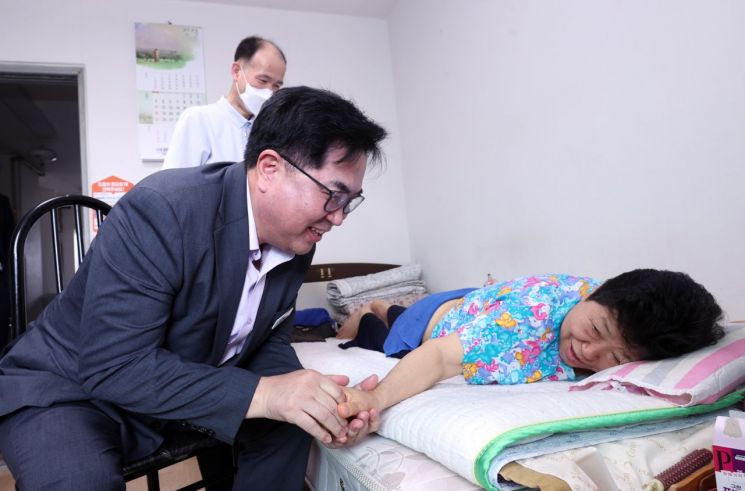 Park Il-ha, Mayor of Dongjak-gu, visited the first household receiving traditional Korean medicine care for the elderly. Provided by Dongjak-gu.
Mayor Park’s “bulldozer administration” is clearly reflected in Dongjak District’s policies over the past two to three years, which have earned “first” titles. The filial piety call center and taxi service launched last year have expanded this year into a “filial piety package” including traditional Korean medicine, laundry, and injections, gaining recognition as exemplary policies for local governments in an aging society.
Mayor Park said, “We established and operate Seoul’s first filial piety call center, which has successfully taken root amid praise as a ‘filial piety policy better than children,’” and added, “We will continue to develop the filial piety series.”
Policies such as affordable housing for youth and newlyweds, Dongjak-style jeonse rental housing, and the establishment of Korea Dongjak Corporation have also caused significant waves in the local community and are rare in other regions.
While constructing a new district office building, the district repurchased the Noryangjin Station area site previously sold to Korea Land and Housing Corporation (LH) to attract a prestigious British private school and build a premium residential complex including sports facilities such as ice hockey and swimming pools. Additionally, on the health center site, a premium healthcare silver town is being developed through a public-private partnership to prepare for aging and upgrade the area. These strategies are also results of his bulldozer-style administration.
© The Asia Business Daily(www.asiae.co.kr). All rights reserved.
![Clutching a Stolen Dior Bag, Saying "I Hate Being Poor but Real"... The Grotesque Con of a "Human Knockoff" [Slate]](https://cwcontent.asiae.co.kr/asiaresize/183/2026021902243444107_1771435474.jpg)












