Yeongdeungpo-gu Mayor Choi Ho-kwon Collaborates with Seoul Mayor Oh Se-hoon and Junior Director Lee Soo-yeon to Create Flower, Moss, and Waterway Gardens in Line with Seoul's Garden City Vision
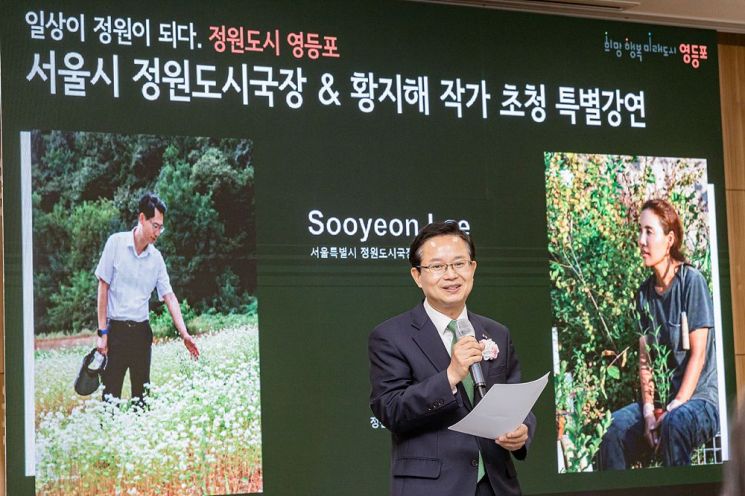 Choi Ho-gwon, Mayor of Yeongdeungpo District, is giving a greeting before the special lecture by a garden city expert.
Choi Ho-kwon, Mayor of Yeongdeungpo District, and Lee Soo-yeon, Director of the Garden City Bureau of Seoul, are drawing attention with their seamless cooperation.
Mayor Choi and Director Lee share common ground as senior and junior alumni of Seoul National University’s College of Agriculture and Forestry, and both began their public service careers in Seoul through the civil service exam. Notably, both have experience as public relations officers handling media affairs. After passing the administrative exam, Mayor Choi’s first position was as Director of the Culture and Public Relations Office at Yeongdeungpo District Office. Director Lee also served as the city’s media officer.
These two have been catching attention by working in perfect harmony under the theme of a garden city.
Since Mayor Choi’s declaration in May of Yeongdeungpo as a ‘Garden City’ and ‘City of Flowers,’ he has been accelerating garden creation efforts, starting with the flower garden in Mullae-dong, establishing a ‘Moss Garden’ in Dangsan Park in front of the district office, and creating a ‘Waterway Garden’ in Yeouido Sister Neighborhood Park (formerly Ankara Park).
To support these efforts, Director Lee Soo-yeon also gave a special lecture titled “Garden City Seoul” to Yeongdeungpo District Office employees.
On the afternoon of the 19th, Director Lee held a special lecture at the district office under the theme “Garden City Seoul Plan for Happy Citizens and a Happy Earth through Gardens,” targeting district office staff and village gardeners.
Before the lecture, Mayor Choi introduced her by saying, “Director Lee Soo-yeon is a charming garden planner who accompanies us. As the inaugural Director of the Garden City Bureau of Seoul, she not only draws a big picture for the future of making the entire city of Seoul one garden but also executes it. We are especially grateful that she visited Yeongdeungpo District.”
He added, “I am the mayor of Yeongdeungpo, creating a hopeful, happy, and future city. Last year, I added one more role as the mayor leading the realization of Garden City Yeongdeungpo. I have a favorite saying: ‘One hour spent in a garden is like one hour spent in heaven.’ To summarize, a ‘heaven on earth’?a garden is exactly that ‘heaven on earth.’ I am the mayor who wants to build Yeongdeungpo, where you live, into heaven on earth. With the Mullae-dong flower garden, the moss garden in Dangsan Park, the waterway garden in Yeouido Sister Neighborhood Park, Yeongdeungpo is leading among the 25 autonomous districts as a garden city. Together with the village gardeners here today, we will continue to create more,” he greeted.
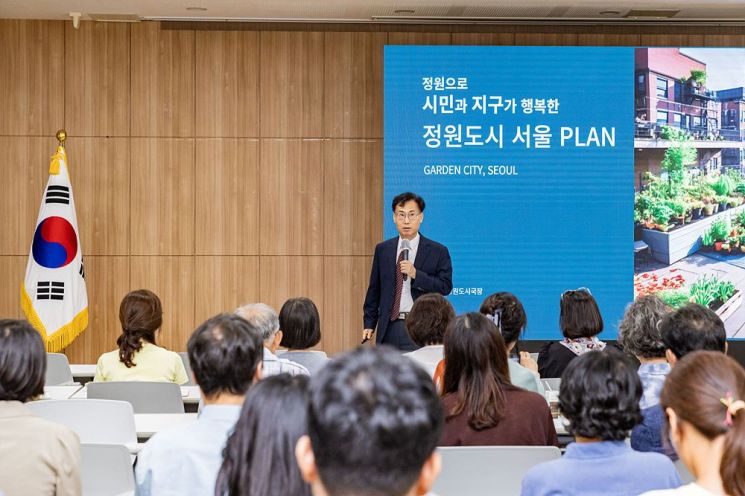
Following this, Director Lee Soo-yeon continued the lecture. Below is the content of her special lecture.
Based on my experience at Seoul Grand Park, when I was appointed as Director of the Garden City Bureau and talked about gardens, people only thought of flower beds. That is a simplistic view. Gardens are diverse and dynamic ecosystems with varied vegetation, mixed and three-dimensional spaces. When I said we should create gardens, people kept telling me to just make flowers. It took a long time to change this mindset. After becoming director at Seoul City, I realized the scale of staff was too large. So, I created the ‘Attractive Garden Creation Group’ on KakaoTalk. It includes 543 voluntary participants such as department heads and team leaders from the 25 autonomous districts working for the garden city.
Please remember the term ‘Biophilia.’ It means ‘living beings are inherently attracted to other living beings.’ Humans have a fundamental yearning for greenery and nature. Happiness does not come from well-made artificial structures alone.
When creating spaces, we must build a ‘Biophilia City.’ Life and people must be connected. When making artificial structures, natural vegetation must be organically integrated. This is an urban planning methodology. Currently, landscaping is considered secondary. However, spaces must connect people, trees, and nature.
Space planning should start with natural vegetation, artificial structures should be organically combined with natural vegetation, and the space should be finished with natural vegetation. Examples include the Van Boeninghen Museum, Azabu Dai Hills, and the Ford Foundation Building.
When a country’s per capita income exceeds $30,000, interest in gardens grows. Gardens have effects on tourism, society, and the economy. Gardening is essential for South Korea. The UK uses gardening to create tourist attractions, solve social problems, and maintain urban safety. In California, USA, inmates receive plant care education, reducing recidivism to 2%.
The German city of Buerishofen is a garden city. Doctors prescribe garden programs when patients fall ill. For example, “Since you are in the early stages of diabetes, attend gardening classes three times a week at the Garden Culture Center and do Nordic walking for an hour and a half.” After certification at the Garden Culture Center, results are sent to insurance companies, which then reduce premiums. Seoul City is also starting a citizen garden prescription program.
The most important aspect of a garden city is resident participation. Thanks to the village gardeners here today, gardens are changing. Since I arrived, I have been increasing MOUs with private sectors and companies. The public sector alone cannot do it. We must change together.
The most perfect carbon storage is trees. We have passed the critical point of climate companionship. So, I gave staff the idea that Arbor Day for the garden city is not April 5 but every day of the year. Trees must be planted daily. I hope everyone gathered here, along with citizens and companies, will unite their hearts to create Garden City Seoul.
Through this content, the necessity of creating a garden city with nature and tree planting was emphasized.
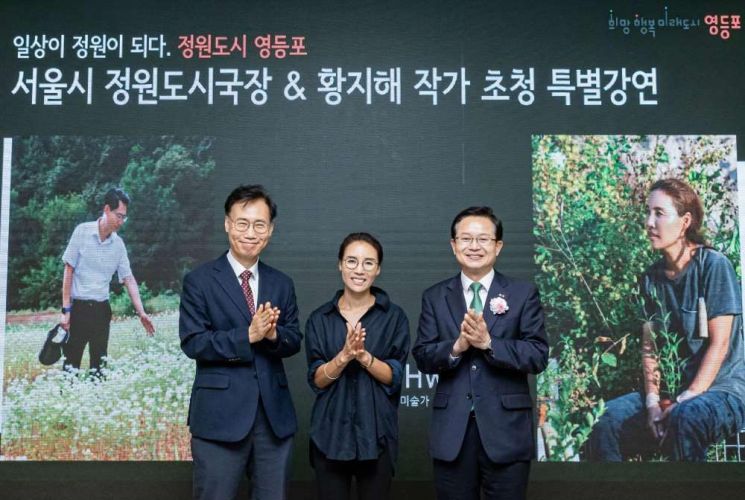 Choi Ho-gwon, Mayor of Yeongdeungpo District (right), took a commemorative photo with Lee Soo-yeon, Director of the Seoul Metropolitan Garden City Bureau (left), before Hwang Ji-hae's special lecture as a garden artist.
© The Asia Business Daily(www.asiae.co.kr). All rights reserved.



















