Swaycheu Glacier in Antarctica, Accelerated Melting
A study has revealed that the melting of Antarctica's Thwaites Glacier, known as the so-called 'Doomsday Glacier,' is accelerating even further as it rapidly melts away.
On the 20th, Yonhap News reported the findings of research conducted by American and British scientists, citing Bloomberg and DPA news agencies. It was confirmed that the melting rate of Thwaites Glacier, which is roughly the size of Florida, nearly doubled in 2010 compared to the 1990s.
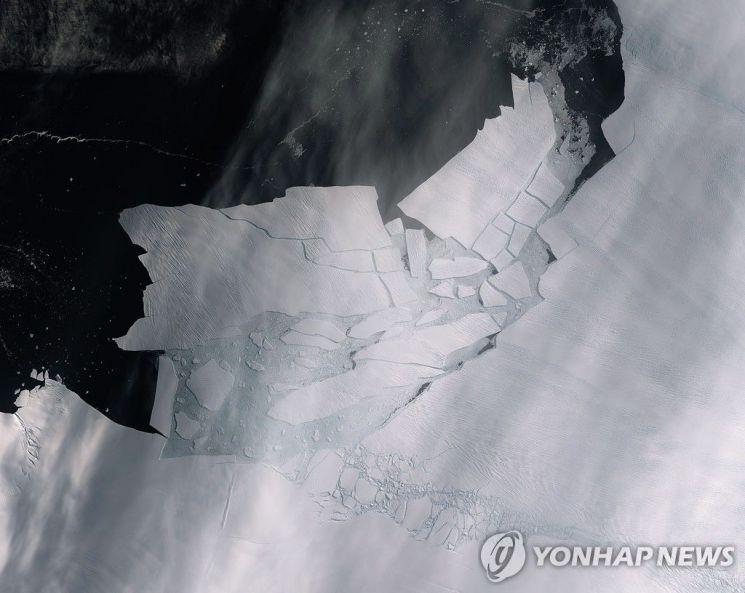
Thwaites is one of the largest glaciers in the world. It is particularly famous for melting the fastest due to the effects of climate change. Experts predict that if the Thwaites Glacier completely melts away, sea levels will rise by approximately 65 cm.
Recent computer simulations also indicate that the melting rate of Thwaites Glacier will accelerate further in the 22nd century, and by the 23rd century, the collapse of the entire West Antarctic Ice Sheet, to which this glacier belongs, is highly likely. If the entire ice sheet melts, sea levels will rise by a staggering 3.3 meters.
Experts expressed concern that if this glacier disappears, the melting rate could become uncontrollably rapid. This is because Thwaites Glacier acts like a kind of 'cork' for the entire West Antarctic Ice Sheet, most of which is submerged below sea level.
Dr. Rob Larter of the International Thwaites Glacier Collaboration (ITGC), which led the study, said, "Thwaites has been melting for over 80 years, but it has been melting particularly rapidly over the past 30 years," adding, "There is broad consensus that this rate will increase even more in the next century."
However, he also noted that frequent heavy snowfall in Antarctica might replenish some of the ice loss. Dr. Michelle McClenaghan, a member of the research team, pointed out, "The problem is imbalance," explaining, "The issue is that ice loss exceeds snowfall."
Previously, there was also a forecast that the glaciers on the highest peak of the Dolomites in northern Italy would completely melt within 16 years due to global warming.
According to a recent investigation by the Italian Glacier Committee, the thickness of the Marmolada Glacier, the highest glacier in the Dolomites, has decreased by 7 to 10 cm per day. Over the past five years, the area of lost glacier has reached 70 hectares, equivalent to 98 soccer fields. Since scientific measurements began in 1888, the glacier's boundary has retreated by 1,200 meters, and experts conducting the survey pointed out that "the Marmolada Glacier is in an irreversible crisis."
© The Asia Business Daily(www.asiae.co.kr). All rights reserved.

![User Who Sold Erroneously Deposited Bitcoins to Repay Debt and Fund Entertainment... What Did the Supreme Court Decide in 2021? [Legal Issue Check]](https://cwcontent.asiae.co.kr/asiaresize/183/2026020910431234020_1770601391.png)














