In Czech Interview: "Proof of Unwavering Nuclear Power Policy"
"Establishing North Korea Nuclear Deterrence and Response System Without Independent Nuclear Armament"
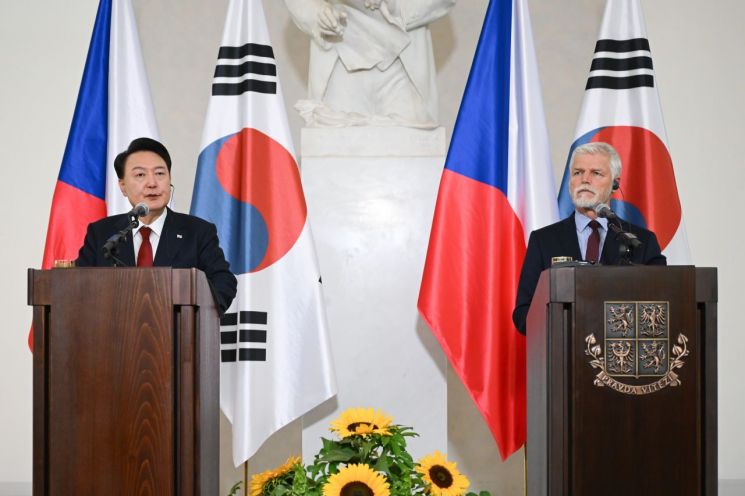 President Yoon Suk-yeol is speaking at the joint press conference between South Korea and Czech Republic held at Prague Castle, Czech Republic, on the 19th (local time), with Czech President Petr Pavel. [Image source=Yonhap News]
President Yoon Suk-yeol stated on the 20th, "Last week, we approved the construction of Shin Hanul Nuclear Power Plant Units 3 and 4, which had been halted for 8 years and 3 months, and immediately commenced the foundational excavation work." He added, "This signifies the complete restoration of the nuclear power ecosystem and is the strongest evidence of an unwavering nuclear power policy." He further emphasized, "The nuclear cooperation will serve as a catalyst to elevate the relationship with the Czech Republic to a higher level of comprehensive and future-oriented partnership."
During his official visit to the Czech Republic, President Yoon said in an interview with the Czech economic newspaper Hospod??sk? noviny released that day, "We plan to enact a 'Special Act on Supporting the Nuclear Power Industry' to ensure the steady growth of the nuclear power industry."
Regarding the future direction of nuclear policy, President Yoon evaluated, "The nuclear power ecosystem is successfully being revived through the abolition of the phase-out policy, resumption of new nuclear power plant construction, continued operation of existing plants, nurturing of nuclear personnel, and development of Small Modular Reactor (SMR) technology." He also stated, "Active utilization of nuclear power is essential to strengthen the competitiveness of key industries while simultaneously achieving policy goals such as climate change response and energy security," and added, "I believe there is also a national consensus on this."
On Korea-Czech economic cooperation, he mentioned, "It should expand and develop into clean energy development centered on nuclear power and future advanced industries." President Yoon said, "The Czech Republic is a hub for transportation and logistics connecting Eastern and Western Europe," and expressed expectations for cooperation with Korean high-speed rail companies, well known for 'Fast and Safe' construction and operation, in the Czech high-speed rail projects.
He continued, "The Czech Republic is an industrial powerhouse in Europe with a solid manufacturing base, and Korea also has a manufacturing foundation, so there is great potential for cooperation in advanced industries such as batteries, advanced robotics, and future vehicles." He explained, "We plan to institutionalize economic cooperation between the two countries by signing a Trade and Investment Promotion Framework (TIPF) between governments and establishing a government-to-government working consultation channel for cooperation."
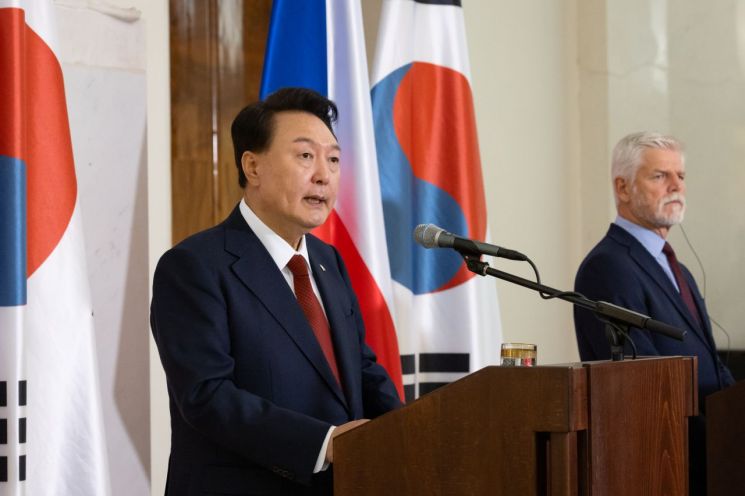 President Yoon Suk-yeol is speaking at the joint press conference between South Korea and Czech Republic held at Prague Castle, Czech Republic, on the 19th (local time), with Czech President Petr Pavel.
 [Image source=Yonhap News]
President Yoon evaluated, "South Korea's defense industry exports, which were around $3 billion (3.9464 trillion KRW) until 2021, have shown high growth, reaching an average of $15 billion (19.9305 trillion KRW) annually since the current administration took office," adding, "This is widely recognized because our equipment has been developed to respond to the actual threat from North Korea, proving the reliability of our weapon systems."
Regarding the self-nuclear armament theory raised by some, he emphasized, "A 'Korea-US integrated extended deterrence system' has been established to effectively deter and respond to the North Korean nuclear threat," and stated, "We will continue to strengthen the alliance's extended deterrence capabilities together with the United States."
In particular, President Yoon said, "In response to North Korea's nuclear threat, strengthening our own defense capabilities along with enhancing the execution of Korea-US extended deterrence is the best strategy. During the state visit to the US in April last year, the establishment of the Nuclear Consultative Group (NCG) was decided through the 'Washington Declaration,' and currently, Korea and the US are jointly advancing not only nuclear strategic planning but also integrated nuclear and conventional (CNI) joint execution," adding, "A system capable of effectively deterring and responding to the North Korean nuclear threat without self-nuclear armament has been established."
When asked about the impact of sanctions against Russia on the Korean economy, he said, "We are taking measures such as expanding export controls against Russia in solidarity with Ukraine and the international community, responding to Russia's illegal invasion and military cooperation between Russia and North Korea, which violates United Nations (UN) Security Council resolutions." He added, "Since the outbreak of the Ukraine war, trade volume between South Korea and Russia has significantly decreased, and Korean companies are facing difficulties, but our government will continue international cooperation to uphold peace as a responsible member of the international community."
Regarding Korea-US-Japan cooperation, he said, "Following the Korea-US-Japan summit at Camp David last August, a trilateral cooperation system has been established to strengthen efforts to promote security and peace in the Indo-Pacific region."
President Yoon stated, "Challenges to the international order based on freedom, human rights, and the rule of law are increasing, especially when pursued through force and coercive diplomacy, the need for cooperation among Korea, the US, and Japan, partners in values and interests, will grow even more," and added, "We will continue to concretize higher-level bilateral cooperation, including Korea-US-Japan cooperation."
Meanwhile, V?t?zslav Jonas, chairman of the Dukovany Regional Council, where two Czech nuclear power plants are planned to be constructed, published an op-ed in the same newspaper on the 20th (local time) titled "The Regional Council Supports the Czech Government's Decision," emphasizing cooperation between the two countries by stating, "If there are problems, we must actively resolve and eliminate them together, and we must strive to prevent the spread of speculation and negative rumors."
Chairman Jonas said, "The construction of two nuclear power plants will not only guarantee the Czech Republic's energy security but also bring significant benefits to the economy and environment," and mentioned, "This project should be a joint effort between Korea and the Czech Republic. Acquiring abundant know-how in the nuclear field is an expected benefit of this cooperation."
© The Asia Business Daily(www.asiae.co.kr). All rights reserved.


















