BMW Unveils iX5 Hydrogen Test Drive Site
"Expanding to Various Models After 2028 Mass Production"
German automaker BMW has announced plans to launch various hydrogen fuel cell vehicles after 2028. It is expected to play a crucial role alongside battery electric vehicles in realizing carbon-neutral mobility. Among European car manufacturers, BMW has shown early interest in hydrogen technology and has indicated its intention to collaborate not only with Toyota but also with Hyundai during the development process.
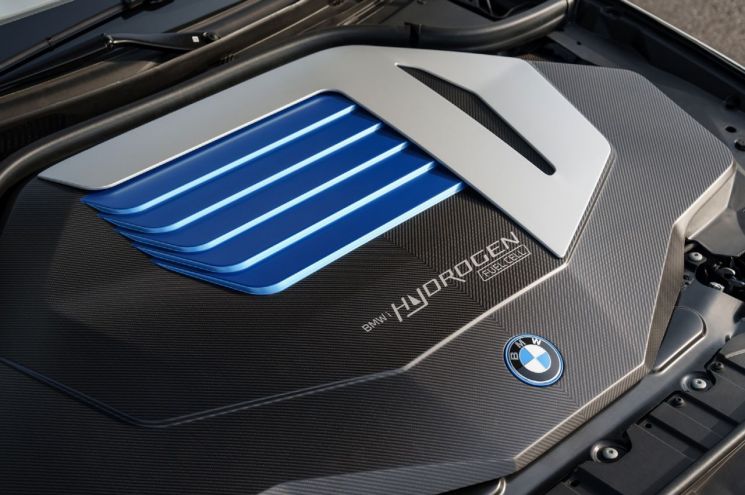
On the 19th (local time), BMW unveiled to Korean reporters the pilot hydrogen fuel cell model iX5 Hydrogen undergoing test drives in Munich, Germany, where its headquarters are located. This vehicle is based on BMW's mid-size sports utility vehicle (SUV) X5 and is powered by a hydrogen fuel cell system developed in collaboration with Toyota. BMW is conducting test drives in more than 20 locations worldwide, including Germany, South Korea, and the United States.
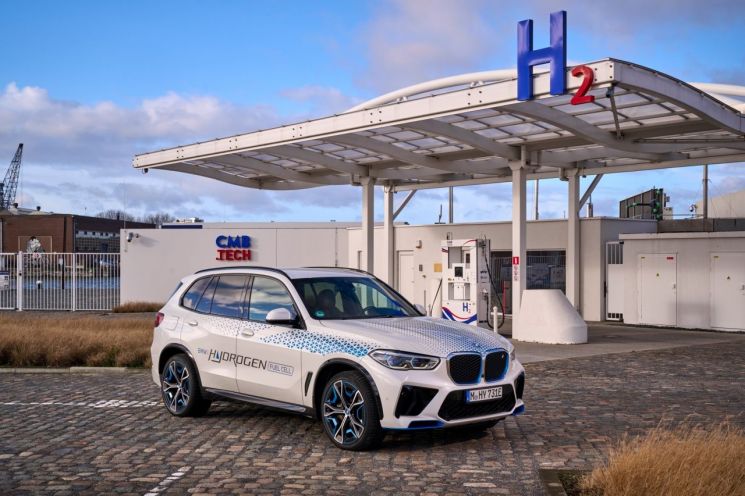
Hydrogen fuel cell vehicles generate electrical energy through the chemical reaction of liquefied hydrogen, which is stored in a battery and used as a power source. Only a few manufacturers, such as Hyundai, Toyota, and Honda, have mass-produced hydrogen fuel cell vehicles. Dr. J?rgen Guldner, who oversees hydrogen technology at BMW, told Korean reporters on the 19th (local time), "We are currently in the testing phase of hydrogen fuel cell vehicles, but we plan to start mass production in 2028 and expand the range of models thereafter."
Earlier this month, Oliver Zipse, CEO of BMW, and Koji Sato, President of Toyota Motor Corporation, announced a joint development plan for hydrogen technology. They aim to increase driving range by more than 20% while halving technology costs to bring the vehicles to market. CEO Zipse said, "This project will significantly increase demand for hydrogen fuel cell vehicles and will mark a milestone in automotive history."
Hydrogen fuel cells have long been considered a next-generation vehicle propulsion system due to zero carbon emissions and long-distance driving capability. However, most automakers have hesitated to develop the technology due to insufficient demand for mass production and a lack of charging infrastructure. As Tesla and Chinese companies have successively launched battery electric vehicles, hydrogen fuel cells have been relatively neglected.
Nevertheless, there is a consensus that hydrogen fuel cells are necessary in the mid to long term as they can complement the shortcomings of pure electric vehicles. In particular, large commercial vehicles such as buses and trucks have consistently faced criticism for the inefficiency of using large-capacity batteries. Liquefied hydrogen refueling takes only 3 to 4 minutes, which is much shorter than for battery electric vehicles. BMW is one of the few automakers that has previously developed not only fuel cells but also engines that directly combust hydrogen.
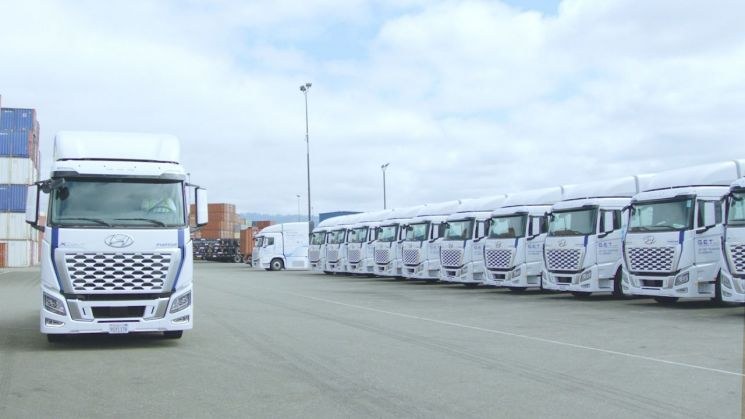 Hyundai Xcient Hydrogen Electric Truck Deployed for Port Logistics Transportation in California, USA [Photo provided by: Hyundai Motor Group] [Image source=Yonhap News]
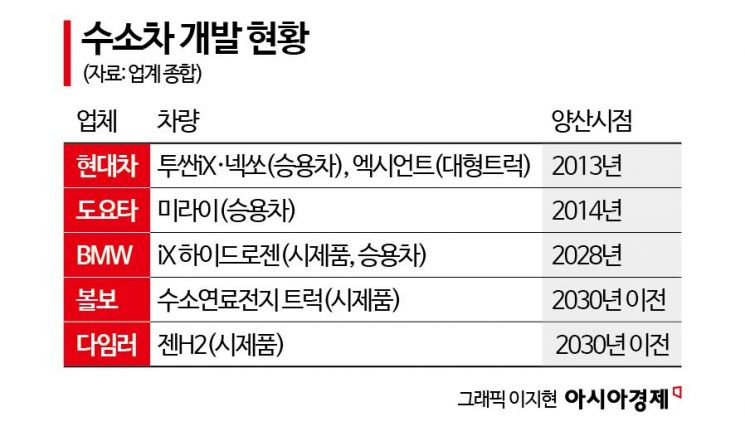
For commercial vehicles operating on fixed routes, unlike passenger cars, installing charging stations within designated areas is feasible, so the industry expects sufficient demand centered on buses and large trucks. While technology development in the passenger car sector is slow, commercial vehicle manufacturers such as Volvo and Daimler are pushing plans to mass-produce various trucks by 2030.
To create demand above a certain level, collaboration among companies is necessary. It is reported that Toyota is exploring hydrogen business cooperation not only with BMW but also with Hyundai. Hyundai has separately launched its self-developed hydrogen fuel cell system under the brand HTWO. They believe the system's applications will expand widely, including in power generators as well as vehicle propulsion systems. Dr. Guldner said, "We are discussing infrastructure cooperation measures with Hyundai through the Hydrogen Council, a global private-sector initiative."
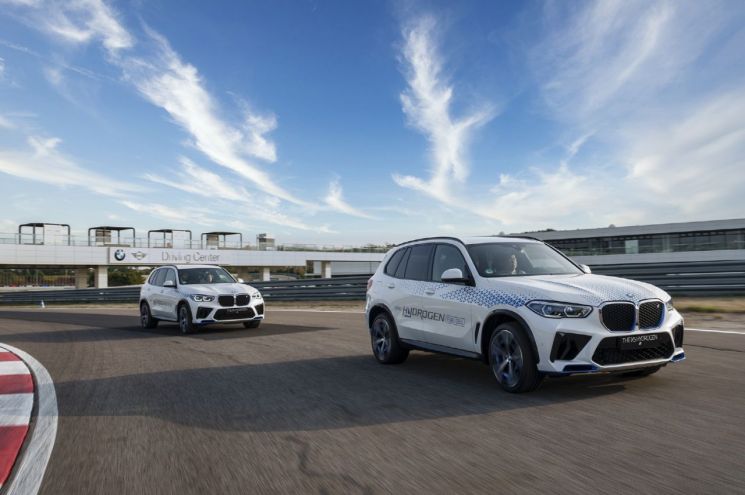 The BMW hydrogen fuel cell pilot model iX5 Hydrogen is undergoing test drives at the BMW Korea Driving Center in Yeongjongdo, Incheon. Test drives began in Korea last year.
 [Photo by BMW Korea]
© The Asia Business Daily(www.asiae.co.kr). All rights reserved.
![Clutching a Stolen Dior Bag, Saying "I Hate Being Poor but Real"... The Grotesque Con of a "Human Knockoff" [Slate]](https://cwcontent.asiae.co.kr/asiaresize/183/2026021902243444107_1771435474.jpg)


















