Typhoon Bavi, the 13th typhoon, struck the eastern region of China, and just three days later, Typhoon Pulasen, the 14th typhoon, made consecutive landfalls. Chinese state-run Xinhua News Agency reported that Pulasen approached Daishan County in eastern Zhejiang Province at around 6:50 PM on the 19th (local time).
At the time of landfall, the maximum wind speed near the center was recorded at 25 meters per second, and the central pressure was 990 hectopascals (hPa). Zhejiang meteorological authorities announced that from that night until early the next morning, strong gusts and heavy rain were expected in the northern region.
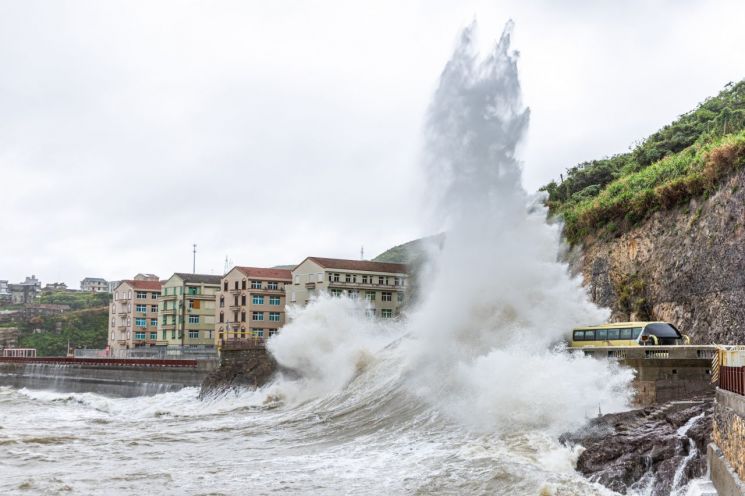 A massive wave is appearing in the waters off Zhejiang Province in eastern China. [Image source=Xinhua News Agency]
Before Pulasen’s landfall on the morning of the same day, Zhejiang authorities issued the third level of emergency response out of four levels. In Zhoushan City, all 72 passenger ferry routes were suspended. Ningbo City halted construction work at 20 coastal sites.
Zhou Xuesong, a researcher at the Shanghai Typhoon Research Institute of the China Meteorological Administration, told Xinhua News Agency, "Pulasen is moving quickly and carries a lot of moisture, so there is a high possibility of tremendous rainfall."
Earlier, during the Mid-Autumn Festival holiday from the 15th to the 17th, Bavi made landfall in Shanghai accompanied by strong winds and heavy rain, forcing more than 400,000 residents to evacuate urgently. Transportation services were also suspended.
Earlier this month, Typhoon Yagi, the 11th typhoon, struck southern China, resulting in 4 deaths and 95 injuries. The economic damage in Haikou City, Hainan Province alone amounted to 26.324 billion yuan (approximately 4.9463 trillion Korean won).
© The Asia Business Daily(www.asiae.co.kr). All rights reserved.

















