Ryu Gwang-jun, Head of the Ministry of Science and ICT Innovation Headquarters, Visits Quantum Communication Company IDQ Korea
Meeting Participants Emphasize the Importance of Fostering Quantum Communication
Gap with Advanced Countries Smaller Compared to Quantum Computers
"We Have a Chance if We Leverage Our Unique Strengths"
The government is seeking active support for the communication sector within the 'Quantum' field, one of the three major game-changing technologies. Separate from the development of quantum computers, where the United States and China are leading, there is also an opinion to focus on quantum communication.
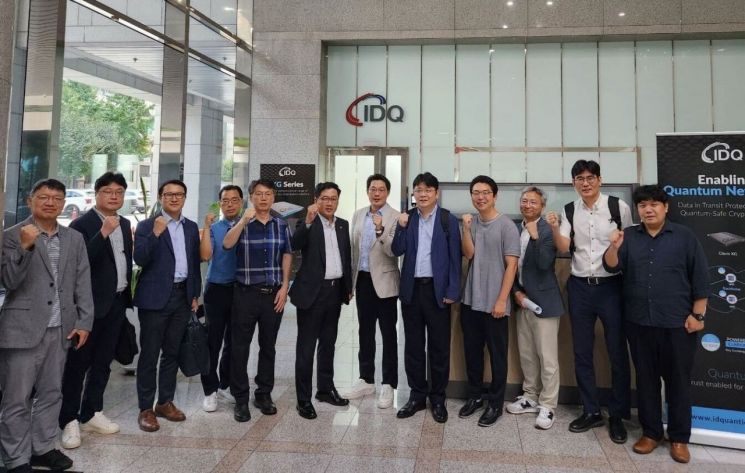 Participants of the Quantum Science and Technology Meeting held at IDQ Korea in Bundang-gu, Seongnam-si, Gyeonggi-do are taking a commemorative photo. Photo by Ministry of Science and ICT
On the 19th, Ryu Gwang-jun, Director of the Science and Technology Innovation Headquarters at the Ministry of Science and ICT, visited IDQ Korea in Seongnam, Gyeonggi Province, held a quantum science and technology meeting, and explained the government's commitment to research and development (R&D) support in the quantum field. After the government R&D budget plan is finalized in 2025, Director Ryu is currently gathering field opinions on the three major game-changing technology sectors including quantum, AI semiconductors, and advanced bio. Separately from the meeting, Director Ryu also inspected IDQ Korea’s quantum cryptographic communication distributor manufacturing facilities and experimental equipment.
The meeting was attended by quantum field researchers from companies, universities, and government-funded research institutes, including Eom Sang-yoon, CEO of IDQ Korea; Kim Dong-woo, team leader at SK Telecom; Son Young-ik, professor at KAIST; Han Sang-wook, head of the Quantum Information Research Group at KIST; Yoon Cheon-ju, head of the Quantum Technology Research Headquarters at ETRI; Park Hee-soo, quantum science group leader at the Korea Research Institute of Standards and Science; and Baek Seung-wook, director of the Quantum National Technology Strategy Center at the Korea Research Institute of Standards and Science.
This event focused on communication, unlike previous public-private dialogues on quantum that centered on quantum computers. The venue, IDQ Korea, is also a quantum communication company. Although IDQ originated in Switzerland, SK Telecom acquired 70% of its shares, effectively transforming it into a domestic company. The Ministry of Science and ICT also considers IDQ Korea a domestic company and is open to providing R&D support.
Participants at the meeting reportedly expressed the opinion that the Ministry of Science and ICT should not focus solely on quantum fundamental technologies. They argued that technologies at the commercialization stage, namely quantum communication, should also be actively supported. This is based on the recognition that while the domestic technology level for quantum computers is significantly low at 2.3 points compared to the United States (100 points) and China (32 points), the situation in the quantum communication field is different.
Eom Sang-yoon, CEO of IDQ Korea, explained, "Quantum communication equipment made with our technology at IDQ Korea is being exported worldwide, and the core component, single-photon detectors, are supplied and used by domestic partners."
Overseas movements toward the adoption of quantum communication are also accelerating. CEO Eom introduced overseas trends, noting that the Polish government and the American investment bank JP Morgan are actively pursuing the adoption of quantum communication.
The Ministry of Science and ICT’s budget plan for the quantum field next year is 198.1 billion KRW, a 58.2% increase from this year’s 125.2 billion KRW. However, this amount makes it difficult to compete with overseas investments reaching the trillion KRW level. Therefore, there is a growing call for concentrated investment in fields where Korea has unique strengths.
Han Sang-wook, director at KIST, expressed confidence, saying, "Even if the government budget for the quantum field increases next year, there is still a significant gap compared to leading countries. However, if we explore areas where we can excel, there is a chance of success."
Ryu Gwang-jun, Director of the Science and Technology Innovation Headquarters, also stated, “The government will actively support the creation of a stable research and development environment in the quantum field and will continue to expand communication with researchers.”
© The Asia Business Daily(www.asiae.co.kr). All rights reserved.
![Clutching a Stolen Dior Bag, Saying "I Hate Being Poor but Real"... The Grotesque Con of a "Human Knockoff" [Slate]](https://cwcontent.asiae.co.kr/asiaresize/183/2026021902243444107_1771435474.jpg)
















