Unwaning Demand for Chinese E-commerce
"No Off-Season for Air Cargo This Year"
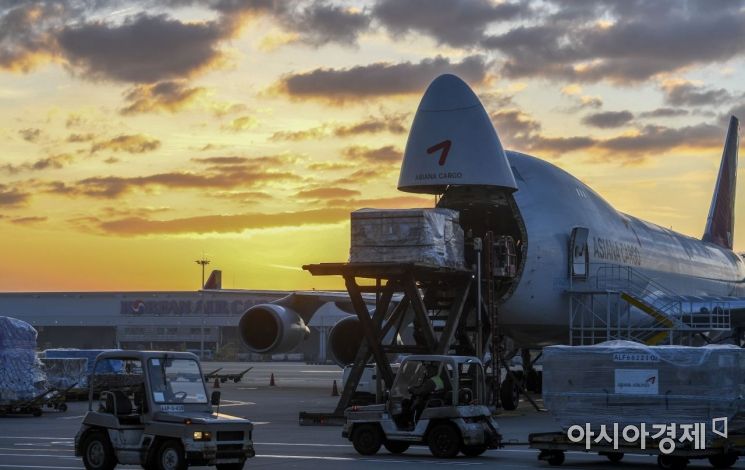 At Incheon International Airport Asiana Airlines Cargo Terminal, dawn is breaking behind an Asiana cargo plane being loaded with freight. / Yeongjongdo - Photo by Jinhyung Kang aymsdream@
Air cargo rates continue to rise even during the summer months, traditionally considered the low season. This is attributed to the steady volume of e-commerce shipments from China, resulting in persistent excess demand in the air cargo market.
According to the global air cargo rate trends released on the 20th by Hong Kong's TAC Index, the Baltic Air Freight Index (BAI00) recorded 2176.00 as of the 16th. This represents an increase of more than 17% compared to 1853.00 on January 22 of this year, showing a continuous upward trend. Notably, even in August, a typical low season for cargo, rates rose by 5.6% instead of hitting a yearly low, an unusual pattern. This contrasts with ocean freight rates, which have stabilized after falling more than 32% since July.
The surge in ocean freight rates compared to previous years and delays caused by the Red Sea incident appear to have increased demand for air cargo. According to the Ministry of Land, Infrastructure and Transport’s Aviation Information Portal System, international air cargo volume last month reached 349,920 tons, an 8.2% increase year-on-year, surpassing the 338,569 tons recorded in August 2019 before the COVID-19 pandemic.
There is also analysis that the volume of e-commerce shipments from China remains a key factor. According to Geneta, a global cargo market analytics firm, e-commerce exports from China increased by 30% year-on-year from January to July this year. Similar trends were observed in domestic air cargo performance, with a sharp rise in shipments transshipped from ocean freight to air cargo in Korea, especially from China. According to Incheon International Airport Corporation, the volume of sea-air combined transport in the second quarter reached 31,644 tons, a 64.2% increase from the previous quarter, with 99.6% of this volume originating from China.
Geneta also analyzed that the AI boom has significantly increased demand related to semiconductors, impacting the air cargo market. Concerns over shipping logistics congestion due to the Red Sea incident led to materials needed for semiconductor factory expansions being shipped by air cargo.
With this strong demand expected to continue for the time being, forecasts suggest that the low season in the air cargo market may disappear this year. There is also analysis that air cargo rates could rise even more sharply toward the year-end, when volumes concentrate around Christmas and other holidays.
Neil van de Vau, Chief Air Cargo Officer at Geneta, stated, "With demand growth rates reaching double digits and rates rising steeply, there will be no low season for air cargo this summer. U.S. regulations against China will not be able to suppress e-commerce demand from Chinese platforms like Ali and Temu."
© The Asia Business Daily(www.asiae.co.kr). All rights reserved.
!["The Woman Who Threw Herself into the Water Clutching a Stolen Dior Bag"...A Grotesque Success Story That Shakes the Korean Psyche [Slate]](https://cwcontent.asiae.co.kr/asiaresize/183/2026021902243444107_1771435474.jpg)
















