Supply Completed at Narita Airport, Japan on the 13th of This Month
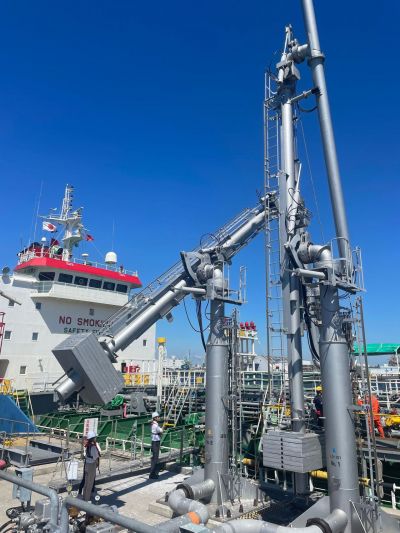 The CORSIA SAF export vessel shipped by GS Caltex arrived at the pier of Chiba Port, Japan on the 13th and is being unloaded into the aviation fuel tanker at Narita Airport, Japan. Photo by GS Caltex
GS Caltex has completed the supply of approximately 5,000㎘ of 'CORSIA SAF,' manufactured by blending general aviation fuel with 'Neat SAF' (100% SAF) supplied by Neste, the world's largest biofuel producer based in Finland, to Narita Airport in Japan on the 13th through the major Japanese trading company Itochu.
The SAF exported by GS Caltex this time is a collaboration among three countries: South Korea, Japan, and Finland. It is significant as the first commercial-scale sale of CORSIA SAF certified by the International Civil Aviation Organization (ICAO) among domestic refiners. It is expected to be sold to major Japanese airlines such as ANA and JAL in the future.
GS Caltex obtained CORSIA certification from the international certification body ISCC for all manufacturing processes. Through this CORSIA SAF project, GS Caltex has secured competitiveness in the global biofuel market and will supply both bio marine fuel and sustainable aviation fuel on a commercial scale.
ICAO will mandate carbon emission reductions starting in 2027. Airlines can officially receive carbon reduction recognition by using CORSIA SAF. In preparation for this, GS Caltex has been closely collaborating with Neste and Itochu since last year to supply CORSIA SAF to airlines and has prepared for this business. Starting with this export, GS Caltex plans to continuously sell CORSIA SAF commercially.
In the global trend of carbon regulations and greenhouse gas reduction, the use of Sustainable Aviation Fuel (SAF) is gradually becoming mandatory, reducing carbon emissions by up to 80% compared to conventional aviation fuel. The European Union (EU) has mandated mixing at least 2% SAF with conventional aviation fuel starting in 2025, and plans to gradually increase the mandatory blending ratio to 6% by 2030, 20% by 2035, and 70% by 2050.
At the end of August, the South Korean government also announced a SAF expansion strategy, planning to mandate about 1% blending of Sustainable Aviation Fuel (SAF) starting in 2027. Amid rising international standards for carbon reduction in the aviation sector and the current absence of dedicated SAF production plants domestically, GS Caltex’s project not only actively participates in the government’s SAF expansion policy but also contributes to improving the trade balance by addressing the shortage of aviation fuel supply in Japan. GS Caltex plans to actively cooperate with government policies through various business reviews even after this Sustainable Aviation Fuel (SAF) supply.
Lee Seung-hoon, head of GS Caltex’s S&T Division, stated, "This is a case of proactively identifying the decarbonization trends in the global aviation industry and the resulting customer needs, and building a new value chain based on the expertise of each company under the active support of the Korean and Japanese governments." He added, "We plan to further expand cooperation with various partners in the future."
© The Asia Business Daily(www.asiae.co.kr). All rights reserved.

![User Who Sold Erroneously Deposited Bitcoins to Repay Debt and Fund Entertainment... What Did the Supreme Court Decide in 2021? [Legal Issue Check]](https://cwcontent.asiae.co.kr/asiaresize/183/2026020910431234020_1770601391.png)