Samsung Electronics and SK Hynix Target Prices Cut
Morgan Stanley's Harsh Assessment of K-Semiconductors
Top Two Semiconductor Stocks with High Market Cap Weight Drag Down
Domestic Stock Market Also Weak
Investor sentiment toward the semiconductor sector is worsening. Samsung Electronics' stock price plummeted to the 60,000 won level just before Chuseok, and SK Hynix's stock, which had risen to the 240,000 won range, fell back to 160,000 won. Experts believe that the third-quarter earnings reports of Samsung Electronics and SK Hynix are crucial to reversing the market mood.
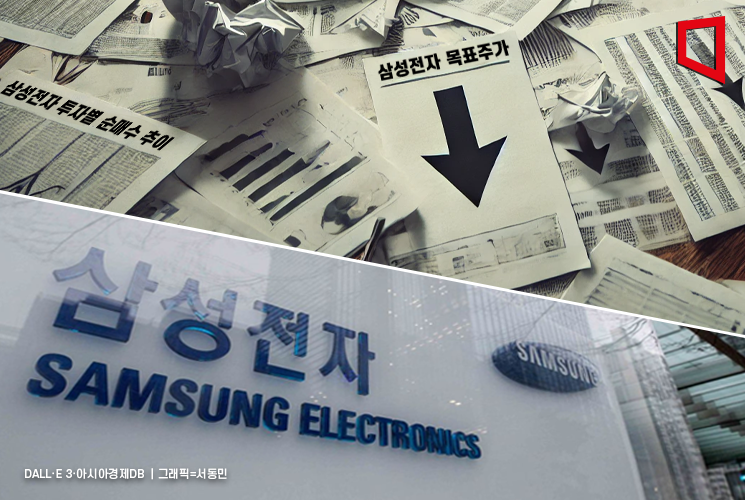
According to the Korea Exchange on the 19th, Samsung Electronics' stock price fell 26.4% from 87,600 won on July 11, when it recorded its highest intraday price this year, to 64,400 won on September 13. During the same period, its market capitalization decreased by 138.5 trillion won, from 522.9 trillion won to 384.4 trillion won. The decline in stock price is attributed to the shrinking investment sentiment in semiconductor stocks and growing concerns over weak third-quarter earnings due to a global demand slowdown amid an economic recession. As Samsung Electronics' closing price dropped to the 60,000 won range, securities firms have consecutively lowered their target prices. Since the 9th, nine securities firms have issued downward revisions of Samsung Electronics' target price, with BNK Investment & Securities setting the lowest target at 81,000 won.
Lee Min-hee, a researcher at BNK Investment & Securities, explained, "Due to prolonged high interest rates and continued weakness in the global consumer economy, as well as falling behind in product competitiveness in the AI server infrastructure investment cycle, Samsung Electronics has not fully benefited." She added that the target price was lowered to reflect the demand slowdown. However, she maintained a 'buy' rating, stating that the current stock price is undervalued at a historically low level.
The situation is similar for SK Hynix. SK Hynix's stock price, which was in the 130,000 won range at the beginning of this year, surged over 70% to close at 242,100 won on July 11. However, due to the semiconductor investment sentiment contraction and forecasts that third-quarter earnings will fall short of market consensus, securities firms have continued to lower their target prices. Starting with NH Investment & Securities, DB Investment & Securities, Meritz Securities, KB Securities, and Samsung Securities have all issued reports lowering their target prices, citing earnings forecasts. Samsung Securities lowered its annual operating profit forecast for SK Hynix from 24.2 trillion won to 23.2 trillion won, a reduction of 1 trillion won.
Kim Dong-won, a researcher at KB Securities, said, "Due to sluggish sales of B2C products such as smartphones and PCs in the third quarter, memory module inventories of set manufacturers have increased, leading to expectations that memory price increases in the second half of this year will fall short of initial expectations. Additionally, the ongoing strength of the Korean won is expected to have an unfavorable impact on earnings improvement."
Adding to this, the U.S. investment bank Morgan Stanley also joined in. On the 15th, Morgan Stanley lowered SK Hynix's target price by 54%, from 260,000 won to 120,000 won. This target price is even lower than the closing price on the 13th (162,800 won). The report titled "Winter looms" downgraded SK Hynix's investment rating by two levels, from overweight to underweight. Underweight is effectively interpreted as a sell recommendation.
Morgan Stanley also cut Samsung Electronics' target price by 27.6% (from 105,000 won to 76,000 won), citing expected price declines due to decreased demand for general DRAM from smartphones and PCs, and oversupply in high-bandwidth memory (HBM). Morgan Stanley downgraded its investment rating for the Korean tech sector from 'neutral' to 'cautious.'
Due to the poor performance of the two semiconductor giants with high market capitalization weights in our market, the domestic stock market has struggled to rebound. Shin Seung-jin, a researcher at Samsung Securities, analyzed, "While bio, secondary batteries, finance, and industrial sectors (such as shipbuilding and defense) are filling the gap left by semiconductors, their relative market capitalization is small, making it insufficient to reverse the overall market sentiment."
Kim Young-hwan, a researcher at NH Investment & Securities, said, "The KOSPI index has fallen 4% since the beginning of the year, but Samsung Electronics' stock price has dropped 17% during the same period. The poor performance of semiconductor companies with large market capitalizations has been a key factor behind the weakness of the Korean stock market."
Experts believe that to reassure investors worried about the semiconductor market's peak-out (decline after reaching a peak), the third-quarter earnings must ultimately support the market. Researcher Shin said, "Although there was a temporary rebound as Jensen Huang, CEO of Nvidia, emphasized that AI demand remains strong, foreign investors seem to be concerned about the semiconductor market peak-out after next year. It appears necessary to dispel investors' concerns with the earnings announcements of Micron on the 26th (Korean time), and Samsung Electronics and SK Hynix in October."
© The Asia Business Daily(www.asiae.co.kr). All rights reserved.

















