“Have you agreed to give your child the mother’s surname and bon (clan name)?”
This is a question included in the application form submitted when registering a marriage. If you answer “No” to this question during the marriage registration, the child to be born will primarily take the father’s surname. Only by agreeing on the child’s surname at the time of marriage registration can the child take the mother’s surname.
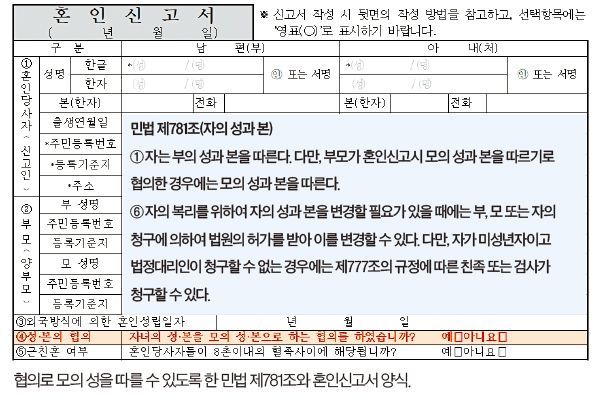
Because times have changed, there are calls to abolish the patrilineal priority system and allow parents to decide the child’s surname through mutual agreement after the child is born. At the 2024 National Vision Legislative Policy Conference held in April this year, the revision of such regulations was proposed as a legislative task. This issue was also included in a recent National Assembly Legislative Research Office’s National Audit issue report.
Father’s surname as the principle, mother’s surname as the exception
Article 781, Paragraph 1 of the Civil Act stipulates that a child shall follow the father’s surname and bon as a principle, and only in the exceptional case where the parents agree at the time of marriage registration to follow the mother’s surname and bon can the child take the mother’s surname.
Under current law, if you select “Yes” in the surname and bon agreement section of the marriage registration form but do not submit a separate agreement document, you cannot pass on the mother’s surname and bon to the child. The agreement document states, “We agree to give all children to be born the mother’s surname and bon.” Because of this, there is criticism that the child’s surname must be decided unilaterally, lacking flexibility.
If you want the child to take the mother’s surname after marriage registration, the procedure becomes more complicated. △ You must either register the marriage again after divorce or △ file a petition with the court to change the surname and bon after the child’s birth. When petitioning for a surname and bon change, you must prove that the change is necessary for the child’s welfare, which involves considerable time and cost burdens.
From forced patrilineality to patrilineal priority
In the past, the father’s surname was mandatory, but in 2005, the Constitutional Court ruled that the law should prioritize the father’s surname instead. In 2005, the Constitutional Court declared the phrase “the child shall follow the father’s surname and bon” in Article 781, Paragraph 1 of the Civil Act unconstitutional (2003HunGa5). It was because forcing the use of the father’s surname unilaterally without allowing the use of the mother’s surname violated individual dignity and gender equality. Subsequently, the revised Civil Act allowed the principle of patrilineality but permitted exceptions where parents agree to follow the mother’s surname.
However, as times have changed, there are calls to revise the patrilineal “priority” system. In a 2019 public opinion survey on family diversity conducted by the Ministry of Culture, Sports and Tourism and the Ministry of Gender Equality and Family, 7 out of 10 respondents (70.4%) supported allowing parents to decide the child’s surname and bon through mutual agreement at the time of birth registration.
Dr. Lee Ki-su, a researcher on surname reform, pointed out, “Revision is needed to reflect social changes,” highlighting “the complexity and psychological burden of the surname and bon change procedure, the lack of parental choice in combining surnames, and issues related to the surnames and bon of sexual minority families.” He added, “While parental choice is important, it is necessary to improve the surname system to guarantee legal flexibility that allows children to decide their surname and bon step-by-step according to their age, granting them self-determination rights.” He emphasized, “Expanding the choice of surname and bon and reflecting family diversity in revisions can be an important foundation for achieving gender equality.”
Overseas, there are few restrictions on the timing or method of deciding a child’s surname. In the UK, parents can freely decide their child’s surname and given name without legal restrictions. France allows parents to choose the child’s surname, with civil law provisions permitting selection of either the father’s or mother’s surname or both combined. China also allows children to take either the father’s or mother’s surname under Article 22 of the Marriage Law. Since the implementation of the two-child policy in 2016, cases of giving the mother’s surname to the second child have increased. As of 2018, statistics show that 10% of newborns in Shanghai carry the mother’s surname.
A constitutional complaint regarding the patrilineal priority system is currently pending before the Constitutional Court. However, the Ministry of Justice expressed a conservative stance on this issue in 2022. The Ministry argued, “If parents are required to agree on the child’s surname every time a child is born, uncertainty about the child’s surname could be prolonged indefinitely, and failure to reach an agreement could cause family discord.”
In 2020, the “Committee for Legal Improvement for Inclusive Family Culture” (Chairman Yoon Jin-su), a body under the Ministry of Justice, resolved to recommend the complete revision of Article 781 of the Civil Act concerning the method of deciding a child’s surname and bon, including abolishing the patrilineal priority system and making parental agreement the principle. However, no significant progress has been made since then.
Reporter Ahn Hyun, Legal Newspaper
※This article is based on content supplied by Law Times.
© The Asia Business Daily(www.asiae.co.kr). All rights reserved.
![Clutching a Stolen Dior Bag, Saying "I Hate Being Poor but Real"... The Grotesque Con of a "Human Knockoff" [Slate]](https://cwcontent.asiae.co.kr/asiaresize/183/2026021902243444107_1771435474.jpg)











