Average Daily Mortgage Loans for Home Purchase at 5 Major Banks: 400 Billion KRW in August → 340 Billion KRW in September
Mortgage Loans Concentration in Seoul and Capital Area Intensifies
Banking Sector "Loan Growth Expected to Continue Until October"
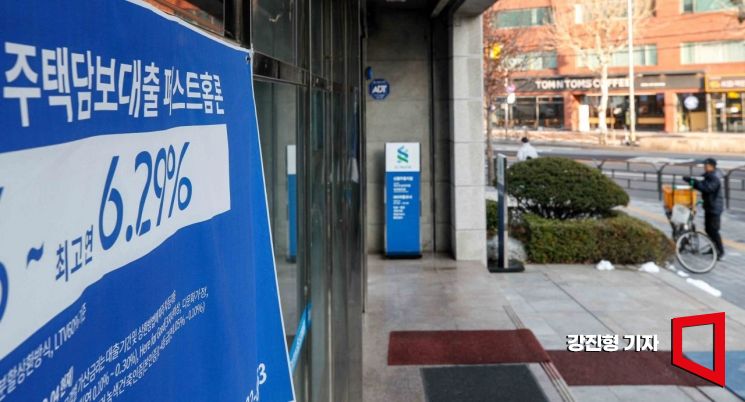 On the 26th, when the 'Stress DSR,' which precisely reflects future interest rate fluctuation risks in the Debt Service Ratio (DSR), was implemented, a real estate mortgage loan interest rate table was posted on the exterior wall of a branch of a commercial bank in Seoul. The Stress DSR system is a measure that applies an additional interest rate (stress interest rate) when calculating the DSR, considering the possibility that borrowers using variable interest rate loans may face increased principal and interest repayment burdens due to rising interest rates during the loan period. The stress interest rate applied until the first half of this year is 0.38%. Photo by Kang Jin-hyung aymsdream@
Since the beginning of this month, the pace of new mortgage loan increases at major commercial banks has slightly declined after reaching an all-time high level in the previous month (August). However, despite the implementation of the second phase of the stress total debt service ratio (DSR) regulation and the banking sector's strong loan restrictions that even block mortgage loans for single-homeowners, the decrease is only about 15%, which is not significant.
According to the five major banks (KB Kookmin, Shinhan, Woori, Hana, and NH Nonghyup) on the 18th, the total amount of newly issued individual mortgage loans for home purchases last month (August) was 12.437 trillion won.
This is the largest scale since January 2011, when time series data began, and is effectively the highest level ever, according to financial authorities.
From the beginning of this month to the 9th, the amount of newly issued individual mortgage loans for home purchases was 3.0645 trillion won.
With a daily average of 340.5 billion won, it is about 15% less than the previous month (401.2 billion won) but shows little difference compared to July (386.1 billion won) or June (361.7 billion won).
The scale of mortgage loans concentrated in Seoul and the metropolitan area has rather increased.
Of the newly issued mortgage loans for home purchases by the five major banks this month, 69.6% (2.1322 trillion won) were related to homes in the metropolitan area (Seoul, Incheon, Gyeonggi). This proportion is the highest since August 2021 (metropolitan area 5.0136 trillion won / total 6.9837 trillion won = 71.8%).
The reason why the rapid increase in housing-related loans is not easily curbed is that housing transactions in the metropolitan area, centered on Seoul, have significantly increased over the past few months.
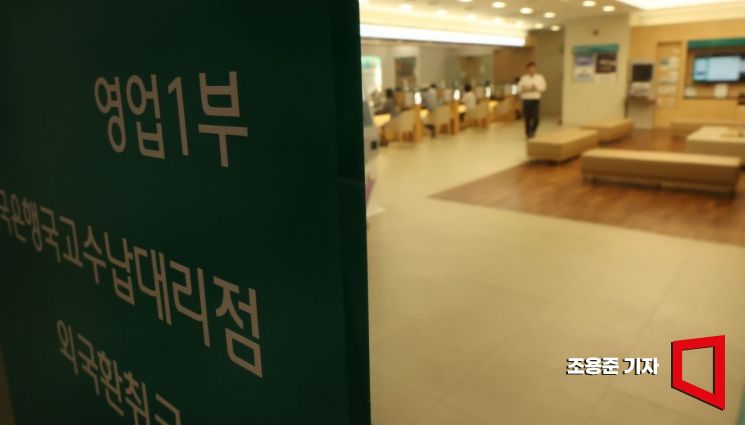 To slow down the pace of household loan growth, commercial banks are consecutively raising mortgage loan interest rates. On the 3rd, a branch of a commercial bank in Euljiro, Jung-gu, Seoul. Photo by Jo Yongjun jun21@
According to statistics from the Ministry of Land, Infrastructure and Transport, housing sales in Seoul (based on the reporting date) reached 12,783 cases in July, a 41% increase from June, surpassing 10,000 for the first time in 2 years and 11 months.
Mortgage loans are actually disbursed with a lag of about two to three months from the time of the housing transaction. For example, even if Seoul housing transactions peaked in July and August, the increase in related mortgage loans could continue until October or November.
Among these, the Bank of Korea recently released a monetary and credit policy report presenting views that expect stabilization after next year based on high housing prices and the effects of government supply and macroprudential policies, as well as forecasts that overheating will continue regardless of the second phase stress DSR regulation.
If household loan-related indicators do not show a clear decline by the end of September to early October, it will be difficult for the Bank of Korea's Monetary Policy Board, which identified housing prices and household loan-driven financial instability as the biggest obstacles to interest rate cuts at last month's monetary policy meeting and in the recent monetary and credit policy report, to pivot (shift monetary policy).
Moreover, if the U.S. Federal Reserve (Fed) lowers the benchmark interest rate first on the 19th (Korean time) as the market expects, the Bank of Korea's concerns related to housing prices and household loans are expected to increase further.
In the report, the Bank of Korea emphasized, "It is necessary to decide the timing and speed of future interest rate cuts while considering the impact of housing prices and household debt trends in the metropolitan area on financial stability," and "It is important to clearly communicate this policy direction to economic agents to manage market expectations and prevent excessive expectations of interest rate cuts."
It also added, "From the perspective of macroprudential regulations, it is necessary to review the effects of expanding housing supply and strengthening regulatory measures, and consider further strengthening measures if necessary."
© The Asia Business Daily(www.asiae.co.kr). All rights reserved.
![Clutching a Stolen Dior Bag, Saying "I Hate Being Poor but Real"... The Grotesque Con of a "Human Knockoff" [Slate]](https://cwcontent.asiae.co.kr/asiaresize/183/2026021902243444107_1771435474.jpg)

















