Exploration of 504km Road Section to be Conducted by 2027
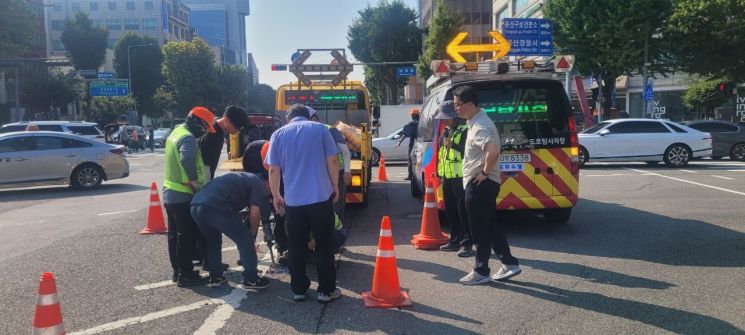 Yongsan-gu confirmed an empty hole under the road at Namyeong Samgeori through subsurface exploration on the 11th and took emergency measures before a sinkhole occurred. Provided by Yongsan-gu.
Yongsan-gu, Seoul (District Mayor Park Hee-young) announced on the 18th that it discovered a sinkhole risk area near Namyeong Station on Subway Line 1 along Hangang-daero on the 11th and took emergency repair measures to prevent accidents. Proactive ground-penetrating radar (GPR) surveys were conducted beneath the road surface where ground subsidence was a concern.
The intersection at Namyeongsamgeori near Namyeong Station, where an underground cavity was confirmed this time, is part of the Hangang-daero section planned to be developed as a national symbolic street. Since this area usually experiences heavy vehicle traffic and frequent congestion, the damage caused by ground subsidence would have been significant if left unattended.
The underground cavity beneath the road, where the district prevented an accident, was confirmed to be 0.4 meters in diameter and 1 meter deep. After discovery, the district handed over the case to the Western Road Office and requested emergency repairs. The cause of the cavity is currently under investigation in cooperation with related agencies.
Since last year, the district has secured an annual budget to conduct surveys for underground cavities beneath road surfaces. The plan is to investigate 504 km of roads within the area by 2027.
Last year, 99.7 km of roads in the area were surveyed, and 10 underground cavities were discovered and repaired in advance. This year, suspected empty cavities identified through surveys are being confirmed through test excavations and borehole camera inspections.
In addition to GPR surveys, sewer pipe inspections are also conducted to prevent road collapses. If cracks or damage occur in underground sewer pipes, leaking sewage can wash away soil, causing ground subsidence.
The district inspected 17 sewer pipe locations in the area from the 4th to the 5th of this month. Through visual inspections of the sewer pipe tops and internal closed-circuit television (CCTV) surveys, they checked for subsidence or cavities above the sewer pipes, pipe damage, and soil loss due to pipe separation.
Next year, after securing the budget, a full inspection of 110 km of sewer pipes over 30 years old is planned. The results of the full inspection will be used to improve sewer pipes and establish mid- to long-term maintenance plans.
District Mayor Park Hee-young stated, “Proactive response through cavity surveys allowed us to prevent sinkhole accidents. We will continue to conduct road surface surveys and sewer pipe inspections to do our best in disaster prevention.”
© The Asia Business Daily(www.asiae.co.kr). All rights reserved.

















