As of 5 PM, Seoul-Busan Both Directions 4 Hours 30 Minutes
On the third day of the holiday and the afternoon of the 16th, one day before Chuseok, traffic congestion on major highways heading toward hometowns has mostly cleared, but some roads in the direction of returning home are experiencing congestion.
According to the Korea Expressway Corporation, as of 5 p.m. that day, the estimated travel times by passenger car from Seoul Tollgate to major cities nationwide are 4 hours 30 minutes to Busan, 4 hours 10 minutes to Ulsan, 3 hours 40 minutes to Mokpo, 3 hours 30 minutes to Daegu, 3 hours 20 minutes to Gwangju, 2 hours 50 minutes to Gangneung, and 1 hour 30 minutes to Daejeon. Compared to around 9 a.m. that morning, these times have generally decreased by about 1 hour 30 minutes to 2 hours, showing much smoother traffic flow.
The estimated travel times from regional tollgates to Seoul Tollgate are mostly the same in the opposite direction, except it is expected to take 4 hours 20 minutes from Mokpo to Seoul, 3 hours from Gangneung to Seoul, and 2 hours from Daejeon to Seoul.
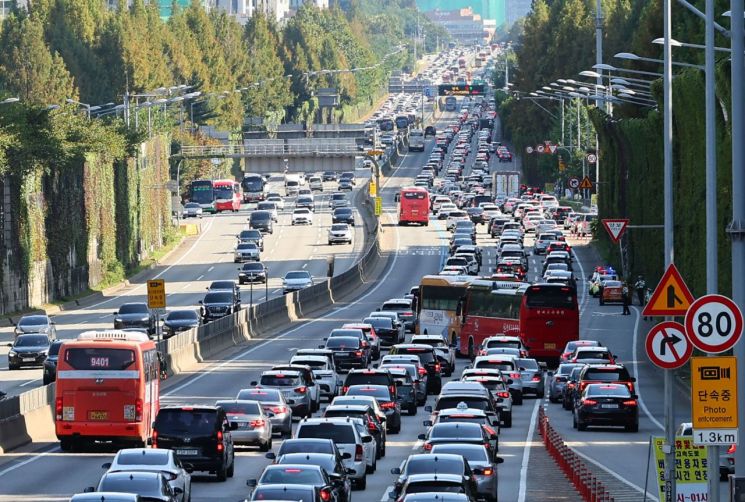
While congestion on the hometown-bound direction has somewhat decreased, traffic jams are occurring in various places on the return-home direction.
On the Gyeongbu Expressway heading toward Busan, congestion is occurring in the sections from Hannam to Seocho (4 km), Singal Junction to Suwon (3 km), near Cheonan Junction to Mokcheon (6 km), and near Oksan Rest Area to Oksan (5 km).
On the Gyeongbu Expressway heading toward Seoul, vehicles are moving slowly in the sections from Yangjae area to Banpo (6 km), Giheung area to Singal Junction area (7 km), Anseong Junction to near Anseong Rest Area (3 km), near Ipjang Rest Area to Anseong (5 km), near Oksan to near Cheongju Rest Area (13 km), and from Sintanjin Rest Area to Jukam Rest Area (9 km).
On the Jungbu Expressway heading toward Namyi, congestion is occurring in the sections near Jincheon to Jincheon Tunnel (6 km). In the Hanam direction, congestion is seen at the 354 km point of Jungbu 1 Tunnel, near Namicheon IC to Moga (4 km), near Iljuk (4 km), from Ochang Junction to near Jeungpyeong (6 km), and from Cheongju Gangseo Hi-pass to near Seo Cheongju (6 km).
On the Seohaean Expressway heading toward Mokpo, congestion is occurring near Mokgam exit and in the section near Seohae Bridge to Seohae Bridge (3 km). In the Seoul direction, traffic is backed up in the sections from Iljik Junction to Geumcheon (4 km), near Maesong Rest Area to Yongdam Tunnel (4 km), and near Dangjin Junction to Seohae Bridge (17 km).
On the Yeongdong Expressway heading toward Gangneung, congestion is occurring at the 5 km point of Wolgot Junction. In the Incheon direction, vehicles are repeatedly stopping and going in the sections near Jinbu to Jinbu 2 Tunnel (7 km), Myeonon to Dunnae Tunnel (5 km), Yeoju Junction to Yeoju Rest Area (3 km), near Icheon to Hobup Junction (4 km), Yongin Rest Area to Yongin (3 km), near Maseong Tunnel at the 50 km point, Dong Suwon to Gwanggyo Tunnel area (2 km), and Dun-dae Junction to Banwol Tunnel area (2 km).
The Corporation expects congestion in both hometown-bound and return-home directions to ease around 6 to 7 p.m. and again around 10 to 11 p.m.
The total nationwide traffic volume for the day is expected to be about 6.03 million vehicles. Of these, the Corporation anticipates 520,000 vehicles moving from the metropolitan area to local regions and 470,000 vehicles moving from local regions to the metropolitan area.
© The Asia Business Daily(www.asiae.co.kr). All rights reserved.

















